
Your Utah RV Purchase Agreement Guide for 2026
You found the RV. Maybe it's a family bunkhouse for weekends at Bear Lake. Maybe it's a toy hauler you can point toward Moab the minute the weather turns good. Either way, the fun part happens fast. Then the paperwork lands on the desk, and the RV purchase agreement suddenly feels bigger than the RV itself.
That reaction is normal. First-time buyers usually don't get nervous about the floorplan. They get nervous about signing something they don't fully understand. We see that every day in Salt Lake City. A customer is excited, then they hit the contract packet and start wondering which lines matter, what can change later, and where people get burned.
Here's the truth. Your RV purchase agreement is the deal. Not the conversation you had on the lot. Not the text message. Not the verbal promise. The contract is what counts when there's confusion about price, options, trade value, delivery timing, or financing. If you can read that document calmly, line by line, you'll make better decisions and avoid a lot of expensive frustration.
Introduction
An RV purchase agreement is easiest to understand if you stop thinking of it as a receipt. It's not. It's the written blueprint for the transaction.
That matters because modern RV deals usually include a lot more than a handshake and a unit price. Common templates now collect the buyer's and seller's full names and addresses, the RV's make, model, year, and VIN, the agreed purchase price, contingency clauses, and financing terms. That level of detail fits the size of the market, too. U.S. RV ownership reached about 11.2 million households in 2024 according to RV purchase agreement template guidance from pdfFiller.
When buyers ask us whether they “just need a bill of sale,” our answer is usually no. A bill of sale is useful, but it's narrower. If you want a simple reference for how people create a bill of sale, that can help you see the difference. A proper RV purchase agreement goes further and spells out the terms that usually cause trouble later.
A clean contract protects both sides. That's not legal fluff. That's what keeps a fun purchase from turning into an argument.
If you remember one thing, remember this. Your RV purchase agreement is the single source of truth for the sale.
What Is an RV Purchase Agreement Anyway?
People often use “purchase order,” “buyer's order,” “bill of sale,” and “contract” like they mean the same thing. They don't always. In plain English, an RV purchase agreement is the document that locks in the terms of the sale.
It covers more than price
Most first-time buyers focus on the sale price. That's understandable, but the contract also controls the parts of the deal that create the biggest headaches later.
Those usually include:
- Who is buying and selling: Full legal names and addresses matter.
- What RV is being sold: Make, model, year, and VIN need to match the actual unit.
- How the buyer is paying: Cash, financing, deposit, trade-in, or a mix.
- What has to happen before closing: Approval, inspection, title work, or delivery.
- What's included: Accessories, promised repairs, installed gear, and option packages.
It gives you something specific to enforce
If a buyer thinks a weight-distribution hitch, backup camera, or battery upgrade was included, that item needs to be on the paperwork. If a dealer believes a deposit is nonrefundable, the contract should say so clearly. If financing falls through, the agreement should already explain what happens next.
That's why generic online advice often misses the mark. The contract isn't there to impress anyone. It's there to pin down facts.
It should be complete before you sign
Our view is simple. If a line matters, fill it in before anyone signs. Don't accept “we'll add that later” for the important stuff.
Use this quick standard:
| Contract Element | Why It Matters |
|---|---|
| RV identification | Prevents mix-ups between similar units |
| Purchase price | Confirms the agreed sale amount |
| Fees and add-ons | Stops surprise charges from appearing later |
| Trade-in terms | Protects the value assigned to your current RV or vehicle |
| Financing terms | Clarifies whether the deal depends on loan approval |
| Delivery conditions | Sets expectations for inspection and pickup |
Decoding the Most Important Clauses in Your Contract
You are sitting in the finance office, the RV looks perfect, and the contract suddenly gets dense. This is the point where buyers either stay in control or sign past details that cost them later. Slow down and read the clauses that decide what you are buying, what you are paying, and what happens if the deal changes.
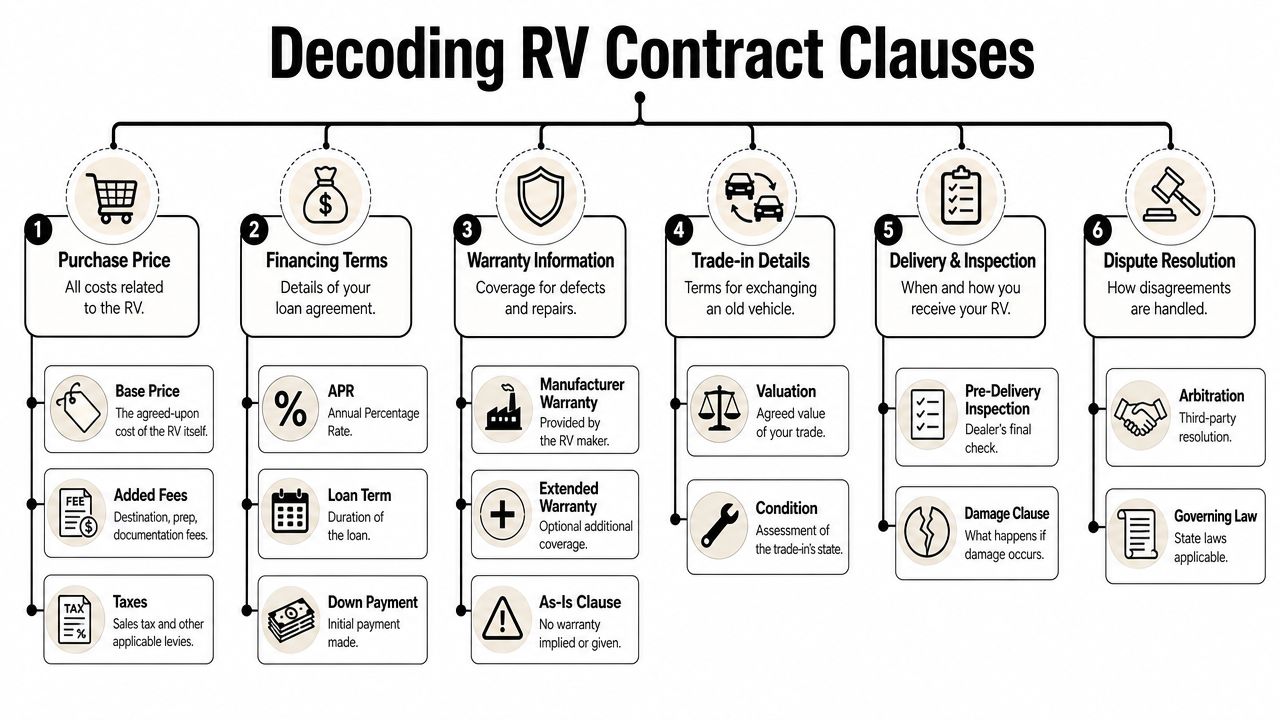
Purchase price and fees
Start with the selling price. Then read every line underneath it.
A clean contract separates the RV price from document fees, dealer-installed accessories, service contracts, GAP coverage, tire and wheel products, and any other add-ons. In Salt Lake City, buyers get in trouble when they compare two rigs by sticker price and ignore the rest of the worksheet. The most important number is the full out-the-door total.
Ask our team, or any Utah dealership, to show that number clearly in writing. If the contract does not match the quote, stop and fix it before you sign.
Practical rule: Any fee you see for the first time in the finance office deserves an explanation before the deal goes further.
Deposit terms
Deposit language needs to be plain. No buyer should have to guess whether the money is refundable.
The contract should spell out the deposit amount, when the dealer can keep it, and what events require it to be returned. That matters even more on factory orders, incoming units, and deals tied to financing approval. If the wording is vague, you are setting up an argument.
In our store, we would rather answer that question up front than deal with hard feelings later. You should expect the same from any dealership.
Trade-in value and condition
Trade-ins create problems when the written value is clear but the assumptions behind it are not. If you are trading a motorhome, trailer, fifth wheel, or tow vehicle, the agreement should show the exact allowance and any condition requirements tied to that number.
Be honest about defects. Water damage, delamination, bad tires, missing keys, title problems, warning lights, or nonworking appliances can change the appraisal. That is not a trick. It is how dealerships protect themselves from taking in a unit that is different from what was presented.
Good paperwork keeps that from turning into a last-minute dispute.
Financing contingency
This clause decides what happens if your lender does not approve the loan on final terms. Buyers miss this all the time.
If you are financing, the agreement should say whether your obligation to buy depends on final lender approval, not a casual comment that you are "probably good." RV deals often involve loan approval, inspection results, and trade-in details all at once, so the contract needs to explain who is bound, when, and under what conditions. Industry forms often tie the buyer's obligation to objective events such as loan approval or a satisfactory inspection, as described in RV bill of sale guidance from Legal Templates.
Utah buyers should pay close attention here because dealership process matters. If a lender changes the term, rate, down payment, or required stipulations, the paperwork needs to reflect that clearly before delivery.
For buyers who want to compare how vehicle contract language is commonly structured, this guide to AutoProv for robust vehicle contracts is a useful outside reference.
Inspection and delivery language
Delivery day should not be built on memory. It should be built on written promises.
Your contract should state what happens before pickup, including the pre-delivery inspection, orientation, promised repairs, parts that still need to arrive, and any cosmetic or mechanical issues the dealership agreed to address. On a used RV, this matters even more because condition drives value fast.
We tell first-time buyers in Utah to confirm four things in writing:
- When the final walk-through happens
- What equipment is included
- Which repairs will be completed before delivery
- What kind of orientation or system demonstration you will receive
That list sounds simple. It prevents a lot of frustration.
Warranty and as-is language
Read this section slowly. New RV buyers often assume every problem is covered. Used RV buyers often miss an as-is clause until after they get home.
Those are two expensive mistakes.
Look for the difference between:
| Clause Type | What It Usually Means |
|---|---|
| Manufacturer warranty | Coverage offered by the RV maker |
| Dealer warranty | Limited coverage offered by the selling dealer, if any |
| Service contract | Optional purchased coverage, separate from factory coverage |
| As-is language | The RV is sold with no additional warranty unless stated otherwise |
If the coach is new, the paperwork should identify the factory coverage clearly. If it is used, the contract should make the as-is language obvious, not buried in a stack of signatures. We prefer to explain that face-to-face because buyers deserve plain English, especially on older units where expectations need to be realistic.
Title, registration, and governing law
The last pages matter just as much as the first ones. Buyers are usually tired by then, which is exactly why mistakes slip through.
Check the clauses covering title transfer, registration, signatures, and dispute terms. Utah is not Wisconsin, but the lesson from Wisconsin administrative code Trans 142.05 still applies. These agreements are formal records, not casual receipts.
Here in Utah, you also want the contract to line up cleanly with local title and registration handling, tax treatment, and any dealer commitments about submitting paperwork. Generic online templates miss that. A Salt Lake City RV deal has local rules, local timelines, and dealership procedures that should show up in the contract you sign.
Spotting Red Flags and Finding Room to Negotiate
A lot of buyers think the only thing they can negotiate is the sale price. That's too narrow. Just as important, a lot of buyers miss warning signs because the RV itself distracts them.
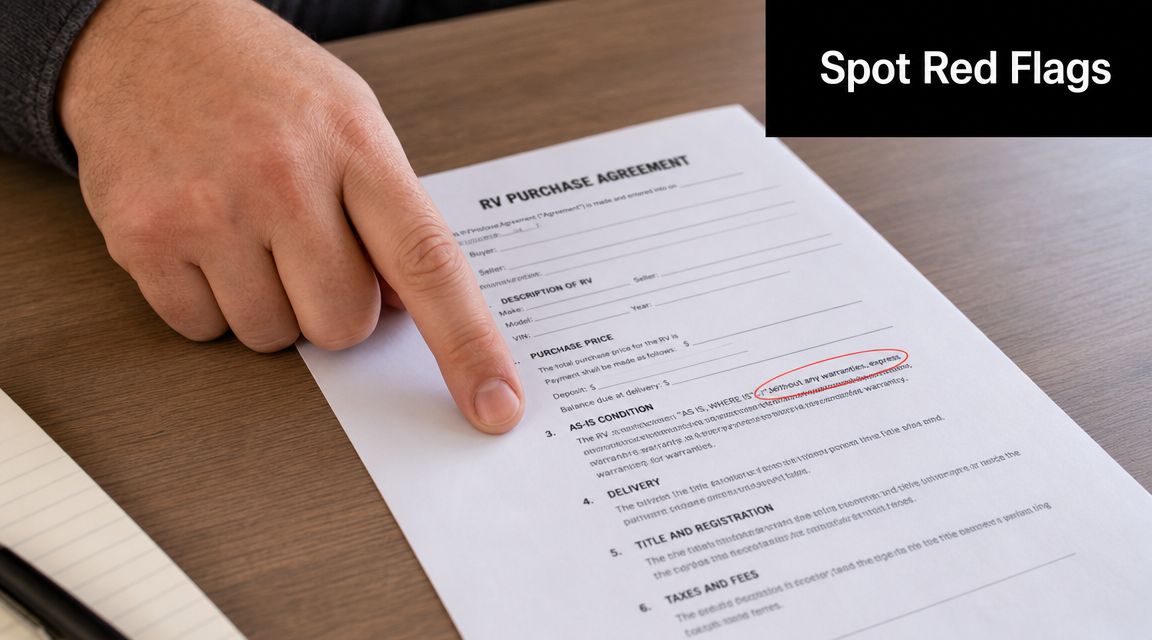
Red flags that deserve a hard stop
If you see any of these, slow the process down.
- Blank spaces in key areas: Price, deposit status, trade value, included gear, and due dates should never be left open.
- Verbal promises missing from the contract: If it isn't written, treat it as not agreed.
- Pressure to sign before financing is final: That's how confusion starts.
- Loose as-is wording on a unit you believed had coverage: Ask for plain-English clarification.
- Mismatched unit details: The VIN, year, model, and options need to match the RV in front of you.
Factory orders need special attention. A common dispute happens when a buyer orders an RV and the dealer tries to change the price or substitute equipment at delivery. It's critical for the contract to protect the buyer from price increases or unilateral changes between the order date and the delivery date, as noted in this discussion of ordered RV disputes.
If you're ordering instead of buying from stock, insist on written language covering price protection, substitutions, and delivery delay remedies.
Where buyers still have leverage
Negotiation doesn't have to be hostile. Good buyers are specific.
Instead of saying “Can you do better?”, ask direct questions about items that often move:
- Prep-related charges: Ask what they cover and whether any can be adjusted.
- Accessory bundles: Sewer hose kit, water pressure regulator, wheel chocks, and surge protection are common asks.
- Trade presentation: A clean, documented trade usually helps the conversation.
- Service contract pricing: Optional products are often more negotiable than buyers realize.
- Repair items before delivery: It may be smarter to have work completed than to argue for a small discount.
If you're comparing a used unit against a new one, our advice in this guide on how to buy a used RV near me can help you frame those conversations better.
Here's a quick video that touches the broader buying process and the kinds of contract questions smart shoppers should ask before signing.
The right tone wins
The strongest buyers aren't the loudest. They're the clearest. They know what matters, they ask for it in writing, and they don't rush.
A Buyer's Checklist for Reviewing Your RV Contract
By the time the contract is ready, fatigue sets in. That's when mistakes happen. Use a checklist and slow the pace down.
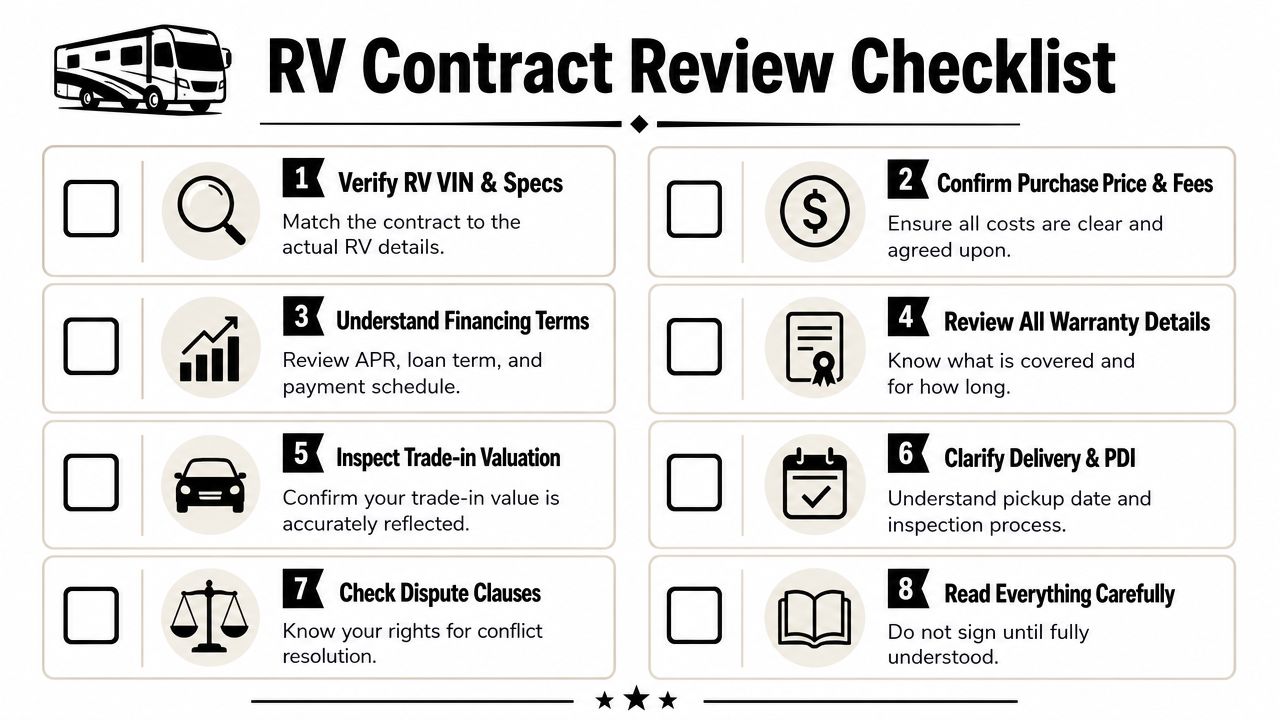
Review it like a final walk-through
Ask for time to read the agreement without pressure. Sit down, compare it to the quote, and look at the actual RV if needed. You're not being difficult. You're being careful.
Never sign a blank or incomplete document. Never assume a missing detail will be fixed exactly the way you expect later.
RV Purchase Agreement Review Checklist
| Check Point | What to Verify |
|---|---|
| Verify VIN and specs | Match the VIN, year, make, model, and listed options to the actual RV |
| Confirm purchase price and fees | Make sure the final figures match your written quote and verbal agreement |
| Check deposit terms | Verify whether the deposit is refundable and under what conditions |
| Review trade-in details | Confirm the agreed value and any condition assumptions |
| Understand financing terms | Read whether the deal depends on final loan approval |
| Clarify included accessories | Check that promised batteries, hoses, cords, or upgrades are listed |
| Review warranty language | Confirm factory coverage, dealer coverage, service contracts, or as-is status |
| Confirm delivery expectations | Make sure promised repairs, orientation, and pickup timing are written down |
What we'd tell a first-time buyer at the desk
Use your finger and go line by line. It sounds simple because it is.
Focus on these trouble spots first:
- Unit identity: Buyers sometimes get excited about a floorplan and miss that the VIN doesn't match the exact trailer they walked.
- Final numbers: Look at the total, not just the monthly payment.
- Promises in writing: If a salesperson said “we'll take care of that,” make sure the document says the same.
- Signature-ready paperwork: Every blank that matters should be completed before you sign.
Bring a notebook or use your phone notes. Write down any question the second it comes up, then get each answer before moving on.
A calm review beats a fast review every time.
Navigating Utah-Specific RV Buying Requirements
Utah buyers need practical contract awareness, but they also need to know what local process issues can affect the deal. Generic templates fall short in such scenarios.
Utah paperwork is more than a template exercise
A Utah buyer usually cares about three things at signing. What they owe, who is handling the title and registration steps, and what happens if there's a problem after delivery.
The contract should reflect those realities clearly. If taxes, registration-related charges, title handling, or dealer processing steps are part of the transaction, ask how those items are being handled and when you'll need to sign supporting state paperwork. Don't assume every dealership process is identical.
Ordered units and timing matter in Utah too
This comes up a lot with factory orders and inbound inventory. A buyer chooses a specific floorplan, a specific decor, maybe a solar package or a second A/C, and then waits. During that waiting period, confusion can creep in if the paperwork isn't specific.
For Utah shoppers trying to decide whether to buy now or wait for a seasonal shift, our article on the best time to buy an RV gives useful context for the market side of that decision. But once you're under contract, timing language matters more than market timing.
Use plain questions:
- Is this contract for an in-stock VIN or an ordered unit
- Can the price change before delivery
- What happens if the equipment package changes
- What happens if delivery is delayed
Keep the Utah process practical
Our advice for local buyers across Salt Lake County and beyond is simple. Ask who is doing what.
You want clear answers on:
| Utah Buying Task | What to Clarify |
|---|---|
| Title paperwork | What the dealership prepares and what you need to sign |
| Registration steps | Whether the dealer is handling submission or guiding you through it |
| Taxes and fees | Which charges are part of the contract total |
| Delivery status | Whether the unit is on site, incoming, or factory ordered |
Utah buyers also tend to use their RVs hard and early. Bear Lake, Jordanelle, the Wasatch, and southern Utah trips start fast once spring hits. That's one more reason not to let paperwork stay vague. If there's a delay, you want to know exactly what your contract says before camping season slips by.
How a Great Dealership Simplifies the Final Paperwork
You are at the signing table, the excitement is high, and this is the moment a good dealership proves whether it takes care of its customers. In our store, the paperwork should slow things down, not speed them up.
A solid finance office explains every document in plain language, points to the exact line that matters, and gives you time to read before you sign. We should be showing you where the sale price, deposit, payoff figures, lender terms, service contract language, and delivery details appear in the packet. If any part of that feels rushed or vague, stop and ask for it again.
That matters even more in Utah, where buyers often want to get on the road fast and the contract has to match real dealership process. Title and registration timing, lender requirements, trade payoff handling, and any promised accessories all need to be clear before you leave Salt Lake City with keys or with a delivery date.
Payment questions are common at this stage. If you want to get familiar with term length, down payment strategy, and loan structure before you sign, review these RV financing options.
Motor Sportsland is a local Utah dealership that handles RV sales, financing support, trade-ins, and service. What matters to you is how our team handles the closing process. We should walk the paperwork line by line, answer direct questions directly, and fix mistakes before signatures happen, not after.
The best final paperwork experience is calm and a little boring.
That is a good sign. It means no mystery, no pressure, and no promises floating outside the contract.
Conclusion
An RV purchase agreement isn't the annoying part of buying an RV. It's the part that protects you. Read the numbers carefully. Match the VIN and options to the actual unit. Get deposit rules, financing conditions, trade terms, and delivery promises in writing. If you're ordering an RV, lock down language on price changes and substitutions before you sign.
That's how you buy with confidence in Utah. If you want help reviewing your next deal, comparing RVs, or getting ready for the paperwork side before you visit the showroom, reach out and start the conversation early.
Your RV Purchase Agreement Questions Answered
A lot of first-time buyers in Salt Lake City ask the same thing right before signing. "What am I agreeing to here?" That is the right question, and the answer should be plain English, not dealership jargon.
What's the difference between an RV purchase agreement and a bill of sale
An RV purchase agreement is the working contract. It lays out the price, deposit, financing terms, trade value, included options, delivery timing, and any conditions that still have to be met. A bill of sale is usually the shorter record showing the sale was completed.
If you are buying from a Utah dealership, focus on the purchase agreement first. That document is where misunderstandings start or get prevented.
Can I cancel an RV purchase agreement in Utah
Do not count on a general cooling-off period. In Utah, your ability to back out usually comes down to the exact contract language you signed.
Our advice is simple. Read the cancellation, deposit, and financing sections before you sign, not after. If a salesperson says, "We can work that out later," stop and get it written into the agreement.
What happens to my deposit if financing falls through
The contract decides that. If the agreement says your deal is subject to financing approval, your deposit terms should match that condition clearly.
If that language is vague, fix it before signing. In our stores, we want buyers to know whether a deposit is refundable, partially refundable, or applied to the sale, because that is one of the biggest points of confusion in real Utah RV deals.
Do I need a lawyer to review my RV purchase agreement
Usually, no. A standard RV purchase can often be handled by a careful buyer who reads the contract and asks direct questions.
Get a lawyer involved if the deal includes a custom order, unusual trade terms, title issues, out-of-state registration questions, or anything that feels rushed or inconsistent. That extra review can save you a very expensive headache.
