
Your 2026 Guide to a Camper Brake Controller for Safe Utah Towing

Picture this: you're heading down a steep grade like Parley's Canyon, your family's travel trailer hitched up behind you. It's in moments like these that a camper brake controller isn't just a gadget—it's your best friend. Think of it as the central command for your towing setup, the one piece of gear that perfectly synchronizes your truck's brakes with your trailer's. When traffic ahead suddenly stops, a properly tuned brake controller is what keeps your trailer from pushing your truck, preventing a dangerous jackknife situation and dramatically cutting your stopping distance.
With over 55 years of helping Utah families tow safely, our team at Motor Sportsland has seen firsthand why this device is absolutely non-negotiable. A great towing experience is about the entire system working together, from the hitch to the trailer tires. In this guide, we'll pull back the curtain on how these controllers work, help you pick the right one for your specific RV, and walk you through the basics of setup and maintenance—all based on our real-world dealership experience. By the end, you'll have the confidence to tackle any Utah adventure.
Why This is Critical for Utah RV Owners
Our team at Motor Sportsland wants you to feel completely confident, whether you're navigating a winding mountain pass or the stop-and-go of a busy Salt Lake City street. A camper brake controller is the key to that confidence.
- Mountain Driving: It gives you command over your trailer's momentum on those long, steep descents like you'll find in the Wasatch Mountains, preventing your brakes from overheating.
- Sudden Stops: It provides that critical, coordinated stopping power you need when someone cuts you off in heavy traffic on I-15.
- Legal Compliance: It's not just a good idea—it's the law. A brake controller is required for trailers weighing over 3,000 lbs in Utah.
By the time you're done reading, you'll have the practical knowledge to tow with peace of mind. And if you want to dive deeper into vehicle compatibility, our comprehensive tow guide is the perfect place to start.
How a Camper Brake Controller Works
Think of a camper brake controller as the brains of your towing operation. It's a small electronic box, usually installed right under your dash, that tells your trailer's brakes what your truck's brakes are doing. Without it, you're just letting thousands of pounds of trailer push you from behind every time you need to slow down—a scenario our service techs see the consequences of all too often.
When you hit the brakes in your truck, the trailer's momentum wants to keep everything moving forward. This is where the controller steps in, preventing a dangerous situation where your truck is doing all the work to stop both itself and a heavy trailer.
What it all boils down to is this: the brake controller takes the signal from your brake pedal and sends a separate, powerful electrical signal to your trailer's brakes. This makes them apply at the same time and with the right amount of force, so your truck and trailer brake together as a single, predictable unit.
Honestly, without a controller, your stopping distances get dangerously long, and the wear and tear on your truck's brakes will be punishing.
The Signal's Journey: From Pedal to Pavement
The whole process happens in a blink of an eye. Here's a quick play-by-play our service team uses to explain it to customers:
- Brake Pedal Activation: It all starts when your foot hits the brake pedal in the truck.
- Signal Sent to Controller: The truck's brake light circuit sends an immediate signal to the camper brake controller, letting it know you've started braking.
- Controller Sends Power: The controller then sends a carefully measured amount of electricity back through your 7-pin trailer connector.
- Trailer Brakes Engage: That electrical current travels down the line to your trailer's electric brakes, where it energizes powerful electromagnets that physically activate the braking system.
This coordinated action forces the trailer to slow itself down instead of shoving your truck forward. The result is a much smoother, stabler stop every single time. It makes a world of difference, especially when you're navigating a steep Utah mountain grade or dealing with sudden stop-and-go traffic around Salt Lake City.
It's also why this is non-negotiable from a legal standpoint. Utah law requires a working brake controller system on any trailer weighing over 3,000 pounds—it's a vital piece of safety gear.
Proportional vs. Time-Delayed: Choosing Your Controller
When it comes to camper brake controllers, one size definitely does not fit all. Picking the right type is one of the biggest safety decisions you'll make. The two main players are proportional controllers and time-delayed controllers. Knowing how they differ is what separates a smooth, confident towing experience from a stressful one, especially on Utah's demanding roads.
Here at Motor Sportsland, our service pros almost always recommend a proportional controller. It's simply the best choice for handling the steep grades and variable conditions you'll find from the Wasatch Front to Zion.
Proportional Controllers: Smooth, Smart, and Synchronized
Think of a proportional brake controller as the "smart" system. It has an internal sensor, an accelerometer, that detects exactly how quickly—or slowly—your tow vehicle is stopping.
It then sends a perfectly matched, or "proportional," amount of braking power to your trailer's brakes. If you just feather the brakes in traffic, your trailer gets a gentle nudge. But if you have to slam on the brakes for a deer darting across the road near Bear Lake, the controller instantly applies full stopping power to the trailer.
The result is an incredibly smooth, intuitive stop every time. You won't feel that unnerving push from the trailer or the jerk of the brakes grabbing too hard. Your whole rig—truck and trailer—feels like one single unit. This is exactly why our team recommends it for everything from a lightweight Forest River bunkhouse to a massive Heartland fifth wheel.
Time-Delayed Controllers: The Basic, Budget-Friendly Option
A time-delayed (or time-based) controller is a much more basic device. Unlike its sophisticated cousin, it has no way of knowing how hard you're braking.
Instead, when you hit the brake pedal, it works off a script you've programmed yourself. It waits a set amount of time (the "delay") and then sends a pre-set amount of power to the trailer brakes. You, the driver, have to manually set both the initial delay and the maximum power.
While it gets the job done on flat, simple trips, this system can feel clumsy. Customers often describe a slight "push" from the trailer before its brakes kick in, followed by a "jerk" as they finally grab. It's a functional system but lacks the finesse you really want for mountain descents or sudden stops in heavy traffic.
At a Glance: Proportional vs. Time-Delayed
| Feature | Proportional Controller | Time-Delayed Controller |
|---|---|---|
| Braking Action | Mirrors the tow vehicle's braking intensity for smooth, synchronized stops. | Applies a pre-set amount of power after a pre-set delay. |
| Feel | Smooth and seamless. The rig feels like a single vehicle. | Can feel jerky, with an initial push followed by the brakes grabbing. |
| Technology | Uses an accelerometer to sense deceleration in real-time. | Basic electronics based on user-set timers and power levels. |
| Best Use Case | All towing situations, especially in mountains or heavy traffic. The best choice for Utah. | Light-duty, occasional towing on mostly flat terrain. |
| Cost | Higher initial cost. A worthwhile safety investment. | More budget-friendly. |
Ultimately, a proportional controller is a smart investment in safety and performance, while a time-delayed unit is a basic, cost-effective solution for less demanding towing.
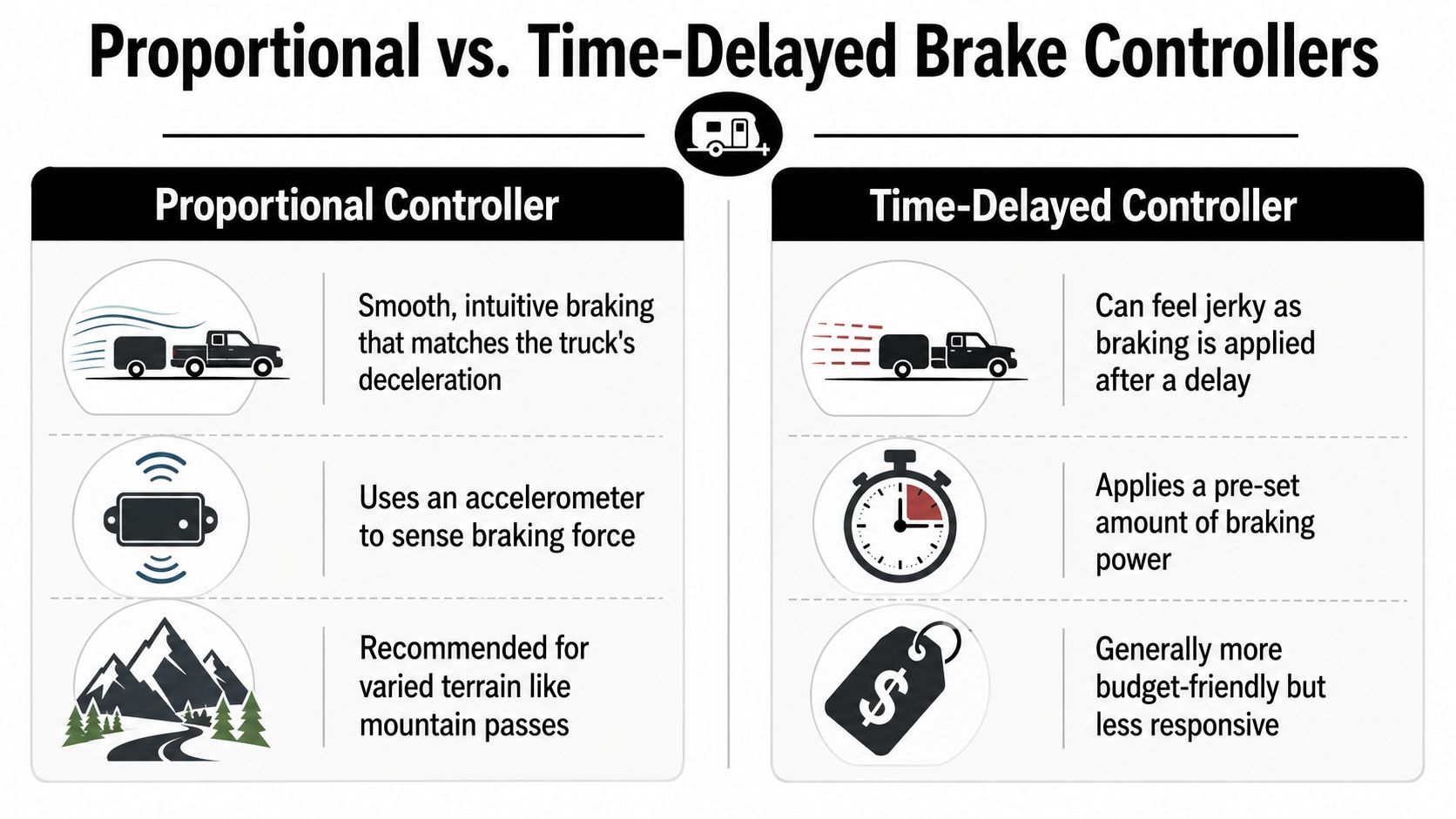
Trailer brake technology has come a long way. Today's proportional controllers are sophisticated devices that give you superior control and reduce wear on your equipment. In fact, studies show that modern braking tech can shorten your stopping distance by 30-40% when pulling a heavy load—a huge safety margin that can prevent a jackknife situation. You can learn more about the evolution of brake controller technology and see just how much these systems have advanced.
Choosing the Right Controller for Your Truck and RV
Picking the right camper brake controller goes beyond just comparing models. It's about creating a seamless system for your specific truck and RV. Here at Motor Sportsland, we help Utah families dial in this exact setup every day, making sure you're safe and confident for every trip, whether it's to the Great Salt Lake or all the way down to Moab.
Your starting point should always be the trailer itself. The single most important factor is its weight and the number of axles it has.
Match the Controller to Your Camper's Axles
A controller's power is measured by how many axles it can safely manage. It makes sense—a tiny, single-axle teardrop has completely different braking demands than a massive, triple-axle fifth wheel.
- 1-2 Axles (Up to 4 Brakes): This covers the vast majority of standard travel trailers and smaller fifth wheels. Almost any quality aftermarket controller, like the ever-popular Tekonsha P3, is designed to handle this load.
- 3-4 Axles (Up to 8 Brakes): If you're towing a big toy hauler or a luxury fifth wheel, you absolutely need a heavy-duty controller. These units are built to manage the higher electrical demand of six or eight separate brake assemblies.
A common mistake we see is people pairing a basic controller with a heavy multi-axle RV. This is a recipe for weak braking or an overheated controller, especially on those long downhill grades on I-80. Always double-check the controller's specs to confirm it supports the number of braking axles on your trailer.
Understanding Your Truck's Wiring
Once you've matched the controller to the trailer, look at your tow vehicle. Modern trucks have made installing a brake controller much simpler, but you still need to know what you're working with.
Is Your Truck "Pre-Wired"?
Most new trucks from Ford, GM, and Ram that come with a factory "tow package" are pre-wired for a brake controller. To check, look under the dashboard for a specific plug, often taped to a wiring harness near the steering column. If you find it, you're in luck! Installation becomes a plug-and-play job. You'll just need the right vehicle-specific wiring adapter—often called a "pigtail"—to connect your new controller directly to that factory plug.
What If There's No Plug?
If you're driving an older truck or one that didn't have a factory tow package, the installation is more involved. It requires a technician to run a new, dedicated circuit from the battery, tap into the brake light signal, and run wiring back to the 7-pin connector at your bumper.
While you can find DIY kits, this is one job our team at Motor Sportsland strongly recommends leaving to our professional service technicians. This ensures it's done safely, correctly, and reliably. For those wanting to dig deeper into what their truck can handle, we have resources to help you understand the tow capacity of popular models like the Dodge Ram.
Installation and Initial Setup Guide
So, you've chosen your camper brake controller. Great! Now comes the most important part: getting it installed correctly and perfectly dialed in for your rig. This is a critical safety step. The goal is to mount the unit where you can easily see the display and grab the manual override lever without ever taking your eyes off the road.
For many newer trucks with a factory tow package, this can be a simple plug-and-play process. But if you're working with an older vehicle, the custom wiring is a job best left to a professional to avoid expensive mistakes or a safety failure.
Mounting and Wiring Your Controller
The best placement is usually on the lower part of your dashboard, to the right of the steering column. This keeps it out of your way but well within arm's reach.
- Plug-and-Play: If your truck is pre-wired, you've got it easy. You'll just need a vehicle-specific wiring adapter. One end plugs into the factory port under your dash, and the other plugs into your new controller. No splicing, no guesswork.
- Custom Wiring: For vehicles without that factory plug, our service team at Motor Sportsland will run a dedicated power line from the battery, connect to your truck's brake light signal, and route all wiring cleanly back to the 7-pin connector. This professional approach guarantees a solid, safe connection.
Calibrating Your Camper Brake Controller for Safety
Once the controller is installed, you must calibrate it. This process, called "setting the gain," determines how much power goes to your trailer's brakes. The goal is firm braking from your trailer without ever locking up the wheels. This is a check you should perform before every single trip.
- Find a Safe Spot: Head to a large, empty parking lot or a quiet, flat stretch of road. You need room to maneuver.
- Set a Low Gain: To start, turn the gain setting on your controller way down.
- Get Rolling: Settle into a steady speed of about 20-25 mph.
- Use Manual Override: Now, without touching your truck's brake pedal, fully engage the manual override on your controller (usually a slide or lever).
- Feel the Brakes: Pay close attention to what happens.
- If you feel the trailer's tires lock up and skid, the gain is too high. Back it off a bit.
- If the braking feels mushy and weak, the gain is too low. Increase it.
- Repeat and Adjust: Keep testing and making small adjustments. You're looking for that perfect sweet spot: strong, aggressive braking that stops just short of a full wheel lockup.
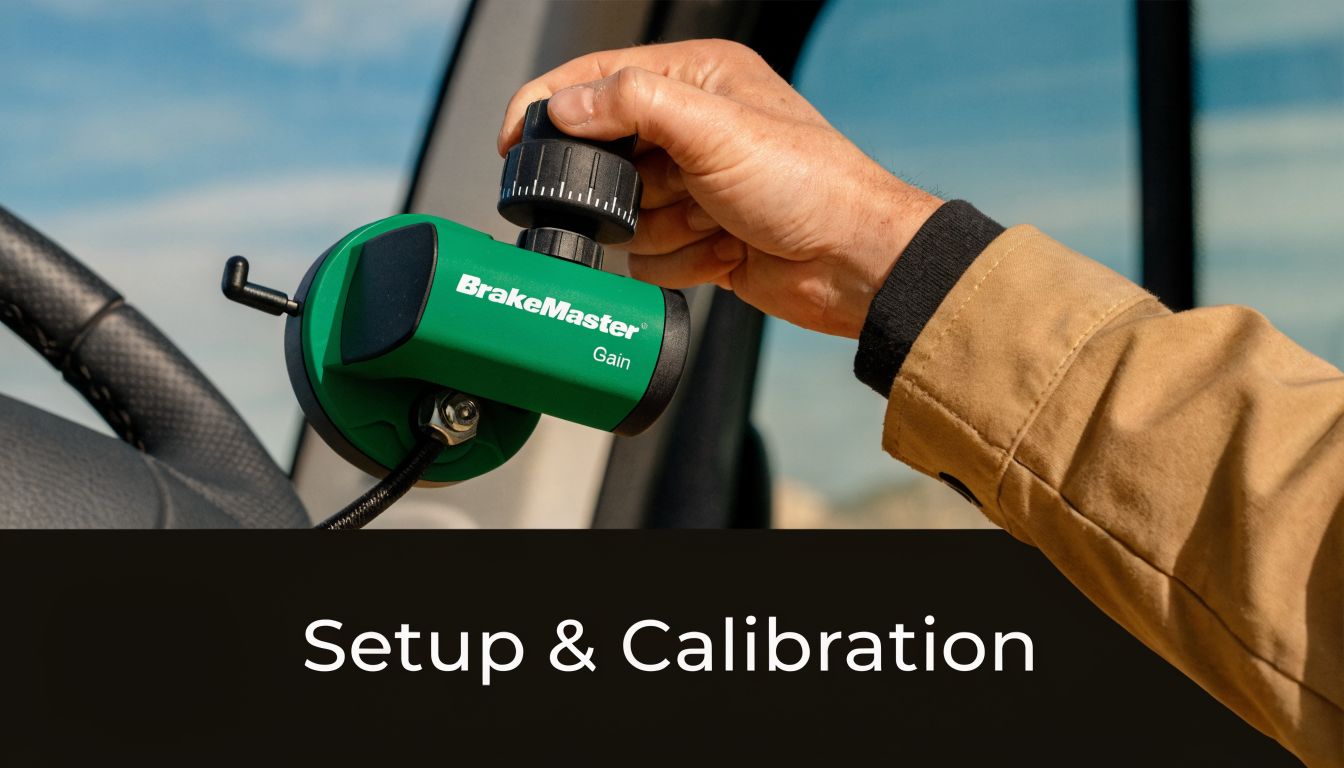
This simple test ensures your truck and trailer brake as a single, predictable unit. It's a lot like learning how to use an E2 weight distribution hitch—it's all about creating a towing experience that is fundamentally safer and more stable.
If you're ever in doubt about your installation or calibration, our experts here in Salt Lake City are always ready to help. Your safety is our top priority.
Troubleshooting Common Brake Controller Issues
Even the best camper brake controller can act up. Don't worry, though—most of the problems we see in our service bays at Motor Sportsland have surprisingly simple fixes. Let's walk through the most common issues our team helps Utah RVers solve.
The dreaded "No Connection" or "NC" error flashing on your display is the most frequent call we get. Before you panic, check the most likely culprit: the physical plug. More often than not, the problem is just a dirty or corroded 7-pin connector on your truck or trailer. All that road grime, winter salt, and moisture can easily interrupt the signal.
Diagnosing the Problem
Grab a small wire brush and some electrical contact cleaner, then give the pins and sockets on both the truck and trailer connectors a good scrub. You'd be amazed how often this simple step gets things working again. If the error still won't clear, your next move should be to check for a blown fuse or a visibly damaged wire.
Another common complaint is that the braking just doesn't feel right—it's either too weak or way too grabby.
- Weak Brakes: If you feel like your truck is doing all the work, your gain setting is probably too low. Go back through the calibration process and slowly increase the gain until you feel that strong, smooth braking action.
- Grabby Brakes: On the flip side, if your trailer tires chirp or lock up with normal pedal pressure, the gain is cranked too high. This is unsafe and chews through your tires. Dial the gain back, little by little, until the braking is firm but doesn't jolt you.
Keep in mind, sometimes braking problems have nothing to do with the controller itself. For a deeper dive into other issues, it's worth reading up on things like the common causes of front end shaking.
When a controller problem has you stumped, that's what we're here for. If you've cleaned the connectors, checked the fuses, and adjusted the gain to no avail, it's time to book an appointment with our expert technicians in Salt Lake City. They can diagnose the issue quickly and get you back on the road safely.
Of course, this all works best when your tow vehicle's brakes are in prime condition, too; for more on that, you can check out resources like Express Lube for expert brake care.
Frequently Asked Questions About Brake Controllers
At Motor Sportsland, we talk about brake controllers every single day with customers at our Salt Lake City dealership. They're one of the most critical—and misunderstood—pieces of towing gear. Here are the questions our team hears most often.
Is a camper brake controller legally required in Utah?
Yes, for almost any travel trailer or fifth wheel. Utah law requires working trailer brakes on any trailer with a gross weight of 3,000 pounds or more. Since the brake controller is what makes those brakes work, it's an absolute must-have for safe, legal towing in our state. If you're unsure, just bring your setup by our Salt Lake City location. We can confirm the specific requirements for your rig in minutes.
Can I install a brake controller myself?
It depends on your tow vehicle. Many newer trucks come "pre-wired" with a dedicated plug under the dash. If that's you, installation can be a simple plug-and-play job with the right wiring harness. However, if your vehicle isn't pre-wired, the job involves tapping into your truck's sensitive electrical system. One wrong move can cause real damage. For these custom wiring jobs, our team strongly recommends a professional installation from our certified technicians to guarantee it's done safely.
My truck has a factory brake controller. Is it good enough?
Great question. The integrated brake controllers (IBCs) that come standard in most modern trucks are fantastic. They are almost always high-quality proportional systems that are perfectly matched to your vehicle. For the vast majority of RVers, the factory controller is the best option. However, if you are towing a particularly heavy rig through Utah's mountains, our service team can run a quick diagnostic on your factory controller to confirm it has the power and responsiveness needed.
How do I set the correct gain on my controller?
Getting the gain right is crucial. Here's the process our team teaches everyone:
- Find a large, empty parking lot where you can safely get up to speed.
- Start with a low gain setting.
- Drive at a steady 25 mph in a straight line.
- Without touching your truck's brake pedal, manually apply the trailer brakes using the slide or button on your controller.
You're looking for the sweet spot where the trailer's brakes engage firmly, but without locking up the tires. If the trailer wheels skid, the gain is too high. If you barely feel it, the gain is too low. Adjust it until you feel a strong, decisive pull from the trailer—but no lock-up.
Ready to ensure your towing setup is safe, legal, and reliable for your next Utah adventure? The experts at Motor Sportsland can help you select, install, and calibrate the perfect camper brake controller. Stop by our Salt Lake City showroom or call us for a personalized consultation. Browse our parts and schedule a service appointment today!
