
Truck Campers for Sale in Utah: A Smart Buyer's Guide
You're standing beside a truck camper that looks like the perfect answer to a Utah weekend. The floorplan works, the cabover bed looks comfortable, and the seller says it'll fit your pickup. Before you discuss appliances or upholstery, check the door-jamb payload sticker. That small label matters more than the brochure.
A truck camper can be an outstanding way to explore the Wasatch Mountains, the Uinta country, Bear Lake, and southern Utah's back roads. It can also overload a truck, push too much weight onto the rear axle, or leave you discovering a roof leak far from home. Our team at Motor Sportsland believes the right purchase starts with payload math, loaded weight, center of gravity, and service access, then moves to amenities.
This guide covers truck campers for sale in Utah by category, truck compatibility, inspection condition, financing, and local ownership realities. You'll get practical numbers, a usable inspection process, and a straightforward way to decide whether a new or used camper makes sense for your truck and travel plans.
Picture Yourself Truck Camping Across Utah
It's Friday afternoon in the Salt Lake Valley. You leave after work, point the truck toward American Fork Canyon, and pull into a Wasatch roadside spot before dark. The camper settles onto an uneven forest surface, the jacks level the living space, and cold mountain air replaces the heat and traffic you left behind.
By sunrise, the Alpine Loop is glowing. After coffee, you head north toward Bear Lake for Saturday night, carrying everything you need without towing a separate trailer. A truck camper feels nimble on roads where a larger RV becomes awkward, and it gives you a bed, cooking space, and shelter close to the places you came to see.
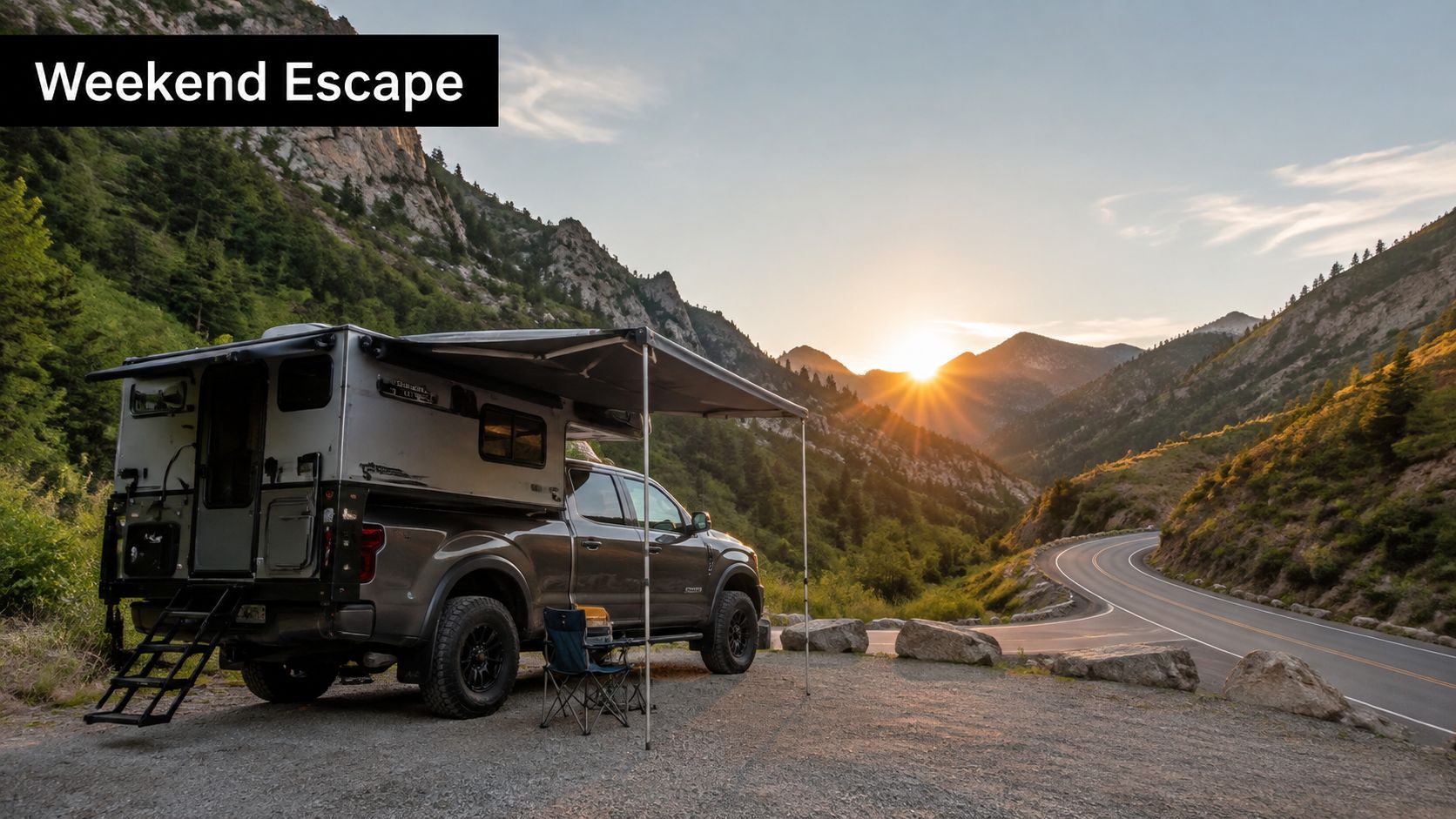
The terrain changes quickly in Utah. High passes can close by mid-October, summer afternoons can bring thunderstorms over the Uintas, and late spring in red-rock country can coat the truck and camper in fine dust. Uneven pullouts, steep grades, cold nights, and long stretches without hookups all expose weaknesses that aren't obvious on a showroom floor.
Dealer advice: The truck camper you want and the truck camper your pickup can safely carry are often different units. Let the sticker decide before the floorplan does.
That's why the buying decision matters. Browse our advice on camping off the grid in Utah with the same practical mindset you should bring to truck campers for sale. Start with compatibility, then choose comfort.
The Three Types of Truck Campers Worth Knowing
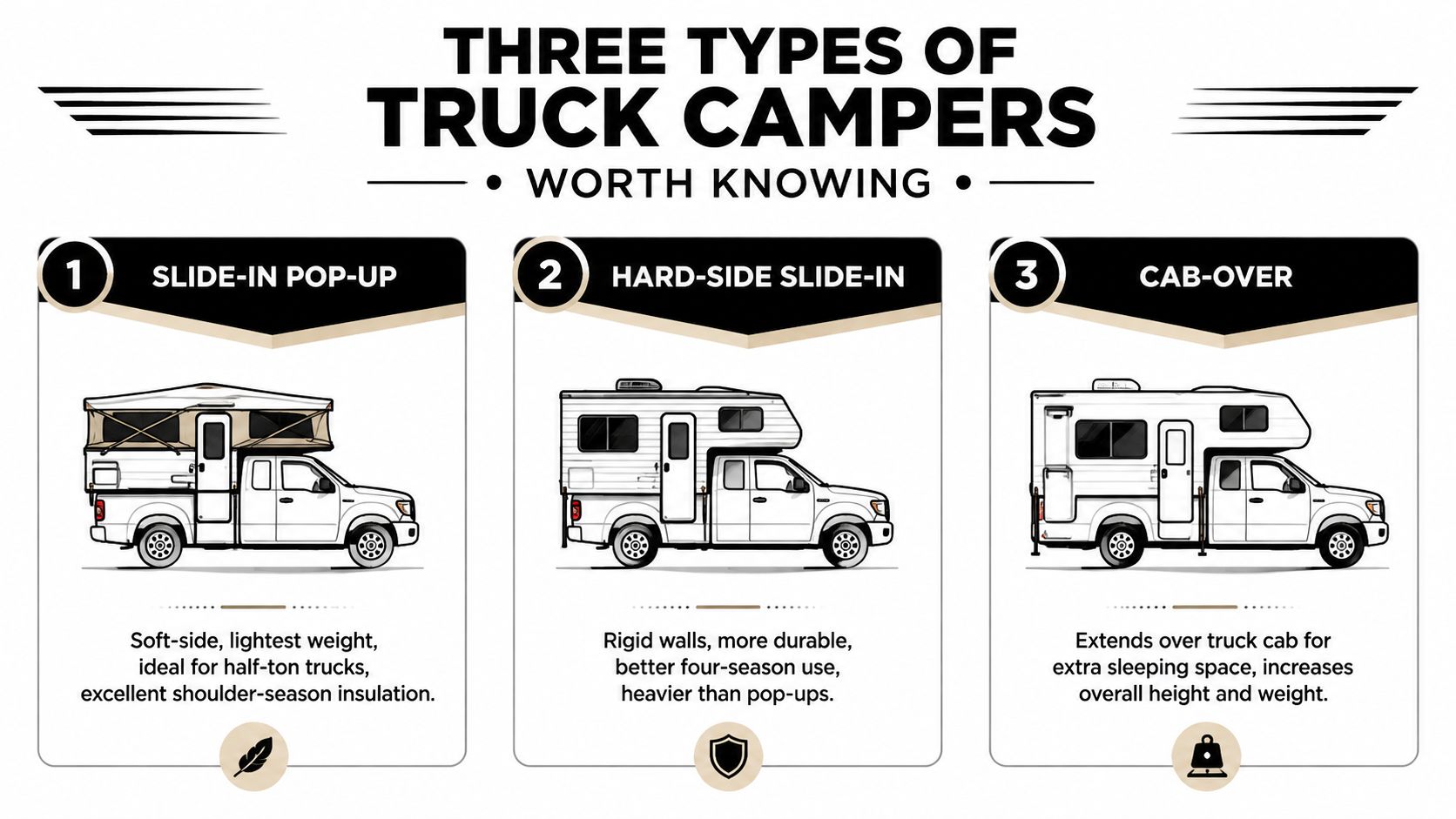
Most shoppers can narrow the field quickly by understanding the camper's structure. The three useful categories are slide-in pop-ups, hard-side slide-ins, and flatbed campers. Each changes the truck requirement, interior comfort, loading process, and seasonal range.
Slide-in pop-ups
A pop-up camper uses a lower travel profile with a soft-sided upper section that raises at camp. It's generally the lightest category and can make sense for a properly equipped half-ton truck. The lower weight and reduced height help with maneuverability, fuel use, and storage, while the fabric section still provides a comfortable base camp for warmer trips and shoulder seasons.
For Utah, a pop-up suits summer weekends, desert travel, and alpine trips when the forecast is stable. It's less convincing for November camping at high elevation, when wind, freezing temperatures, and snow demand more insulation and weather protection.
Hard-side slide-ins
Hard-side campers use rigid walls and usually provide more enclosed storage, larger tanks, and a more substantial interior. The trade-off is weight. Many loaded hard-side campers fall in the 3,000 to 5,500-pound range, while pop-ups are often 1,000 to 2,000 or more pounds loaded, according to payload and mounting guidance for truck campers.
That puts many hard-side units in three-quarter-ton or one-ton territory. A hard-side can be the better choice for cold-weather comfort, but only if the truck's actual payload and axle ratings support it.
Flatbed campers
Flatbed campers mount to a dedicated flatbed body rather than sitting inside the pickup bed. They can offer broad floorplans, exterior storage, and a stable platform, and they're commonly paired with heavy-duty work trucks. They're more specialized, so the truck, camper, and mounting system need to be evaluated as one package.
Floorplans vary inside all three categories. You'll see cabover designs with sleeping space over the cab, non-cabover or flat-front layouts, and side-bath arrangements. Cabover space improves sleeping capacity, but it also affects height, center of gravity, and total weight. Choose the shape that fits your truck and your trips, not just the one that photographs best.
The supplied video offers another visual look at truck-camper layouts and setup considerations:
Matching a Camper to Your Truck's Payload
The correct starting point is the payload number on the yellow door-jamb sticker. It tells you how much weight that specific truck can carry, and it's more useful than a generic model brochure because options, cab configuration, drivetrain, and equipment change the result.
Run the calculation in order
- Find the truck's rated payload. Read the driver's door sticker, not a general internet specification.
- Account for people and truck equipment. Subtract passengers, fuel, a toolbox, a fuel transfer tank, hitch equipment, and other bed-mounted gear.
- Use the camper's loaded weight. Add water, propane, batteries, bedding, food, clothing, recovery equipment, and personal gear. A truck-camper payload guide notes that dry specifications can understate use-ready weight by roughly 18 to 29%, and hard-side slide-in models may finish 20 to 35% above dry weight after tanks and gear are added.
- Keep working capacity in reserve. Buying guides recommend targeting about 90% of available payload, rather than running directly at the limit.
- Check the axles and center of gravity. GVWR isn't the only boundary. Each axle has a GAWR, and a camper's center of gravity needs to sit in the truck manufacturer's recommended zone.
Here's a simple planning table. These are decision categories, not substitutes for your truck's sticker and scale ticket.
| Truck class | Typical payload rating | Recommended camper type | Safe loaded weight at 90% |
|---|---|---|---|
| Half-ton | Use the door-jamb sticker | Smaller slide-in pop-up | 90% of remaining payload after occupants and gear |
| Three-quarter-ton | Use the door-jamb sticker | Pop-up or carefully matched hard-side | 90% of remaining payload after occupants and gear |
| One-ton | Use the door-jamb sticker | Hard-side or compatible flatbed camper | 90% of remaining payload after occupants and gear |
The table intentionally avoids a universal payload number because there isn't one. A half-ton with a high payload package can differ substantially from another half-ton with a different cab, engine, four-wheel-drive system, and factory options. If you want more detail on choosing the tow vehicle first, review our guide to selecting the right truck for an RV.
Don't ignore the rear axle
NHTSA guidance says the owner's manual must explain how to determine the camper's center of gravity and where it should sit in the pickup bed. Ram's owner guidance also directs owners to check loaded axle weights on a scale and stay within GAWR limits, as shown in the Ram truck owner information.
A truck camper can remain under GVWR while overloading the rear axle because much of the camper's mass sits behind or near that axle. Industry guidance estimates that roughly 80 to 90% of the load may land on the rear axle, with 10 to 20% on the front axle, depending on the setup, as explained in this center-of-gravity guide. Get the truck and camper weighed when loaded. Guessing is how an attractive purchase becomes an expensive suspension problem.
New Versus Used Truck Campers
New and used truck campers solve different problems. A new unit gives you current construction, manufacturer warranty coverage, fresh appliances, and a documented delivery inspection. You'll usually pay the highest market price at purchase, but the unit arrives without another owner's maintenance shortcuts.
Used campers can make the category more accessible, especially when the previous owner kept records and stored the unit properly. They can also hide years of roof exposure, freeze damage, appliance neglect, or tie-down abuse. A low online listing is only a bargain after the structure, systems, and mounting hardware pass inspection.
| Factor | New | Used |
|---|---|---|
| Warranty | Manufacturer coverage may protect eligible defects | Coverage may be limited or expired |
| Depreciation | You absorb the early ownership drop | A prior owner may have absorbed part of it |
| Wear points | Components start with a known baseline | Seals, jacks, plumbing, and appliances need testing |
| History | Factory and dealer documentation is available | Maintenance and storage history may be incomplete |
| Price approach | Higher purchase cost with current equipment | Lower entry cost with greater inspection responsibility |
| Best fit | Buyers prioritizing predictability | Buyers willing to inspect and budget for repairs |
The practical price gap varies by brand, age, construction, condition, and equipment. Don't rely on a broad percentage estimate from a listing page. Compare actual units side by side and ask what work has been completed.
What changes the risk
A new camper's warranty doesn't excuse a poor truck match. A used camper's lower price doesn't automatically make it a bad choice. The important questions are whether the loaded unit fits your truck, whether water has entered the structure, and whether the cost of correcting defects still makes sense.
Motor Sportsland offers new and pre-owned RV inventory, so buyers can compare condition, equipment, and ownership history in person rather than making a decision from photos alone. If you're considering used truck campers for sale, schedule enough time for the inspection checklist below.
Used Truck Camper Inspection Checklist
Inspect a used camper in zones, starting above your head and working downward. A clean interior can distract you from a roof problem, and a polished exterior can hide floor damage. Bring a flashlight, moisture-checking tools if available, a phone charger for testing outlets, and enough time to operate every system.
Roof and exterior
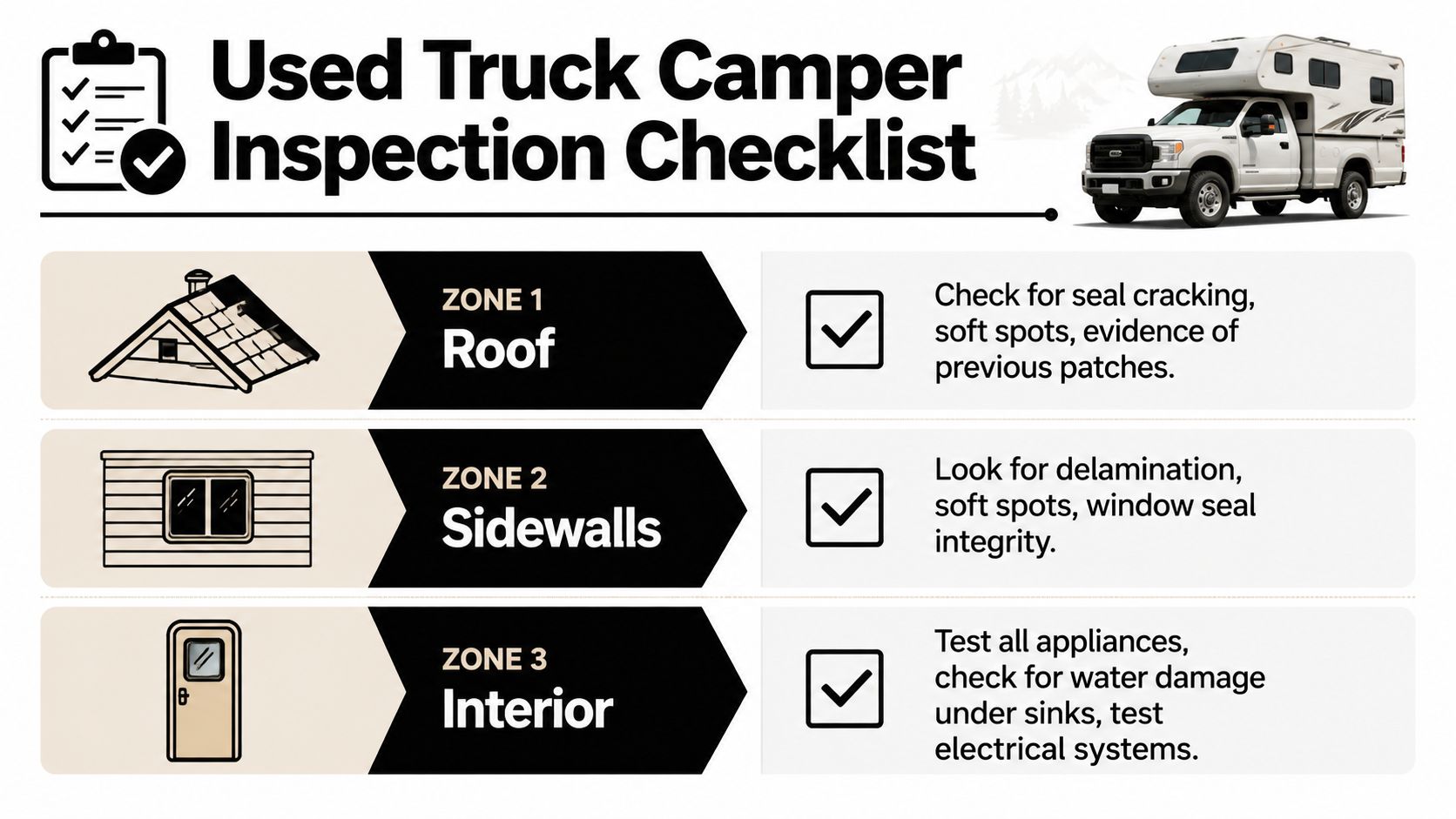
- Roof seals: Look for cracking, separation, soft spots, and evidence of previous patches. Utah's high elevation and strong sun can bake EPDM seams and shorten the life of sealants.
- Roof penetrations: Inspect vents, skylights, antennas, and air-conditioning surrounds for staining or fresh sealant that appears to cover a larger repair.
- Sidewalls: Check for delamination bubbles, stress cracks, and rippling around windows, doors, and tie-down points.
- Corners and lower edges: Look for swollen trim, damaged caulking, and impact marks from loading or unloading.
- Jacks and mounts: Operate the jacks if possible. Listen for strain, inspect mounting areas, and check whether hardware is bent or corroded.
Floor and interior
- Flooring: Walk every area, especially near windows, vents, the bathroom, and the entry door. Soft spots often indicate water intrusion.
- Cabinets: Open every cabinet and storage compartment. Musty odors, warped plywood, and discolored fasteners deserve attention.
- Plumbing: Inspect beneath sinks and around the water heater. Utah freeze cycles can split plumbing lines even when damage isn't immediately visible.
- Appliances: Test the furnace, refrigerator, water heater, cooktop, lighting, outlets, and ventilation on available power sources.
- Electrical systems: Check the 12-volt system on battery, then verify shore-power operation. Confirm that the battery compartment is clean and free of corrosion.
- Storage damage: Look for rodent droppings, chewed wiring, nesting material, and damaged insulation.
Underside and hardware
Ask to inspect the camper while it's unmounted if possible. Look for frame cracks, rust scale, bent brackets, missing fasteners, and worn tie-down attachment points. Tie-downs and turnbuckles need visible, readable working-load ratings, and damaged components should be replaced before travel.
The mounting system deserves its own pass. Cargo-securement guidance recommends that the combined working-load limit of all tie-downs equal at least half the cargo weight, and it distinguishes restraint needs by cargo weight and length in this Ohio State cargo-securement guidance. Match the anchors, turnbuckles, frame mounts, and camper attachment points as a complete system.
Financing, Trade-Ins, and Credit Applications
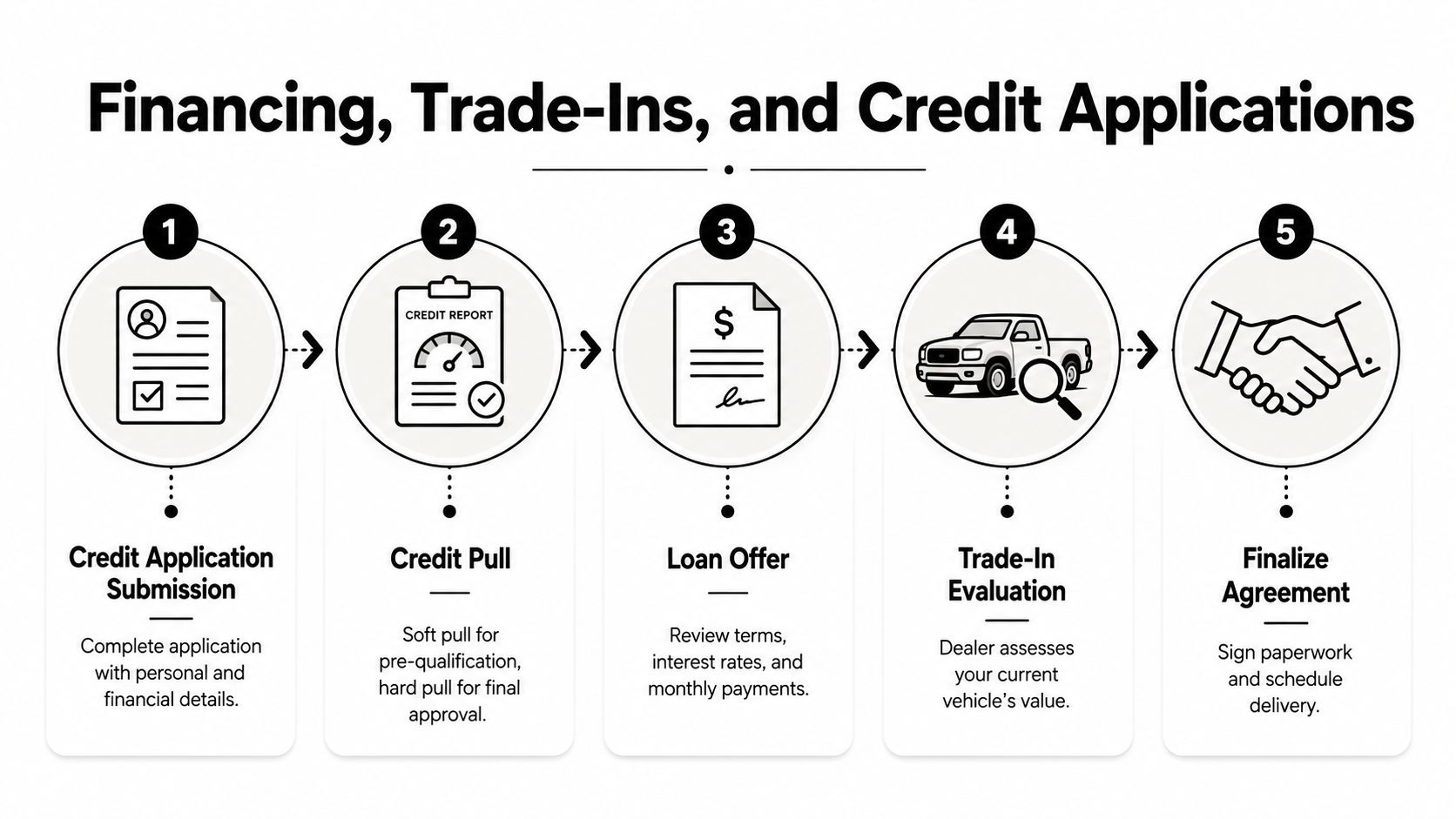
A dealership financing process is easier when you know which decisions happen in which order. Start with the camper and truck match, then submit the credit application with accurate information. Typical documentation includes identification, proof of income, residence history, and details about existing loans.
A soft credit pull may support pre-qualification, while final approval generally requires the lender's hard pull and complete documentation. Loan length, interest rate, down payment, collateral, credit profile, and lender policy all affect the final payment. Longer RV terms can reduce the monthly payment but increase the time you carry the balance, so compare total repayment rather than focusing only on the monthly figure.
The trade-in is a separate workflow:
- Walk-around inspection: The appraisal team records condition, equipment, tires, water damage, and modifications.
- Market valuation: The dealer compares the vehicle with current market information and condition.
- Loan payoff review: Any existing balance is included in the equity calculation.
- Application of equity: Positive trade equity can reduce the amount financed, while negative equity requires careful discussion.
- Final paperwork: The lender terms, trade value, taxes, fees, and delivery details are documented together.
A bank or credit-union pre-approval gives you a useful comparison point, but it isn't required before you visit a dealer. Buyers can review RV financing options and bring an outside offer for comparison. Ask for the complete rate, term, payment, fees, and payoff conditions before signing.
Why Buying Local Beats the Cheapest Listing
The cheapest listing often leaves out the ownership work that follows delivery. Utah's climate adds real demands, especially for campers stored outdoors or used across large elevation changes. A local purchase gives you a service relationship when the problem appears, not just a lower number on a screen.
Utah storage changes the equation
Snow load matters on flatbed and hard-side roofs. Frozen plumbing can split lines, fittings, or water-heater components. Batteries need attention during storage at higher elevations, and unsealed roof penetrations can turn the first spring thaw into an interior repair.
A proper seasonal routine includes:
- Spring: De-winterize the plumbing, inspect roof seals, test appliances, and check for water intrusion.
- Summer: Inspect tires, brakes, bearings, suspension components, and tie-down hardware before long trips through the Wasatch or toward Bear Lake.
- Fall: Winterize the water system, fill with the correct antifreeze where appropriate, protect exposed plumbing, and remove or maintain batteries according to manufacturer guidance.
- Mid-winter: Check the roof, exterior seals, storage area, and evidence of rodents or moisture rather than ignoring the camper until spring.
The value of a staffed service bay is practical. Technicians can winterize and de-winterize the unit, repair plumbing and electrical systems, inspect slide-out seals where applicable, install upgrades, and address problems before your departure date.
Mountain roads punish weak setups
A loaded camper changes braking, steering, tire loading, and suspension behavior. Before descending grades on I-15 near Parowan or traveling through the Wasatch, verify tire pressure against the loaded setup, inspect brakes, and confirm that the truck isn't carrying more than its ratings allow.
You also want a technician who understands how the camper was mounted and inspected. That relationship matters when a jack motor fails, a tie-down loosens, or a propane regulator freezes during a cold-weather trip. Private-party sellers may provide a lower purchase price, but warranty questions, recall work, and post-sale troubleshooting become your responsibility.
Use a concrete buying sequence
- Confirm the truck's payload sticker and axle ratings.
- Measure the bed length and identify the required mounting points.
- Select pop-up, hard-side, or flatbed construction.
- Compare the camper's loaded weight and center of gravity.
- Set a budget that includes mounting hardware, repairs, and service.
- Complete the used inspection checklist when applicable.
- Compare financing offers and trade-in equity.
- Schedule a delivery walk-through.
- Book the first service inspection and seasonal maintenance.
Truck campers are a small but active niche. U.S. wholesale shipments were about 3.6 thousand units in 2024, according to Statista's truck-camper market data. RV Industry Association figures list 3,262 units shipped in 2024, down 7.2% from 3,515 in 2023, followed by 4,084 in 2025, a 25.2% year-over-year increase. That limited supply can affect inventory and availability, which is another reason to inspect the exact unit and secure the right mounting equipment instead of waiting for a supposedly perfect listing.
A published camper specification can make the difference between a sound match and a guess. For example, one Adventurer 901SB listing gives a 38.5-inch center-of-gravity measurement and 36 gallons of fresh-water capacity, details shown on the Adventurer 901SB specifications page. Compare those measurements with your truck, not just the advertised floorplan.
Motor Sportsland has served Utah RV buyers for over 55 years through its Millcreek and Spanish Fork locations, with sales, financing, parts, and service capabilities. That local support won't eliminate every repair, but it can shorten the distance between a problem and a workable solution.
The decision is straightforward. Buy the unit that matches your truck's real payload, carry it with properly rated hardware, and choose a dealer that can help you maintain it through Utah's seasons.
Motor Sportsland offers new and pre-owned RV inventory, financing coordination, trade-in evaluations, parts, repairs, upgrades, and seasonal service for Utah owners. Visit Motor Sportsland to review current inventory, then bring your truck's door-jamb payload information so our team can help you compare truck campers for sale with the actual numbers in front of you. Ask for a delivery walk-through and schedule the first inspection before your first mountain trip.
Frequently Asked Questions
What truck do I need for a truck camper?
Start with the payload sticker on your specific truck. Smaller slide-in pop-ups may suit a properly equipped half-ton, while many loaded hard-side campers require a three-quarter-ton or one-ton truck. Confirm payload, GAWR, center of gravity, bed length, and tie-down locations together.
Should I use dry weight or wet weight?
Use loaded, or wet, weight. Add water, propane, batteries, food, bedding, passengers, and gear to the manufacturer's dry figure. Dry specifications can understate use-ready weight by roughly 18 to 29%, depending on camper style and equipment.
Can a truck camper overload the rear axle?
Yes. The truck can remain under GVWR while exceeding the rear GAWR because much of the camper's weight sits over the rear axle. Weigh the loaded front and rear axles separately and compare each result with the manufacturer's ratings.
Are pop-up truck campers suitable for Utah winters?
They can work in mild shoulder-season conditions, but soft-sided pop-ups provide less protection than a properly insulated hard-side camper in cold, windy, high-elevation weather. For November or winter trips, evaluate insulation, furnace capacity, plumbing protection, and weather conditions carefully.
What should I inspect first on a used camper?
Start with the roof and exterior seals. Then check sidewalls for delamination, floors for soft spots, cabinets for moisture or odor, all appliances and electrical systems, and the underside for frame damage and worn mounting hardware.
Do I need financing pre-approval before visiting a dealer?
No. A bank or credit-union pre-approval can provide a useful comparison, but a dealership can also submit an application to lenders and review available terms with you. Bring accurate income, residence, identification, and existing-loan information.
