
RV Stabilizer Jacks Explained for Utah Campers

You pull into a site near Jordanelle after dark, get the trailer parked, drop the steps, and finally sit down with a cup of coffee the next morning. Then someone walks from the bed to the kitchen and the whole camper gives that familiar wobble. Cabinets rattle a little. The coffee ripples. It doesn't feel broken, but it sure doesn't feel settled either.
That's usually the moment new owners start cranking on the jacks harder than they should.
At our Salt Lake City service center, that's one of the most common stabilizer mistakes we see on travel trailers and fifth wheels. RV stabilizer jacks absolutely help, but only when you use them for the job they were built to do. They're there to reduce movement after the RV is already level. They are not a substitute for leveling blocks, tongue jacks, landing gear, or an auto-level system.
Utah makes this more obvious than most places. A hard, flat pad at a private campground in the valley behaves very differently than a slightly uneven dirt site in the Wasatch or a soft desert spot down south. If you understand that difference, your setup gets faster, your RV feels better underfoot, and your jacks last longer.
Introduction
Most first-time owners don't have a jack problem. They have a setup-sequence problem.
A travel trailer can feel loose and shaky even when everything is technically parked correctly. That's because a parked RV still has suspension movement, frame flex, and amplified movement when people walk around inside. Longer trailers show it more. Fifth wheels usually feel steadier up front, but you can still get rear-end bounce when someone heads to the bathroom at night.
In Utah, that movement shows up differently depending on where you camp. At a paved site near Bear Lake, the issue is usually small but annoying floor shake. On older campground pads in the mountains, the problem often starts with uneven terrain and too much jack extension. In southern Utah, soft dirt can let a jack foot settle enough to bring the wobble back after you thought setup was done.
The fix isn't “more pressure.” The fix is using RV stabilizer jacks the right way, in the right order, with realistic expectations. That's what matters most if you want a campsite that feels planted instead of springy.
The Golden Rule Stabilize Dont Level
If you remember one thing from this article, remember this. RV stabilizer jacks do not level your RV.
Keystone and Lippert both make that distinction clear. Stabilizer jacks are meant to reduce motion after the RV is already level, and overloading them can damage electric motors and bend components because they are meant for stabilizing, not lifting the full chassis load, as outlined in Keystone's guidance on parking, leveling, and stabilizing an RV.
Think of them like the little fix for a wobbly restaurant table. You slide something under the leg just enough to stop the rock. You're not rebuilding the table. You're just taking out the movement.
What leveling actually uses
Leveling and stabilizing are two separate jobs.
For a typical travel trailer, leveling usually happens with:
- Side-to-side correction: Leveling blocks under the low-side tires before unhitching
- Front-to-back correction: The tongue jack after the trailer is in position
- Wheel security: Chocks before final setup
- Support on advanced systems: Auto-level or dedicated leveling hardware if the RV has it
If you want a good primer on setup order, this guide to proper RV leveling is worth a read, and we also break down the same process in our article on how to level a travel trailer.
What happens when owners use them wrong
When someone cranks a stabilizer until the trailer visibly lifts, a few problems start fast.
- Motors get overloaded: Electric stabilizers can keep pushing when they should've stopped
- Metal parts deform: Arms, brackets, and mounting points can bend
- The RV can feel worse: A jack under too much strain can reduce side support instead of improving it
- You chase the wrong fix: The owner tries to solve a leveling problem with a stabilizing tool
Practical rule: Once the jack foot has firm contact and you've added slight pressure, stop. If the RV is lifting, you've gone too far.
That's the rule our techs repeat to new owners every week. It saves parts, saves headaches, and keeps you from creating damage during what should be the easiest part of campsite setup.
Comparing Common RV Stabilizer Jack Types
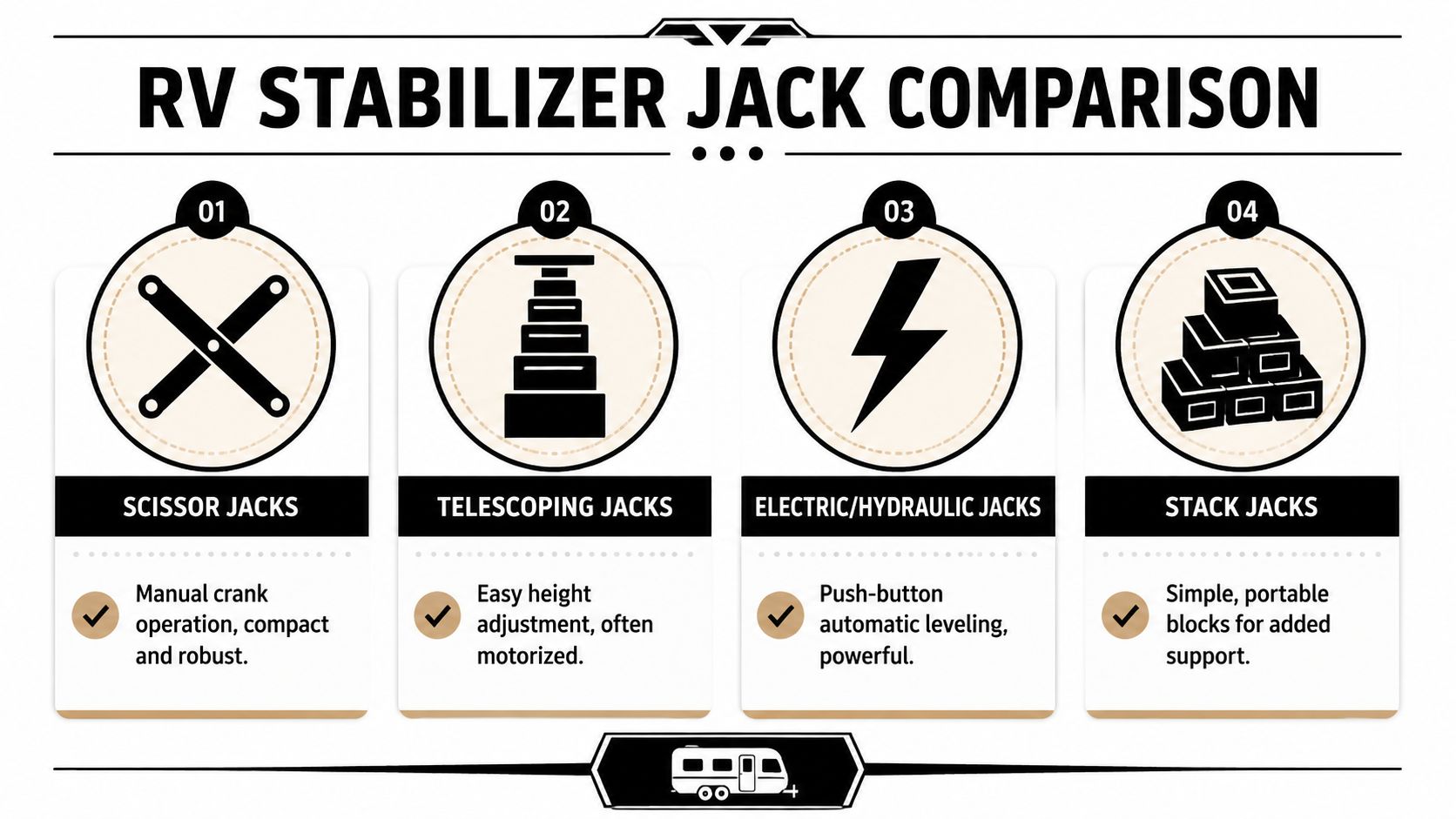
Walk around any dealership lot and you'll see several kinds of RV stabilizer jacks. They all try to do the same basic job, but they don't behave the same on rough Utah campsites, and they don't suit every RV equally well.
Scissor jacks
Scissor jacks are the familiar folding style mounted near the trailer frame. You'll see them on a lot of travel trailers. Some are manual crank models. Some are powered.
They're compact, easy to recognize, and practical for many owners. Their weakness is that they can tempt people into over-extending them on uneven ground. The farther they reach, the less confidence they inspire.
Corner steady and drop-down styles
These are common on lighter trailers and some folding or smaller campers. They deploy quickly and can be convenient when you're moving often.
They're nice for easy access and simple use, but they usually don't give the same planted feel owners expect from a heavier scissor setup. On a windy night or with kids moving in and out all day, that difference becomes pretty obvious.
Electric stabilizer systems
Powered stabilizers are popular because they cut setup effort. Push a button and you're done faster. That matters when you pull into camp late or when it's cold enough in Utah that hand-cranking isn't your idea of fun.
The trade-off is simple. Convenience goes up, but so does the importance of proper use. If an owner uses electric stabilizers like a leveling system, the motor usually pays the price first.
Stack jacks and portable supports
Portable supports and stack-style accessories can help in some setups, especially when owners want an extra support point or need a temporary solution.
They can be useful, but they're not a cure-all. If the trailer isn't properly leveled first, portable supports won't solve the underlying problem.
RV Stabilizer Jack Comparison
| Jack Type | Best For | Pros | Cons |
|---|---|---|---|
| Scissor jacks | Common travel trailers | Compact, widely available, sturdy feel when used correctly | Slower by hand, weaker feel when over-extended |
| Telescoping jacks | Lightweight trailers and easier height changes | Quick deployment, simpler adjustment on some rigs | Often less planted than heavier scissor designs |
| Electric hydraulic jacks | Larger RVs with advanced systems | Push-button convenience, less physical effort | More components to maintain, misuse can damage motors |
| Stack jacks | Supplemental support or simple portable setups | Portable, flexible, useful in certain campsites | Not a replacement for proper leveling and mounted stabilizers |
Some owners focus on vertical strength. In real campsite use, what you feel inside the RV is usually tied more closely to side-to-side firmness and how much jack extension you're asking for.
A practical buyer lesson here is simple. Faster isn't always steadier, and heavier-looking hardware isn't automatically better if it's the wrong style for your trailer and camping habits.
How to Choose the Right Jacks for Your RV
The right choice starts with your RV, not the catalog page.
A compact bunkhouse travel trailer used for weekend trips around Utah Lake doesn't need the same stabilizing setup as a longer fifth wheel headed for extended stays near Flaming Gorge. The frame length, overhang, suspension feel, and campsite types all matter more than flashy marketing language.
Match the jack style to the RV type
For smaller and mid-size travel trailers, factory scissor jacks are often perfectly fine when they're mounted well and used with pads or blocks. If the trailer is longer, extra attention to center-frame movement matters because that's where owners usually notice bounce.
For fifth wheels, the front is handled differently because the landing gear does so much of the support work there. Rear stabilization becomes the piece owners notice most once they're parked. If you're learning the differences in towing and setup between trailer styles, our guide to 5th wheel pin box basics helps explain why fifth wheels behave differently from bumper-pull trailers.
Don't misread the rating
A common point of confusion is that some stabilizer jacks are rated in the thousands of pounds, and one guide notes some can lift upwards of 6,000 lbs. while product literature cited in an owner forum reports scissor-type stabilizer jacks rated at 7,500 lbs. according to RV SnapPad's overview of stabilizer jacks. But those numbers don't change the operating rule. Tighten only until there is tension, not until you lift tires off the ground.
That's why we tell owners to treat the rating as a design limit, not as permission to jack the trailer up with them.
Think about where you camp
Use matters.
- Mostly paved campgrounds: Standard factory stabilizers may be all you need
- Mountain and forest sites: You'll benefit from pads, blocks, and shorter extension
- Soft desert soil: Footing matters almost as much as the jack itself
- Frequent overnight stops: Electric systems can make setup easier
If you're shopping for lifting equipment for shop work rather than campsite stabilization, that's a different category entirely. A resource like this guide to the best 12-ton jack for pros is useful for understanding how true lifting jacks differ from stabilizers.
A good purchase decision usually comes down to this. Choose the simplest stabilizer setup that matches your RV's size, your camping terrain, and how much setup effort you want to do every trip.
A Step by Step Guide to Using Your Jacks
Most jack trouble starts before the stabilizers ever touch the ground. The setup order matters.
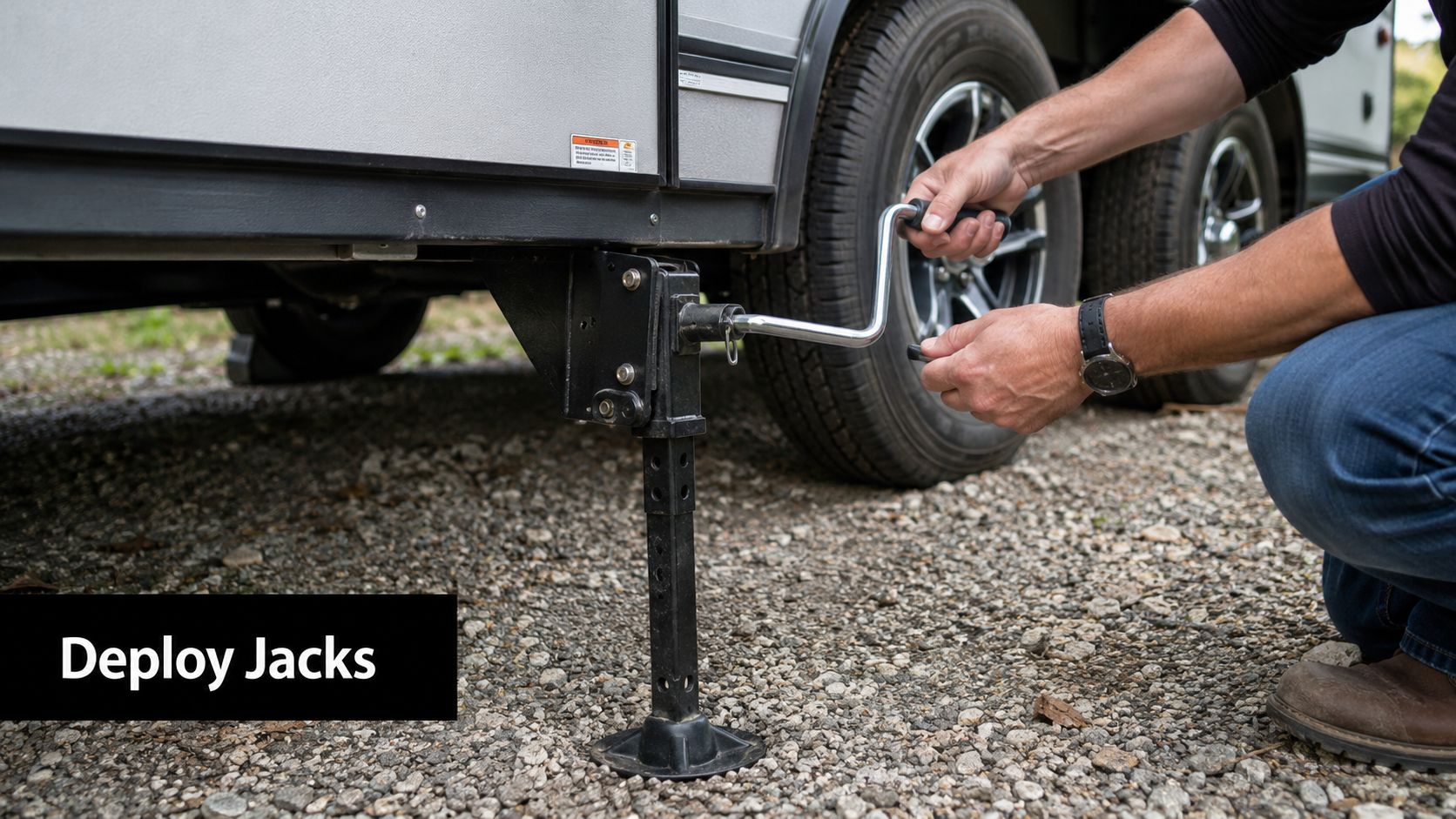
Get the RV level first
Before you think about RV stabilizer jacks, handle the actual leveling.
- Check the site: Look at slope, soft spots, and where your jack feet will land.
- Level side to side: Use wheel blocks under the low side if needed.
- Level front to back: Use the tongue jack on a travel trailer or landing gear on a fifth wheel.
- Chock the wheels: Don't skip this on sloped Utah campsites.
If you miss this order and try to fix a lean with the stabilizers, you'll just preload the jacks and still end up with a trailer that moves.
Put something solid under the feet
A lot of Utah campsites are tougher on jack feet than owners expect. Desert dirt can crumble. Gravel can shift. Asphalt in summer can get soft enough to leave a nice little imprint under a narrow footpad.
Use a solid pad or a block under each jack foot when needed. That does two things. It spreads the load and reduces how far the jack has to extend.
MORryde's guidance is useful here. It notes that lateral rigidity, not vertical lift, is the key performance metric, and that standard scissor jacks offer very little lateral support on their own. The same guidance recommends extending jacks only until they firmly contact pads, and using a pyramid-style block stack if the required height exceeds three blocks to improve stability under load, as shown on MORryde's scissor jack stabilizer page.
The trailer should feel tighter after setup. It should not look taller.
Lower each jack with a light hand
Bring each jack down until it makes firm contact with the pad or block. Then add a little tension.
That's enough.
You're trying to reduce sway and shake, especially side-to-side movement. You are not trying to take over the job of the tires, suspension, tongue jack, or landing gear. If one corner starts lifting or a jack arm looks strained, back off.
A simple pattern helps:
- Rear pair first: Snug them evenly
- Front pair next: Bring them into contact and add slight tension
- Re-check feel inside: Walk through the RV and notice the difference
- Fine tune carefully: Small adjustments only
This walkthrough helps if you want to see the motion and hand positioning in real time:
Know what success feels like
Good setup doesn't make a trailer feel like a house on a concrete foundation. It just removes the worst of the sway.
That matters because owners often expect too much. Properly set RV stabilizer jacks make midnight bathroom trips less jarring, reduce bounce when someone climbs into bed, and calm down the frame movement enough that the trailer feels settled. They don't erase every motion.
A stable campsite feels improved, not frozen solid.
That expectation keeps people from over-tightening in search of a result the hardware was never meant to deliver.
Essential Maintenance and Troubleshooting
Stabilizer jacks live close to road spray, mud, gravel, and winter grime. In Utah, they also deal with dry dust in summer and moisture plus road salt during colder months. If you ignore them, they eventually let you know.
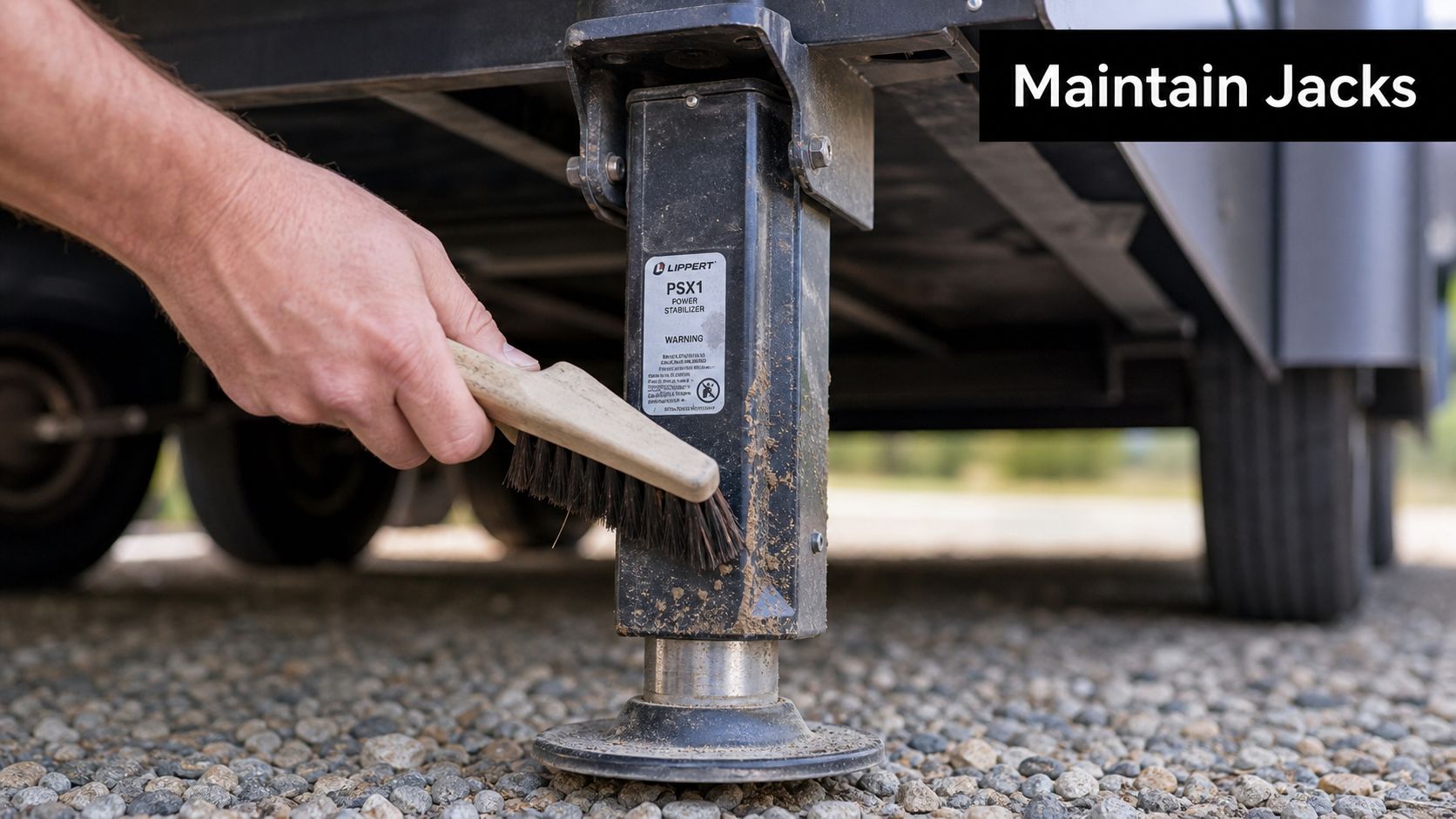
Basic upkeep that prevents bigger repairs
A few habits go a long way.
- Clean the mechanism: Brush off packed mud, sand, and road grime
- Inspect the screw and pivot points: Look for rust, binding, or uneven wear
- Use the right lubricant: A dry lube is usually the safer choice for exposed moving parts because it doesn't hold grit the way greasy products can
- Check mounting hardware: Loose bolts can create movement that feels like bad stabilizers
- Watch the feet and pads: Bent feet or chewed-up pads reduce stability fast
If your trailer sits through winter storage, inspect the jacks before the first spring trip instead of discovering a seized mechanism at the campground.
What common failures look like
Bent jack arms are usually a misuse story. Somebody lifted when they meant to stabilize.
A jack that cranks hard, chatters, or moves unevenly often points to dirt, corrosion, thread damage, or a component that's no longer aligned. Electric units that stall or strain may have a motor problem, but they can also be fighting a jack that's overloaded or physically binding.
Here's the simple field test our service writers often suggest. Retract and extend the jack with no unnecessary load on it. If motion is still rough, noisy, or visibly crooked, stop using it until it's inspected.
When it's time for service
Some issues are owner-maintenance jobs. Some aren't.
- Try cleaning first: Dirt and old grime can make a healthy jack feel broken
- Stop if metal is bent: Don't force a damaged jack through another cycle
- Don't keep running a struggling motor: That usually turns a smaller repair into a pricier one
- Get an inspection when movement feels wrong: Mounting brackets and surrounding structure matter too
If you need a shop to look at bent components, motor problems, or hardware replacement, you can schedule help through our RV service department. That's often the right move when the jack issue may involve the bracket, wiring, or frame attachment and not just the jack itself.
Conclusion
You feel this mistake fast at camp. The trailer is finally parked, someone drops the stabilizers to “help level it out,” and now a jack is carrying weight it was never built to handle.
The takeaway is simple. Stabilizer jacks steady the trailer after it is level. They do not level it.
That distinction matters even more in Utah, where camping surfaces change from one trip to the next. On a flat pad out near the west desert, the job is usually quick. On an uneven site up Big Cottonwood or along the Wasatch back, it takes more patience with leveling blocks before the stabilizers ever touch down. Owners who keep those two jobs separate usually get a quieter trailer, less floor bounce, and fewer bent parts.
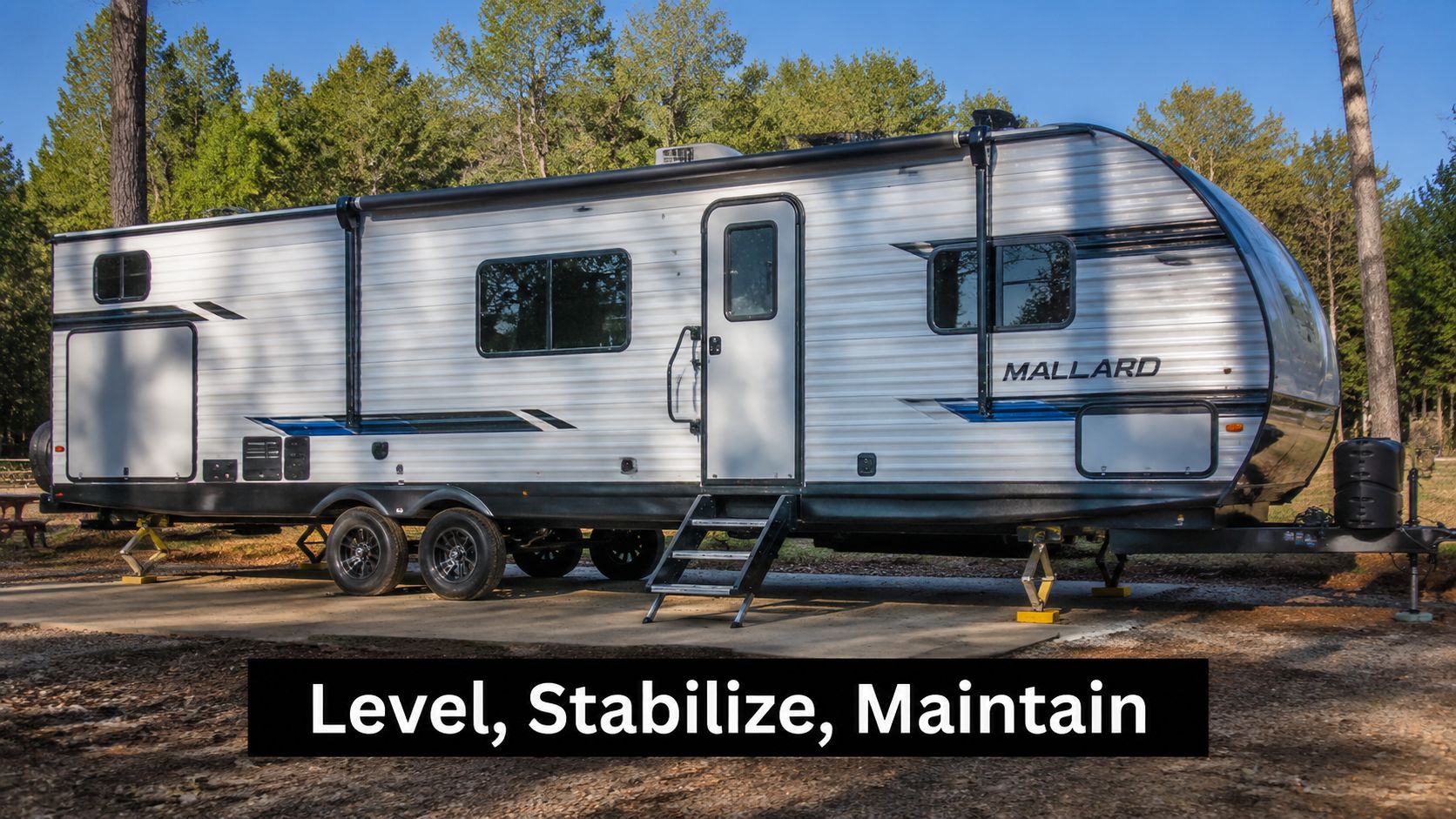
Good jack habits are pretty boring, and that is the point. Level the trailer correctly. Set the stabilizers down on solid footing. Add light pressure and stop there. That routine holds up whether you camp on a paved site near Salt Lake or a rougher forest spot where one corner wants to sink into soft ground by morning.
If you are comparing trailers, replacing worn hardware, or looking at a jack that sits crooked, talk it through with the Salt Lake City area team at Motor Sportsland. A quick look at your trailer size, frame setup, and the places you camp usually tells you what will work and what will cause trouble later.
Frequently Asked Questions About RV Stabilizers
Can RV stabilizer jacks lift my trailer a little bit?
No. If a stabilizer starts raising the frame, it is doing the wrong job and taking load it was not designed to carry. Level the trailer with your tongue jack and leveling blocks first, then run the stabilizers down until they make firm contact and add light pressure.
That mistake is one of the fastest ways to bend scissor jacks on travel trailers we see around Salt Lake.
Do stabilizer jacks remove all movement inside the RV?
They cut down the bounce and side-to-side shake, but some movement is still normal, especially in longer trailers or when a few people are walking around inside. Wheel chocks, solid jack pads, and the right amount of pressure all help.
Some owners also add wheel-to-wheel stabilizers. Great American RV explains that well in its article on using RV stabilizer jacks correctly.
Are scissor jacks enough for a longer travel trailer?
Often, yes. Condition matters more than style alone. A properly mounted set of scissor jacks can do a good job on a longer trailer if the frame is solid, the jacks are not twisted, and you are not extending them too far.
On uneven Wasatch campsites, longer trailers usually need more attention to blocking and pad placement because extra extension makes any stabilizer feel less firm.
Should I put blocks under my stabilizer jacks?
Usually, yes. Blocks reduce how far the jack has to extend and give it a better footing on gravel, dirt, and soft shoulder areas. That matters on Utah sites where the ground can look packed in the evening and sink a little by morning.
Use wide, stable pads. Skip loose rocks, scrap lumber, or anything that can split.
Why does my RV still wiggle after I set the jacks?
Start with the basics. Check that the trailer is level first, the wheels are chocked, and each stabilizer is landing on solid ground. If one corner is hanging lower than the rest or a jack foot is sitting in soft dirt, the trailer will still move.
A little wiggle is normal. Excessive rocking usually means setup needs another look, not more force on the stabilizers.
If you want help checking your current setup or getting a trailer ready for trips from the west desert to the mountain campgrounds above the Wasatch Front, Motor Sportsland can take a look and point out any jack or frame issues before they turn into a repair.
