
RV Sales Utah: A Local Buyer's Guide for 2026
You pull into a Utah RV lot after a weekend at Jordanelle or Bear Lake with one question on your mind: can this rig handle the next trip better than the last one? The answer isn't found in the biggest screen, fanciest trim, or lowest advertised price. It comes down to tow weight on Wasatch grades, insulation for mountain nights, storage at home, registration paperwork, and whether the floorplan still works when the kids, bikes, and coolers are inside.
That's why RV sales in Utah require a more local approach than a generic national buying guide. Utah's market is unusually active, the terrain exposes weak tow setups quickly, and ownership costs continue after delivery. This guide will help you choose between towables and motorhomes, compare new and used inventory, narrow a dealership lot efficiently, understand Utah fees, prepare for financing, and plan service for desert dust and winter storage. Our team at Motor Sportsland works with Utah buyers who want a rig that fits the trip, not just the brochure.
Why RV Sales in Utah Move Differently
A family arriving from Salt Lake City may already know what they want. They saw a bunkhouse online, pictured the kids sleeping comfortably, and assumed the purchase would be simple. Then they stand beside the trailer and start asking better questions. Will their current vehicle pull it up a mountain grade? Can they store it through a Wasatch winter? What happens when a seal leaks after a season of dust and temperature swings?
Those questions matter because Utah is widely described as the largest per-capita owner of RVs in the United States, according to the Utah RV market profile. The same profile projects Utah's RV-dealer market to reach about $1.4 billion in 2026, supported by 215 businesses and 1,685 workers, with business count growing 9.8% annually and market size expanding 3.2% annually from 2021 to 2026. Those figures describe a mature retail and service market, not a short-lived summer rush.
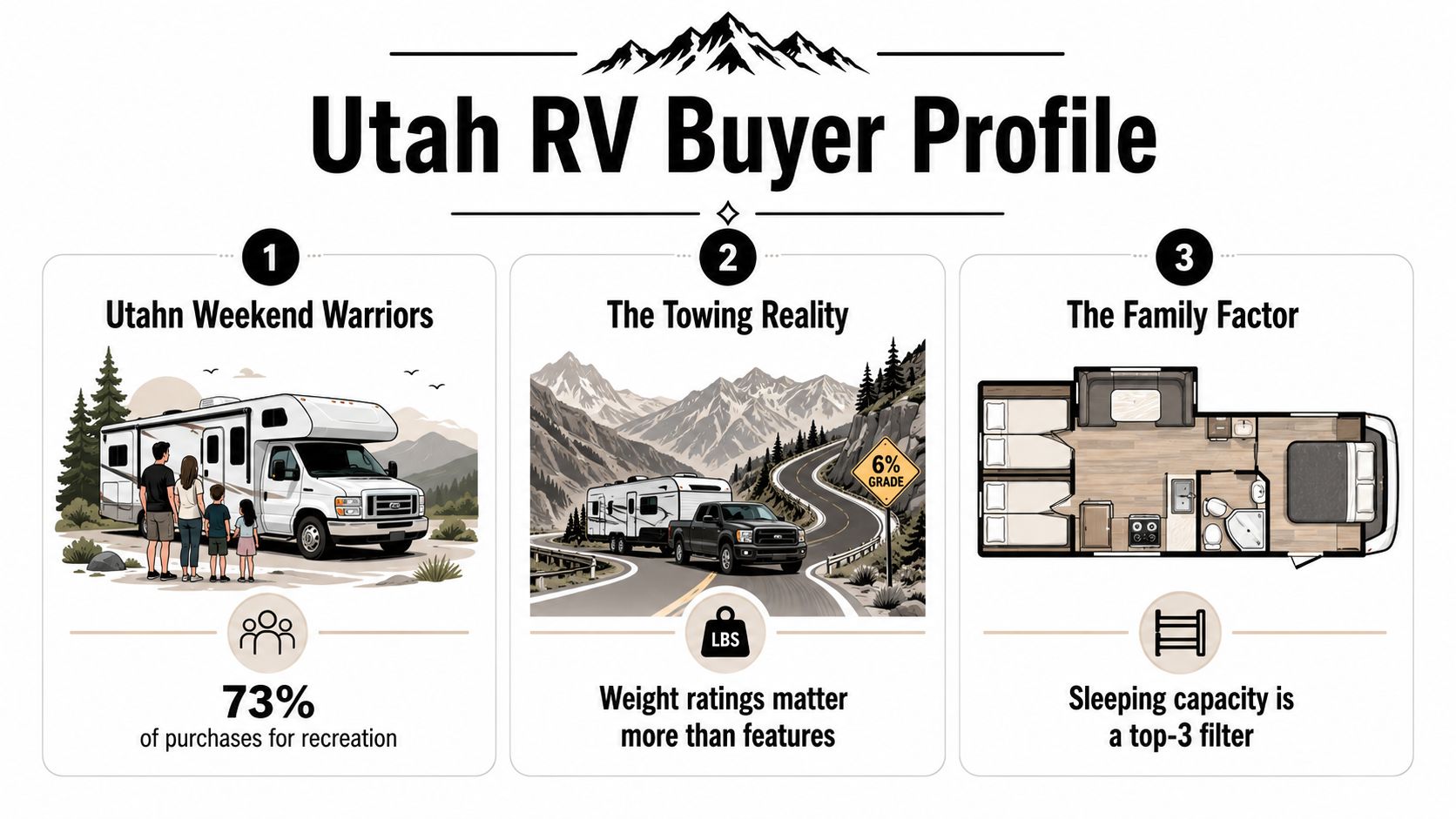
What that means on a Utah lot
You should expect more variety, but also more decisions. A local lot may include a lightweight travel trailer for a family SUV, a fifth wheel designed for extended travel, and a used motorhome that looks affordable until you account for fuel, registration, and service.
Utah buyers also benefit from competition. Compare floorplans, condition, tow requirements, and dealer support instead of assuming the first attractive unit is the right one. The best purchase usually begins with a hard look at the trips you take, including Jordanelle weekends, Bear Lake stays, Moab powersports trips, and shoulder-season camping near the Wasatch Mountains.
Practical rule: Buy for Utah's hardest conditions first. A rig that handles mountain cold, canyon grades, and storage demands will usually feel easy during a mild summer weekend.
RV Types Sold in Utah and Who Each One Suits
Utah's RV inventory covers nearly every camping style, but each category creates a different compromise. Start by choosing whether you want a motorized coach or a towable, then match the unit to your vehicle, sleeping needs, and campground habits.
Motorhomes
Class B motorhomes suit couples who want compact travel, quick departures, and easier maneuvering through Salt Lake City streets or tighter campground approaches. They're convenient for trailheads and short mountain weekends, but sleeping, storage, and bathroom space are limited.
Class C motorhomes are the practical family middle ground. The cab-over bed and available bunkhouse layouts can work well for trips to Jordanelle or Bear Lake. They're easier to drive than a large Class A, though you'll still need to plan for height, wind, braking, and mountain grades.
Class A motorhomes fit buyers who want a larger living area and extended highway travel. They can be comfortable for long trips, but their size makes narrow canyon roads, tight campsites, fuel stops, and winter storage more demanding.
Towable RVs
Travel trailers are the broadest category. Lightweight models may work for some SUVs, while larger units require a properly equipped pickup. They're a strong choice for first-time buyers who want floorplan flexibility without buying a motorized coach.
Fifth wheels provide a stable-feeling towing platform and generous living space, making them attractive for longer trips or seasonal travel. They require a compatible pickup and enough room to maneuver, and their front overhang can complicate storage.
Toy haulers make sense for Utah riders carrying motorcycles, bikes, or off-road equipment toward Moab and desert trails. The garage adds flexibility, but cargo weight changes the tow calculation, so don't judge the setup using the empty trailer alone.
Folding campers are compact and easier to store, but their soft-sided sections offer less protection from cold and wind. They suit fair-weather families and buyers with limited driveway space.
Destination trailers are built more for extended placement than frequent canyon travel. They can work at a seasonal site, but they aren't the right tool if you plan to move every weekend.
The selection test
Write down your tow vehicle, sleeping requirement, storage situation, and typical destination. If those four answers point in different directions, don't force a purchase. A smaller rig used often beats a larger rig that makes every departure stressful.
New vs Used RV in Utah's 2026 Market
The new-versus-used decision is sharper in 2026 because national shipment data shows a softer new-RV market alongside steadier used demand. RV shipments were down 18.7% year over year in May 2026 and 14.4% year to date, while February 2026 new RV sales fell 24.12% year over year and used RV sales rose 1.57% year over year, according to RVIA shipment reporting. Utah ranked fourth among the top five states for used RV sales growth in 2025, at +2.5%, according to the same verified market brief.
That doesn't mean every used RV is a bargain. It means buyers should compare condition and total ownership cost instead of treating “new” as automatically safer or “used” as automatically cheaper.
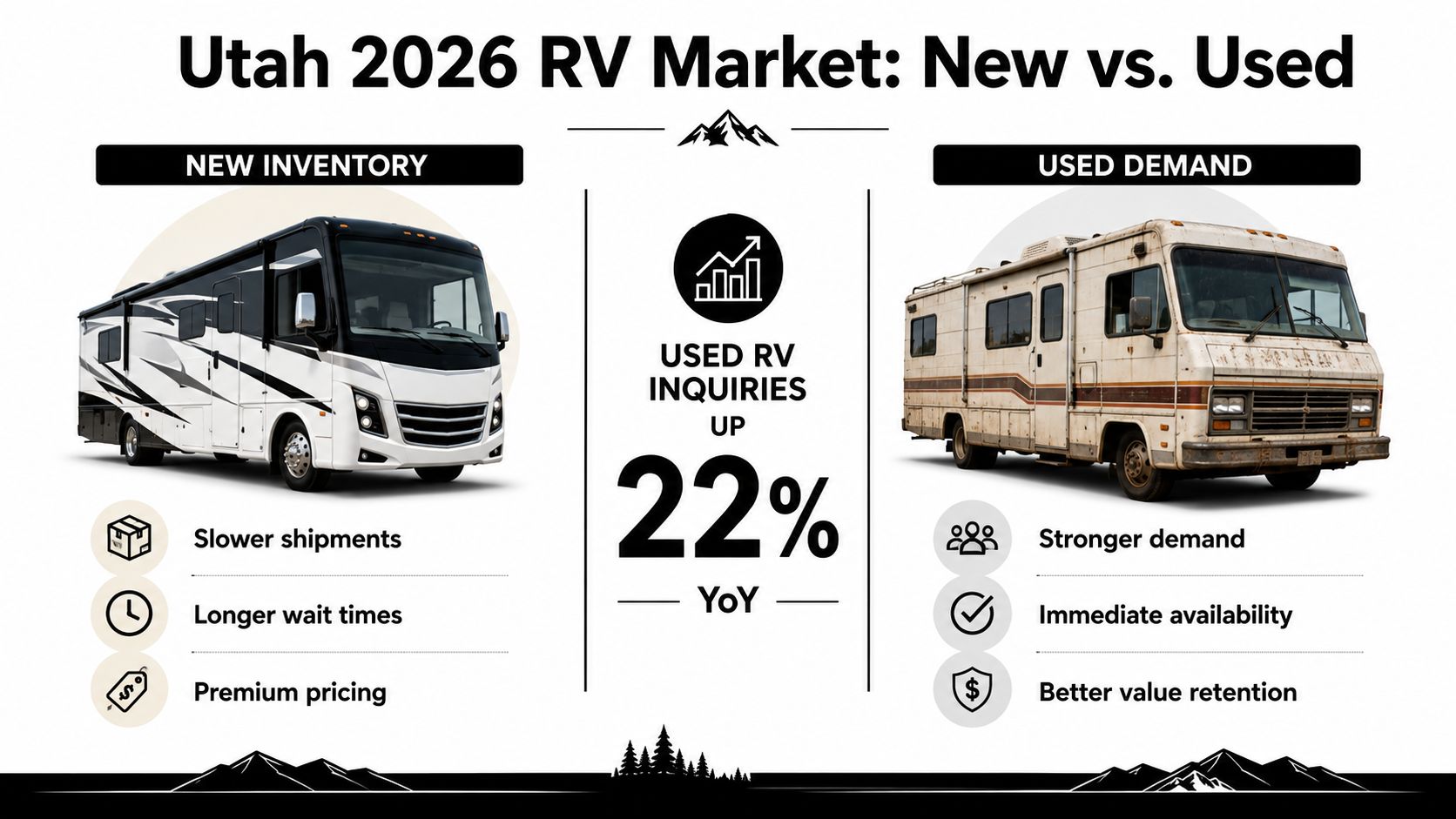
When new makes sense
Buy new when you need a specific floorplan, want current warranty coverage, or don't want to inherit unknown maintenance. New inventory can also make sense when your schedule is tight and you need predictable delivery and immediate use.
National shipment forecasts remain volatile. RVIA lowered its 2026 annual forecast to 300,000 to 328,100 units, with a median of 314,000, below the 342,200 units shipped in 2025, as reported in RV industry coverage of the revised forecast. That environment can create changing availability across floorplans and model years.
When used is the smarter buy
Used inventory can provide better value when you're willing to inspect carefully. Utah's dry heat, winter freezes, road vibration, and elevation changes make the following areas essential:
- Slides and seals: Extend slides, inspect seals, and look for staining or soft areas.
- Tires: Check age, sidewalls, tread, and signs of long-term sitting.
- Roof: Look for cracked sealant, neglected maintenance, and water intrusion.
- Appliances: Test the refrigerator, furnace, air conditioner, water heater, and plumbing.
- Interior condition: Soft flooring, musty odors, and discoloration deserve explanation.
The January 2026 industry report separated the categories clearly. Total RV sales were down 14.51% year over year, towables were down 14.42%, motorized RVs were down 15.07%, and used RV sales increased 1.29%, according to Statistical Surveys industry reporting. That supports a simple recommendation: if you shop used, spend more time on inspection than on cosmetic features.
How to Shop Utah RV Inventory the Right Way
Don't begin with a favorite brand. Begin with filters that protect you from buying the wrong rig.
Start with weight
Use the exact tow vehicle specifications, not a casual estimate based on engine size. Account for passengers, cargo, hitch equipment, propane, water, and the gear you'll carry to a mountain campground. A trailer that feels manageable on flat pavement can behave differently on a Wasatch grade or through a canyon crosswind.
Sort by length and floorplan
Length affects campsite fit, driveway storage, turning radius, and your comfort backing into a site. Then compare floorplans according to how people sleep. A bunkhouse can keep children out of the main living area, while a rear living layout may serve a couple better on longer stays.
Build a short list
A productive dealership visit should leave you with three credible options, not ten units you vaguely like. For each candidate, record:
- Tow details: Confirm listed weight, hitch requirements, and compatibility with your vehicle.
- Identity: Ask for the VIN, model year, ownership history, and whether the unit was used seasonally or extensively.
- Condition: Test slides, appliances, plumbing, roof areas, seals, and tires.
- Ownership fit: Check storage, registration, service access, and expected travel conditions.
Owner's Picks and rotating inventory tools can help shorten the search, but don't let a badge replace a walk-through. The Salt Lake City RV dealer guide is also useful for understanding how local shoppers can compare sales, service, and inventory support.
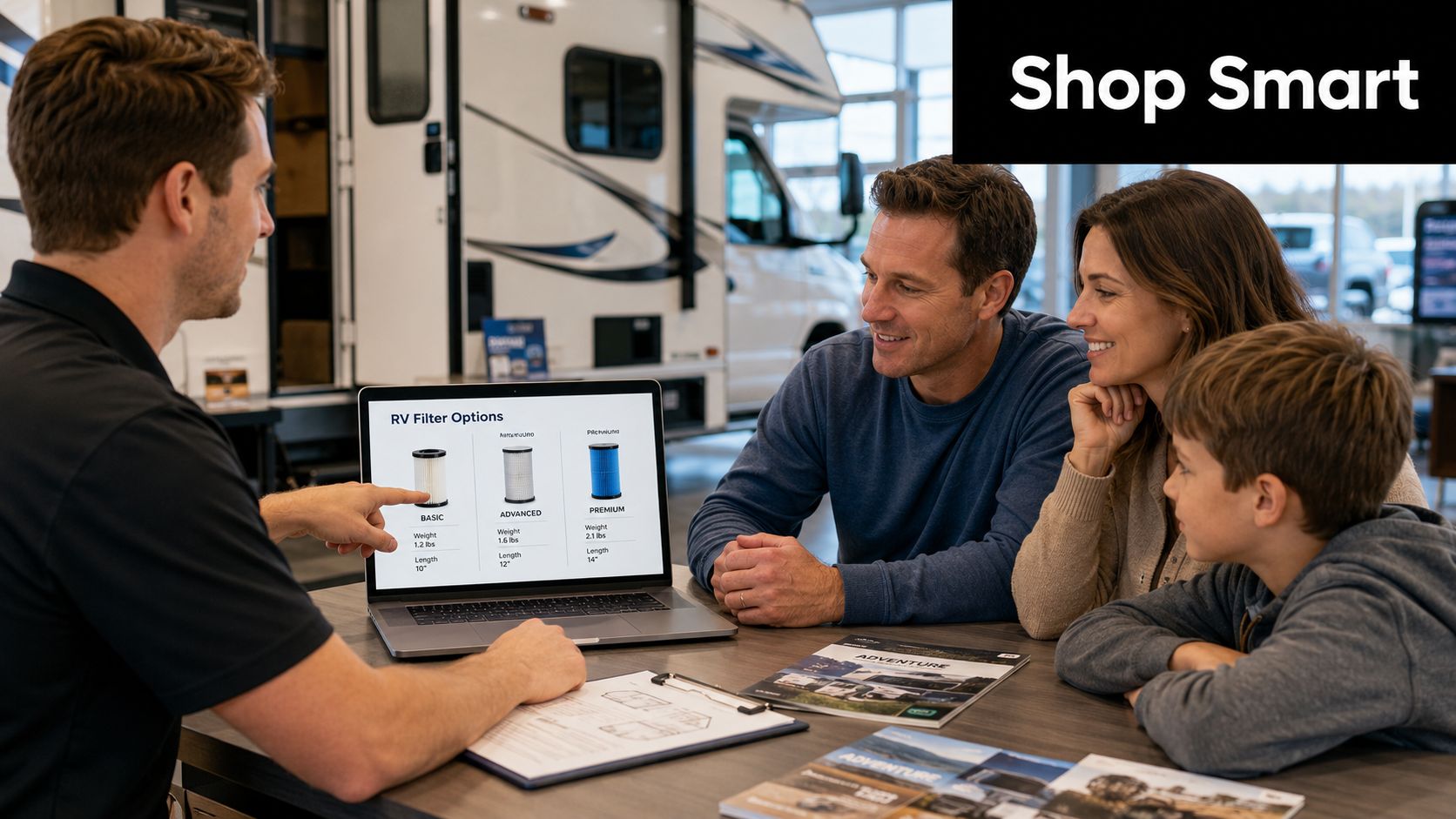
Ask yourself one uncomfortable question before signing: Will I enjoy towing and storing this RV enough to use it regularly? If the answer isn't clear, keep narrowing.
Utah Registration Fees and Ownership Costs That Change the Math
The purchase price is only one line on the worksheet. Utah uses an age-based uniform fee schedule for travel trailers and park model recreational vehicles. For 2024 to 2026 models, the fee is $175. For 2021 to 2023 models, it's $135. For 2018 to 2020 models, it's $90. For 2015 to 2017 models, it's $65, and for 2014 and older units, it's $20, according to the Utah DMV uniform fee schedule.
Travel, camping, and fifth-wheel trailers weighing more than 750 pounds unladen must be registered, and Utah guidance says campers from 2015 onward and park model recreational vehicles from 2015 onward are subject to title and registration rules. Motorhomes use a different fee structure tied to vehicle type and model year, so compare the recurring cost before deciding between a self-propelled coach and a towable.
A practical ownership worksheet
| Cost area | What to confirm |
|---|---|
| Registration | Unit age, vehicle type, title status, and applicable Utah fee |
| Fuel | Vehicle baseline plus a buffer for grades, wind, altitude, and trailer weight |
| Storage | Home storage, paid storage, winter protection, and access |
| Maintenance | Roof, seals, tires, plumbing, appliances, brakes, and battery care |
| Setup | Hitch equipment, leveling gear, brake controller, and safety equipment |
Utah law also limits the draw-bar or other connection between two vehicles on a highway to 15 feet, as described in the Utah towing rule reference. Check the complete tow configuration before buying a trailer, tow dolly, or motorhome setup.
Fuel planning needs the same honesty. The EPA explains that official fuel economy information is intended for vehicle and emissions comparisons, not real-world towing MPG estimates, as outlined on the EPA Fuel Economy site. Treat the window sticker as a baseline, then budget for I-15 traffic, mountain grades, high-elevation campgrounds, wind, and loaded cargo.
Financing, Trade-Ins, and Pre-Qualification in Utah
Financing gets easier when you prepare before choosing a floorplan. A quick credit application or pre-qualification can help establish a payment range, but it isn't permission to ignore the total cost. Registration, insurance, storage, maintenance, and fuel still belong in the budget.
Bring the right information
Have your identification, income details, housing information, current lender details, and trade-in paperwork ready. If you're trading an RV, bring the title or lien information, service records, keys, manuals, and details about upgrades. A clean file helps the appraisal team understand what they're evaluating.
The trade-in conversation is especially important when new-unit demand softens. A dealer may have more flexibility with used inventory, but trade value still depends on condition, marketability, equipment, title status, and whether the unit needs immediate repairs. Be realistic about roof work, tire age, appliance faults, and water damage.
Compare the structure, not only the payment
A longer term can lower the monthly payment while increasing the total cost of borrowing. Ask about down payment, interest rate, early payoff terms, warranty products, and gap coverage. Gap coverage can matter when the loan balance and RV value don't move at the same pace, but you should understand what it covers and what it excludes.
Dealer financing and outside lenders can both be useful. Compare written offers using the same amount financed and term length. The RV financing options guide can help first-time buyers understand the questions to ask before they commit.
My recommendation is simple. Get pre-qualified, choose the RV based on fit and condition, then evaluate the final contract line by line. Don't let a manageable payment hide an unaffordable ownership plan.
Service, Parts, and Collision Repair After the Sale
The first serious test often comes after the sale. A family may need winterization before a cold snap in Heber Valley, then discover a slide seal issue when spring arrives. Another owner may prepare a toy hauler for Moab and need plumbing, electrical, tire, battery, or cargo-area work before departure.
A useful Utah service operation handles more than oil changes. Ask whether the shop can support:
- Systems: Plumbing, electrical, water heaters, furnaces, refrigerators, and air conditioning.
- Structure: Roof inspections, slide adjustments, seal replacement, and water-intrusion work.
- Travel readiness: Brakes, tires, batteries, hitch components, and safety checks.
- Customization: Storage improvements, appliances, electronics, and other upgrades.
- Damage repair: Collision assessment, body repairs, and parts sourcing.
Seasonal examples
Winterize before freezing weather, not after the forecast turns. Drain and protect the water system, inspect exposed plumbing, and store batteries according to the manufacturer's guidance.
Before a desert trip, check roof seals, tire condition, slide operation, cooling systems, and the equipment you've loaded into the garage. Dust finds weak seals, and a minor electrical issue becomes a larger problem when you're far from town.
A local service relationship also helps with parts. When a repair needs a specific component, experienced staff can identify the correct model and avoid the expensive guesswork that comes from ordering a similar-looking replacement.
Best Times of Year to Buy an RV in Utah
There isn't one perfect buying month for every Utah shopper. The right time depends on whether you want the newest floorplan, the widest selection, a trade-in conversation, or the strongest chance of finding an outgoing model year.
The seasonal pattern is predictable enough to use. Winter can create more negotiating room around outgoing inventory, spring brings more shoppers and trade-ins, summer produces strong demand, and fall often brings model-year changeover. Deals of the Week can add another layer, especially when a current promotion lines up with trade-in equity or manufacturer support.
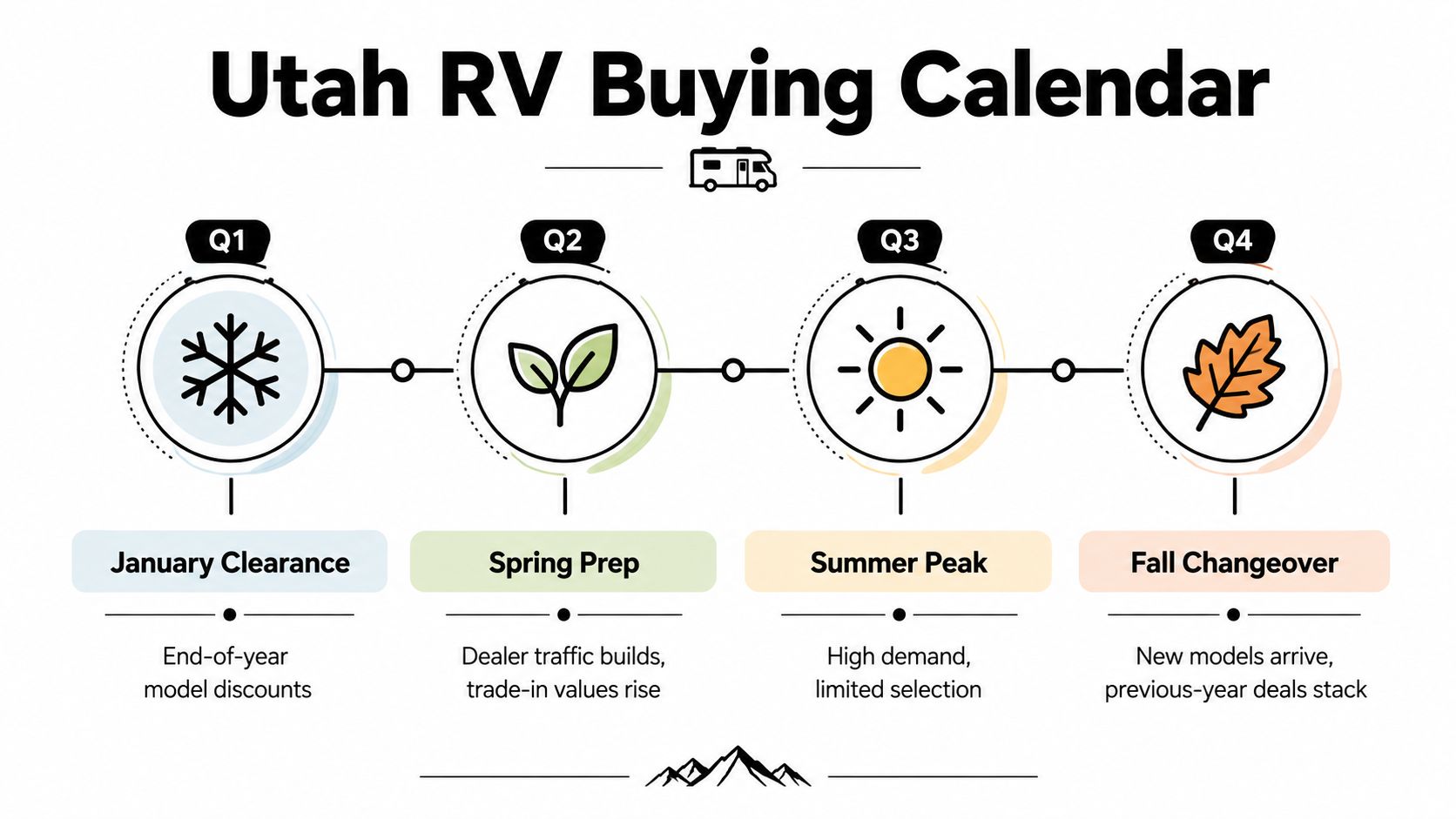
A Utah buying calendar
January and winter clearance: Outgoing inventory may receive more attention, and buyers who can shop before peak camping season may find useful opportunities. The trade-off is that some campgrounds and test trips aren't practical, so inspect heating, seals, plumbing, and storage condition carefully.
Spring preparation: Buyers start planning Jordanelle, Bear Lake, and mountain trips. Inventory movement increases, and trade-ins can broaden the used selection. This is a good time to compare multiple floorplans before summer urgency takes over.
Summer peak: The weather makes shopping and camping easy, but popular bunkhouses, toy haulers, and family layouts may move quickly. If you need a specific setup for an upcoming trip, waiting can reduce your choices.
Fall changeover: New models begin arriving while previous-year units may receive attention. This is often the best period for buyers who want to compare current and outgoing floorplans side by side. The best time to buy an RV guide offers a broader way to evaluate timing without treating a calendar date as a guarantee.
Questions to answer before signing
Utah paperwork deserves a place in your seasonal plan. A buyer may need a title or bill of sale to begin the process, and a temporary permit may be useful while gathering additional documents. Depending on the unit and situation, the DMV process can involve VIN inspection, safety or emissions checks, and Utah-specific title and registration steps. Recent Utah DMV updates also include online title-transfer pathways and permit options, so confirm the current process through the Utah DMV campers guidance.
For a used RV, inspect slides, seals, tire age, roof condition, appliances, flooring, and signs of water intrusion. Don't confuse a clean interior with a sound structure.
Winter storage should influence the floorplan too. A rig with exposed plumbing, weak insulation, or difficult roof access may create more work in a Utah climate. Altitude and temperature swings also affect comfort, fuel planning, tire checks, and heating demands, especially on mountain trips.
Dealer advice: The best time to buy is when the right unit, tow setup, paperwork, and ownership budget line up. A discount doesn't fix a mismatched RV.
Motor Sportsland offers new and used RV inventory, financing and trade-in support, parts, service, upgrades, and collision repair through Utah locations in Millcreek and Spanish Fork. That combination gives buyers a place to handle both the purchase and the maintenance realities that follow it.
If you're comparing RV sales in Utah, browse the current selection at Motor Sportsland, then bring your tow vehicle details and trip plans to our team. We'll help you compare floorplans, inspect used candidates, review financing, and plan the service your rig needs for Utah's mountains, deserts, and winters.
Buyer FAQs
What RV type works best for Utah mountain travel?
The best type depends on your tow vehicle, passengers, cargo, storage, and camping style. A properly matched travel trailer, fifth wheel, Class C, or Class B can work well, but weight, braking, height, and driver comfort matter more than exterior size.
Should I buy a new or used RV in Utah?
Buy new for warranty coverage, a specific current floorplan, and fewer unknowns. Buy used when condition, inspection results, and value matter more than having the newest unit. Used buyers should focus on slides, seals, tires, roof condition, appliances, and water intrusion.
What Utah registration fees apply to travel trailers?
Utah uses age-based uniform fees for travel trailers and park model recreational vehicles. The applicable amount depends on the model year and vehicle category, while motorhomes follow a different fee structure. Confirm the current amount with the Utah DMV before finalizing your ownership budget.
What should I inspect on a used RV?
Test every slide and appliance, inspect the roof and seals, examine tires and sidewalls, check plumbing and electrical systems, and look for soft flooring, stains, odors, or evidence of water damage. Review the VIN and title history before becoming attached to the unit.
Does EPA fuel economy predict towing MPG?
No. EPA figures provide a standardized vehicle comparison baseline, but they don't account for your trailer, cargo, wind, mountain grades, or altitude. Build a fuel buffer for Utah routes instead of relying on the window sticker alone.
Can Motor Sportsland help after the sale?
Yes. Motor Sportsland supports RV owners with service, parts, maintenance checks, plumbing and electrical work, upgrades, and collision repair, along with sales, trade-in, and financing assistance.
