
RV Financing Length: A Utah Buyer’s Guide for 2026

Buying your first RV usually starts the same way. You walk through a bunkhouse travel trailer or a roomy fifth wheel, start thinking about weekends at Bear Lake or cool summer nights up in the Uintas, and then you look at the price tag. That's the moment when most first-time buyers stop thinking about floorplans and start asking the question. How long can I finance this, and should I?
That question matters more than is often appreciated. The wrong loan term can make a fun purchase feel tight every month, or worse, leave you owing more than the RV is worth when you want to sell or trade. The right term gives you breathing room without dragging the loan out so long that the payment looks good on paper but hurts you later.
Around our Salt Lake City showroom, we see this every season. A family wants enough space for kids and gear, a couple wants to upgrade from tent camping, or a retiree wants to travel Utah and the Mountain West in comfort. The excitement is real, but financing still needs a hard, honest look. If you're shopping used, one smart first step is to check motorhome history before you talk loan options, because the RV's age and condition can affect both eligibility and term length.
Your Dream RV and the Big Question About a Loan
A lot of first-time buyers focus on the monthly payment first. That's normal. You're trying to picture the RV fitting into real life, not just into a weekend fantasy.
But RV financing length changes more than your payment. It affects how quickly you build equity, how much interest you'll pay, and how flexible you'll be if your plans change. If you buy a trailer for family trips around Jordanelle, Zion, or Moab and then decide a few seasons later that you want a different layout, your loan term will shape what that transition looks like.
The cheapest monthly payment isn't always the smartest deal.
That's especially true in Utah, where RV ownership comes with real costs beyond the loan itself. You may need storage through winter, maintenance before a long towing season, and extra budget for mountain travel, tires, batteries, and seasonal prep. If your loan already stretches your budget, those costs can turn a fun RV into a financial headache.
First-time buyers do best when they stop asking only, “What's the lowest payment I can get?” and start asking, “What term fits how we'll plan to use this RV?”
What Is a Typical RV Financing Length
RV financing length in major U.S. markets typically spans 5 to 20 years, and lenders often offer terms up to 20 years for loans of $50,000 or more, while loans under $25,000 are often capped at 6 to 10 years according to Good Sam's RV financing FAQs.
What that range looks like in real life
An RV loan isn't usually built like a short car loan. The purchase price is often much higher, and lenders spread that cost over more years to lower the payment.
Here's the practical version:
- Smaller loan amounts often come with shorter repayment windows.
- Larger balances usually allow for longer terms.
- Newer RVs tend to qualify for more flexible financing than older ones.
- Used units can still be financed, but the term often tightens as the RV ages.
That's why a lightweight travel trailer and a larger Class A motorhome rarely land in the same financing bucket, even if both are “RVs.”
Common term buckets buyers should expect
In the finance office, buyers usually see terms grouped something like this:
| RV situation | Typical expectation |
|---|---|
| Smaller balance or older RV | Often a shorter term |
| Mid-range purchase | Often a middle-term option |
| Higher-value newer RV | Often eligible for the longest terms |
The big takeaway is simple. The longest available term is not the default. It has to be earned by the deal itself. Loan size, collateral quality, and borrower strength all matter.
Practical rule: If you're shopping a lower-priced used trailer, don't assume you'll automatically get the same long-term financing offered on a newer, more expensive motorhome.
Buyers often get tripped up. They build their shopping list around a payment they saw online, then find out the term they assumed isn't available for that specific RV. It's smarter to shop with realistic term expectations from the start.
Key Factors That Determine Your RV Loan Term
The published range only tells part of the story. The term you're offered depends on risk. Lenders look at the file in front of them and ask one question: how confident are we that this borrower and this RV make sense together?
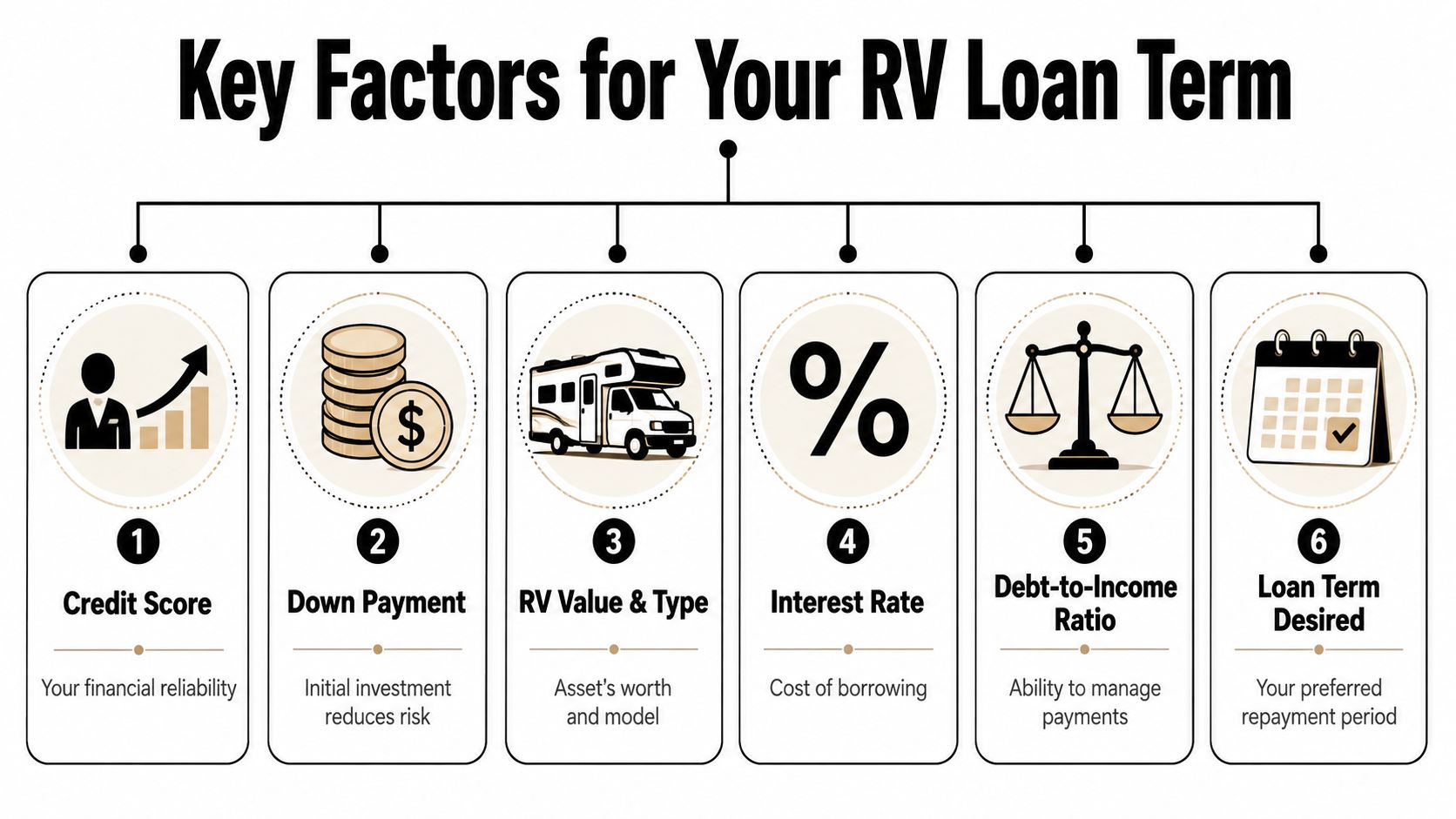
The factors that matter most
Loan eligibility and term length can shift based on down payment, credit score, loan-to-value, RV age, and whether the RV is for personal use or rental or commercial use, which may require a different type of financing, as noted by Carpenter's Campers on used RV financing terms.
Here's how that plays out.
Credit profile
Stronger credit usually opens more doors. A weaker file can still get approved, but the lender may shorten the term or ask for more money down. If you want a quick refresher on how lenders look at your file, this guide to understanding credit score calculations is useful background before you apply.Down payment size
More cash down lowers lender risk. It can also help if the RV is older or if the borrower wants a longer term than the file would otherwise support.Loan-to-value
This is one of the most important pieces buyers overlook. If the amount financed sits too close to the RV's value, lenders get cautious fast.RV age and condition
Newer collateral is easier for lenders to underwrite. As the RV ages, financing usually gets tighter.Use case
Personal camping use and rental use aren't the same thing. If you plan to rent the unit out, standard recreational financing may not fit.
What buyers in Utah should pay attention to
If you're shopping used inventory, the details matter more than people think. Two trailers with similar floorplans can land very different financing offers because one is newer, cleaner, and easier collateral.
That's one reason buyers spend time researching older inventory before they commit. If you're comparing pre-owned options, our guide on how to buy a used RV near you can help you think beyond the sticker price.
A used RV can still be a smart buy. You just need to match the RV's age, condition, and intended use to a realistic loan structure.
A lot of first-time buyers assume the lender is judging them alone. That's not how this works. The lender is judging the full package: borrower, down payment, collateral, and purpose.
The Big Trade-Off Monthly Payments vs Total Cost
This is the part buyers need to understand before they sign anything. A longer term lowers the payment. It also keeps you in debt longer and increases the amount of interest you'll pay over the life of the loan.
That trade-off isn't minor. It's the central decision in RV financing.
According to Good Sam's guide on RV loans and financing, RV loans can run from 5 to 20 years, but RVs depreciate quickly and longer terms can leave buyers upside down for years. That same guidance notes that some buyers on 20-year terms may spend 3 to 5 years paying mostly interest before the principal meaningfully declines.
Why the lower payment can fool you
A long term can make an expensive RV look manageable. That's the trap.
If you're focused only on the monthly payment, stretching the loan may feel like a win. But if you plan to trade in a few years, that same loan can leave you with weak equity or negative equity. Then your next purchase gets harder, because the old balance has to be dealt with first.
Here's a simple comparison using the sample scenario requested.
| Loan Term | Monthly Payment | Total Interest Paid | Total Loan Cost |
|---|---|---|---|
| 10 years | Lower than a shorter term, but higher than longer options | Lower than longer terms | Lower than longer terms |
| 15 years | Lower monthly payment than 10 years | Higher total interest than 10 years | Higher total cost than 10 years |
| 20 years | Lowest monthly payment | Highest total interest | Highest total loan cost |
The math direction is what matters here. The longer you stretch the term, the more expensive the RV becomes overall.
Why being upside down matters
Being upside down means you owe more on the loan than the RV is worth. That becomes a problem when:
- You want to trade early and the payoff is higher than the trade value.
- You need to sell because plans changed, but the sale won't clear the loan.
- The RV depreciates faster than your balance drops in the early years.
- You financed for comfort instead of financing for ownership strategy.
If you think you might upgrade in a handful of years, don't choose a loan term like you'll keep the RV forever.
That's one reason we tell first-time buyers to treat the monthly payment as only one number, not the whole story. You also need to think about exit options.
If you're trying to lower the long-run cost after you buy, some of the same ideas in Velzee auto loan advice apply here too, especially around paying extra toward principal when your budget allows.
My opinion as a finance advisor
If you need a very long term just to make the payment work, the RV is probably too expensive for your current budget.
That doesn't mean you should give up. It usually means one of three better moves:
- Buy a less expensive RV
- Put more money down
- Choose a term that still fits your real ownership timeline
A comfortable payment matters. But total cost and equity matter more than most buyers realize.
How to Choose the Right RV Loan Length for You
The right loan term isn't the longest one you can get. It's the one that matches your budget, your ownership timeline, and the kind of camping life you plan to have.

Start with your real monthly budget
Don't build your budget around the maximum loan payment a lender says you can handle. Build it around what your life says you can handle.
For Utah buyers, that means leaving room for things like:
- Insurance and registration
- Winter storage if you don't have space at home
- Seasonal maintenance and battery care
- Tires, brakes, bearings, and roof upkeep
- Fuel and campground costs for longer trips
If your payment already eats the whole fun budget, the RV won't feel relaxing for long.
Match the loan term to your ownership plan
A lot of buyers say they'll keep the RV “for a long time,” but their behavior says otherwise. Families often upgrade once the kids' needs change. Couples sometimes move from a trailer to a motorhome. Some buyers realize after a few trips that they want bunks, a slide, a bigger tank setup, or easier towing.
Ask yourself this plainly:
- Will we likely keep this RV for many years?
- Are we testing the lifestyle or fully committed to it?
- Would we want to trade if our camping style changes?
If you expect to change RVs sooner rather than later, a stretched-out term can box you in.
Smart approach: Choose the shortest term you can comfortably afford, then keep enough monthly breathing room that RV ownership still feels enjoyable.
A useful middle ground for many buyers is a moderate term that keeps the payment reasonable without pushing the balance decline too slowly.
Here's a good walkthrough on how loan choices affect ownership decisions:
Leave yourself an exit strategy
One practical move is taking a term that gives you flexibility, then paying extra principal when you can. That way you're not locked into an aggressive mandatory payment every month, but you can still work the balance down faster.
This only works if you do it.
If your plan is “we'll just pay extra later,” be honest with yourself. Some buyers do. Many don't. If you know you prefer fixed discipline over optional discipline, pick the shorter term upfront.
Financing Your Adventure with Motor Sportsland
The RV lending market is big, and that matters to buyers because it means financing isn't some side note. The RV Industry Association reported over $15.5 billion in RV wholesale loan volume in 2024, and average new RV loan APRs were around 7.53%, according to the RVIA lender experiences survey.
Why lender access matters
When rates and terms vary by borrower, collateral, and loan size, one lender's answer isn't enough. A strong lender network gives you a better shot at finding a structure that fits the RV you want and the way you plan to use it.
That's the practical value of dealer-arranged financing. You're not guessing whether one bank's offer is “good enough.” You're comparing.
If you want to understand the options before filling out paperwork, our overview of RV financing options is a solid place to start.
What I recommend first-time buyers do
Come in with a target budget, not just a target payment. Bring basic income and housing information. Be honest about whether you want new or used, and whether you're likely to keep the RV for a long time or trade sooner.
At Motor Sportsland, buyers can use dealership financing support as one option to compare lenders, review term scenarios, and line up a purchase with the RV they're considering. That's useful because the right term on the wrong RV still isn't a good deal.
The financing process gets much easier when you decide your ownership plan before you shop, not after.
That's how you avoid getting emotionally attached to an RV that only works on paper.
Your Next Adventure Starts with a Smart Plan
The right RV financing length balances two things that pull against each other. You want a payment that fits your life, and you want a loan that doesn't trap you in slow equity and high total cost.
My advice is simple. Don't chase the lowest possible payment without thinking about how long you'll keep the RV and what your budget will look like after storage, maintenance, and travel costs hit. A term that feels comfortable and realistic usually beats the longest term available.
If you're still deciding when to shop, our guide on the best time to buy an RV can help you line up pricing, inventory, and planning. Then browse inventory on our site or stop by our Salt Lake City area showroom and talk through the numbers with someone who'll give you a straight answer.
Frequently Asked Questions About RV Loans
Can I finance a used RV for as long as a new one
Sometimes, but not always. Older RVs often get shorter terms because lenders view them as riskier collateral.
Is a longer RV loan always a bad idea
No. It can make sense if it keeps the payment comfortable and you plan to keep the RV long enough to justify it. It becomes a problem when the long term hides an RV that's outside your real budget.
Should I focus more on monthly payment or total cost
Both matter, but total cost deserves more attention than most buyers give it. A low payment can still be an expensive deal.
What if I want to upgrade later
Then be careful with a very long term. If you trade early, slow equity growth can work against you.
Does a bigger down payment help
Yes. It can improve the structure of the deal, reduce lender risk, and make the loan easier to manage over time.
If you're ready to compare RV loan options, browse inventory, or talk through a realistic payment plan, visit Motor Sportsland. Our team can help you sort through terms, used versus new options, and the kind of RV that fits the way you want to travel in Utah.
