
RV Dealerships Near Me: A Utah Buyer's Guide
You're probably searching “RV dealerships near me” after seeing a trailer online, checking the tow rating on your truck, and realizing the closest lot may be only part of the decision. In Utah, the dealership you choose can affect far more than the purchase appointment. It can determine how easily you handle warranty work, winter storage, parts orders, brake inspections, and the repairs that follow mountain roads, dusty desert campsites, and long highway miles.
A nearby lot is convenient, but convenience alone won't protect you from an overloaded tow vehicle or a slide-out problem in the middle of camping season. This guide gives you a practical way to compare local RV dealerships, inspect a unit, estimate ownership costs, evaluate financing, and judge the service department before you sign. Motor Sportsland serves Utah buyers from locations in Millcreek and Spanish Fork, but the right approach is the same whether you're comparing a large affiliated dealer, a regional group, or a small independent lot.
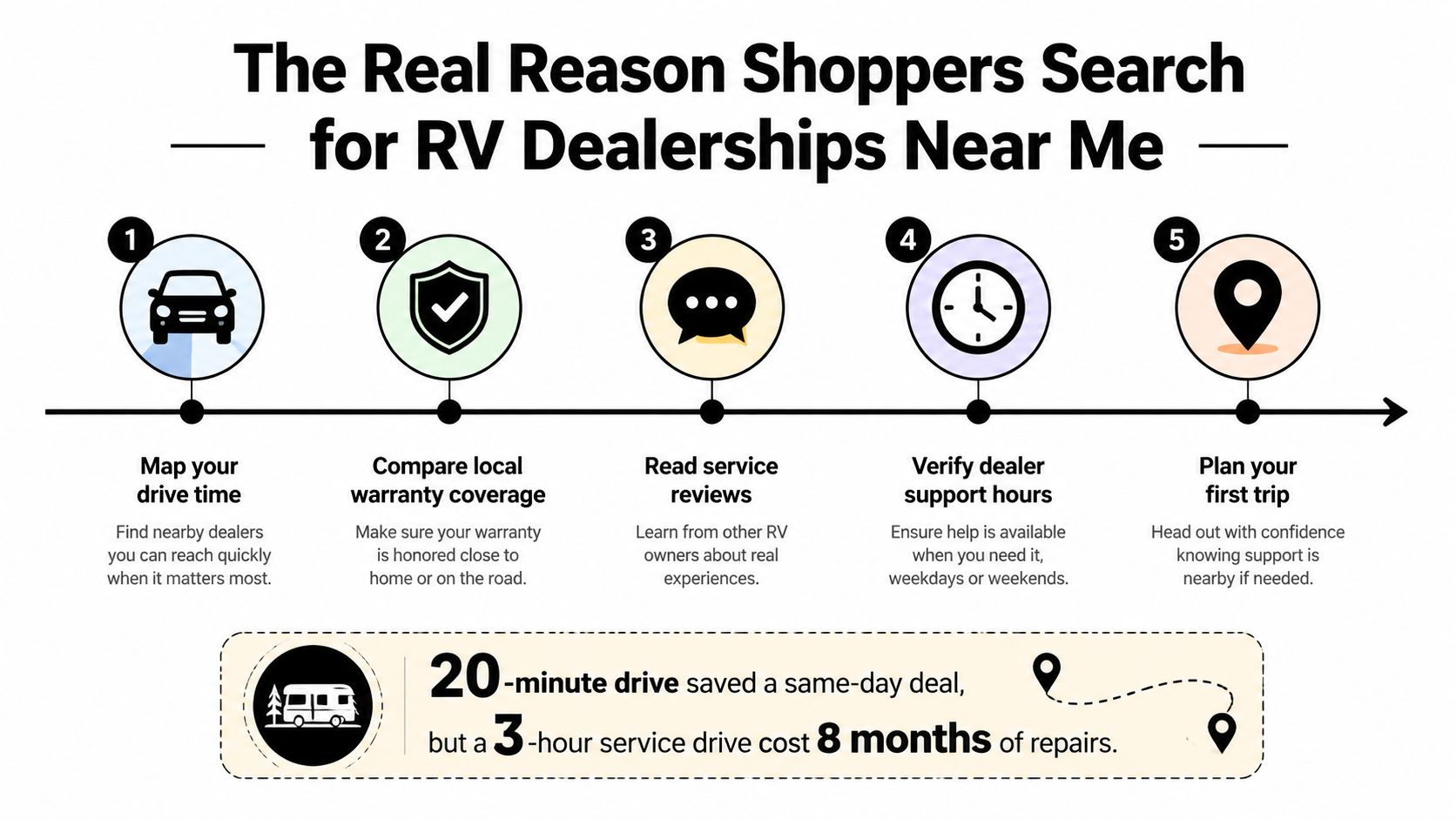
The Real Reason Shoppers Search for RV Dealerships Near Me
A couple from Draper once drove about twenty minutes to the closest RV lot, found a floorplan they liked, and signed papers that afternoon. The purchase felt efficient until warranty issues began appearing. Their original dealer stopped selling the brand, and the couple spent the next eight months chasing repairs at a shop three hours away.
That story captures the problem with choosing an RV dealership based only on distance. A short drive helps on purchase day. Long-term service access matters on every ownership day that follows.
Utah puts unusual demands on RVs. A tow vehicle that feels comfortable on flat pavement can struggle on Wasatch Mountain grades when the trailer is loaded with water, camping gear, propane, and recreational equipment. Winter storage around Heber and Park City brings freezing conditions that punish neglected plumbing, batteries, seals, and exterior components. Trips to Goblin Valley and Snow Canyon add fine dust, rough roads, and repeated setup cycles. Propane systems also work hard during alpine shoulder seasons when nights turn cold.
Practical rule: Choose a dealer by the support you can realistically use, not just by the miles shown in a search result.
Build a Utah-specific dealer map
Start with a 60-mile search radius from your home city, then adjust it for the routes you drive. A buyer in Salt Lake County may compare Millcreek, Utah County, Davis County, and Ogden along the I-15 corridor. Someone in Park City should consider I-80 access, while buyers in Provo, St. George, and Cedar City need to think about service access in relation to their regular travel direction.
Use several sources instead of trusting one listing:
- Google Maps: Compare drive time, shop photos, posted hours, and recent customer feedback.
- RVIA directories: Use dealer directories to identify established RV businesses and then verify their current operations.
- KSL Classifieds: Check both private listings and dealer transfers, but confirm who will handle title questions, inspection findings, and post-sale support.
- Utah RV and Outdoor Expo: Walk multiple dealer booths in one visit and ask direct questions about service, warranty work, and parts.
- Local camping communities: Ask owners around Pineview, Deer Creek, and Jordanelle which service departments communicate well after the sale.
The RV dealer market is widely distributed. As of January 2026, the United States had more than 8,500 RV dealerships, and the largest dealership group held only 12.6% of the overall market, according to industry market coverage of the RV retail channel. That fragmentation means your Utah search will likely include independent and regional operators, not just a national chain.
Verify the business before you drive out
Before making an appointment, confirm the dealer's state license through the Utah Division of Motor Vehicles. Check the physical address in satellite view to make sure the business has a genuine sales lot and service operation, then read reviews from the last ninety days on Google and the Better Business Bureau.
Call before you leave home. Ask whether the advertised brand is currently franchised, whether the specific unit is physically on-site, and whether the service department accepts warranty work for that brand. You can also use this Salt Lake City RV dealer guide to compare local search considerations before narrowing your list.
A dealer that answers those questions clearly has already passed the first test. A dealer that can't confirm its brands, address, or warranty process isn't worth the drive, even if it's close to home.
Independent Lots vs Regional Groups vs Manufacturer-Affiliated Dealers
Utah buyers usually encounter three dealership models. None is automatically right for every buyer, but each creates a different balance between price, selection, warranty access, and continuity.
| Factor | Independent Lot | Regional Group | Manufacturer-Affiliated |
|---|---|---|---|
| Inventory | Often focused on used or lower-cost units | Multiple brands across locations | Brand-specific new and used inventory |
| Pricing | May show lower front-end pricing | Can have stronger purchasing leverage | May carry slightly higher front-end pricing |
| Warranty authority | Often relies on the manufacturer or outside service | Depends on location and brand relationships | Factory-authorized warranty process |
| Parts access | Can vary considerably | Broader access across locations, but policies vary | Brand-specific parts and factory systems |
| Best fit | Price-focused buyers comfortable with more responsibility | Buyers wanting variety and multiple locations | Buyers prioritizing structured support after delivery |
Independent lots
An independent lot can be a good fit if you know exactly what you're inspecting and you're comfortable arranging repairs yourself. These dealers may offer older inventory or lower advertised prices, but financing can come through a narrower lender group. Warranty claims may also depend heavily on the manufacturer's response and the availability of an authorized shop.
That matters for a buyer in Brigham City or another market where the service network is thin. A lower purchase price loses some appeal if every warranty question becomes a long-distance coordination problem.
Regional groups
Regional groups can offer more brand variety and stronger negotiating power. They may move parts between locations and provide more than one service address, which helps buyers who travel across Utah. The risk is organizational consistency. A corporate policy can change, or a department can close, without the local sales team having much control over it.
Ask how warranty records transfer between locations, whether a different branch will honor an open repair order, and who owns communication when a part is delayed.
Manufacturer-affiliated dealers
A manufacturer-affiliated dealer generally has factory warranty authority, brand-specific training, and access to the manufacturer's parts and repair procedures. That structure can simplify ownership when your RV needs work involving a specific chassis, appliance, slide system, or roof component.
The tradeoff may be a higher initial price than an independent listing. I'd consider that a service decision, not merely a price decision. If you're buying a new coach, towing through the Wasatch Mountains, or planning to keep the RV for years, dependable support can matter more than shaving the smallest amount off the front end.
Read the lot like a buyer, not a browser
Walk the rows before you judge the sales pitch. A lot heavy in single-axle travel trailers usually serves weekend campers and entry-level buyers. A broad mix of bunkhouses, toy haulers, four-season coaches, fifth wheels, and motorhomes tells you the team works with more varied ownership plans.
Look for floorplans that match Utah use:
- Bunkhouses: Practical for families traveling to Bear Lake or Utah state parks.
- Toy haulers: Useful when motorcycles, ATVs, or other powersports equipment is part of the trip.
- Rear kitchens: Comfortable for longer stays and basecamps near Moab.
- Outdoor kitchens: Convenient for family camping, but they still need protection from dust and winter exposure.
- Fifth wheels and motorhomes: Better suited to buyers prioritizing space, longer trips, or residential comfort.
New model year units beside prior-year inventory can indicate active turnover or aging stock. Sections marked Owner's Picks or Staff Favorites can also reveal whether the sales team matches floorplans to lifestyles instead of just presenting the newest arrival.
Pre-Purchase Inspection Workflow That Actually Catches Problems
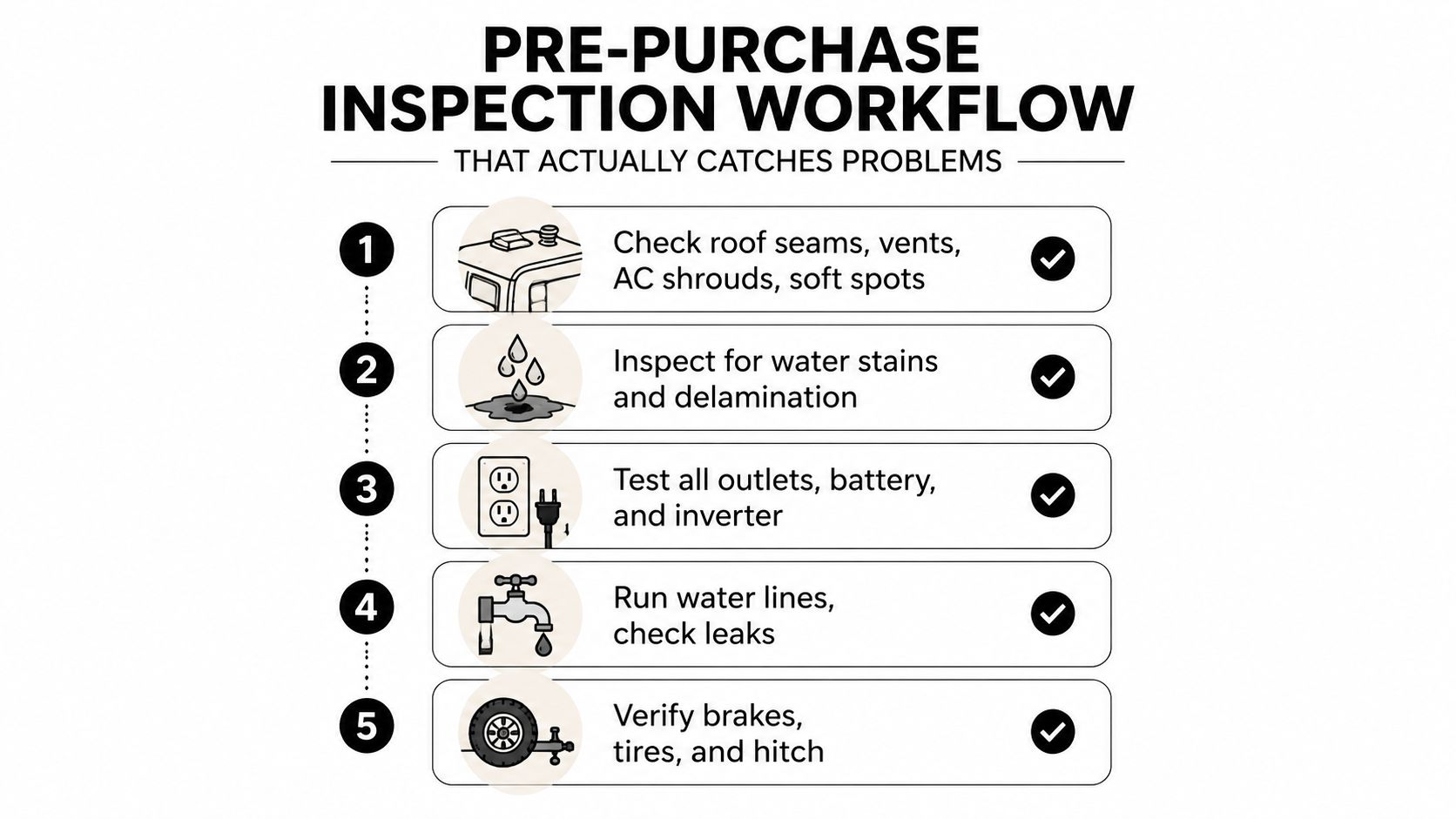
Don't begin with the upholstery. Start with systems that can strand you on I-15 or create a safety problem on a canyon road.
Independent RV inspection reporting found 20% of inspected units had life-safety issues, including detector failures, gas-line repairs, or hot-skin problems. The same reporting found 35% had major functional issues, such as appliances or systems failing to operate as designed, according to RV inspection reporting from NRVIA.
Use this order:
- Roof first: Check seams, vents, air-conditioning shrouds, and soft spots. Water intrusion can spread behind ceilings and walls.
- Water evidence: Search for stains, delamination, swelling, and musty areas around windows, slides, roof transitions, and plumbing fixtures.
- Electrical systems: Test outlets, batteries, inverter operation, lights, detectors, and shore-power functions.
- LP gas and appliances: Run the refrigerator, furnace, water heater, stove, and oven on the available power sources. Don't assume a clean interior means a healthy system.
- Slides and plumbing: Cycle every slide twice. Run faucets, flush the toilet, operate the shower, and check visible connections for leaks.
- Road safety: Inspect tires by age stamp rather than tread alone. Check brakes, bearings, suspension, hitch components, frame condition, and holding-tank mounts.
- Records and technician walkthrough: Review recalls, roof reseals, axle service, and prior repairs. Ask a technician, not only a salesperson, to complete the final systems orientation.
A low-mileage RV can still have hidden defects. Before signing, put every deferred repair, promised part, and warranty commitment in writing. For more detail on evaluating pre-owned units, use this guide to buying a used RV near you.
Total Cost of Ownership in Utah Beyond the Monthly Payment
The monthly payment is only one line on the ownership sheet. Before you compare RV dealerships near me, write down the costs that follow you after delivery: storage, insurance, registration, winterization, propane, routine service, tires, and campground stays.
Utah ownership is especially seasonal. A unit stored near Salt Lake City needs different preparation than one used year-round in St. George. A motorhome driven through mountain grades also deserves a different maintenance plan than a lightweight trailer used occasionally on paved roads.
Recent industry commentary notes that fuel, insurance, maintenance, storage, campground fees, and financing can push annual RV ownership costs into five figures, while affordability and interest rates remain major buyer concerns in 2026. See this 2026 RV ownership cost discussion before treating a payment estimate as your full budget.
Don't use the following table as a quote. Use it as a checklist of questions for your dealer, insurer, storage facility, and service provider.
| Expense Category | Typical Utah Range | Frequency |
|---|---|---|
| Indoor heated storage | $150 to $400 monthly | October through April |
| Outdoor covered storage | $75 to $150 monthly | Seasonal or annual |
| Registration | About 1.5% of assessed value | At registration and renewal |
| Winterization | $200 to $350 | Annually if professionally completed |
| Propane | $4 to $5 per gallon | As needed during cold-weather use |
| Routine service and tires | $500 to $1,000 | Yearly service budget, with tires every three to five years |
| Campgrounds | $50 to $80 per night | Per night used |
The buyer who understands the whole budget can choose the right length, weight, and floorplan. That person is less likely to keep an oversized RV that sits unused because storage and operating costs became uncomfortable.
Financing, Trade-Ins, and Down Payment Targets That Work
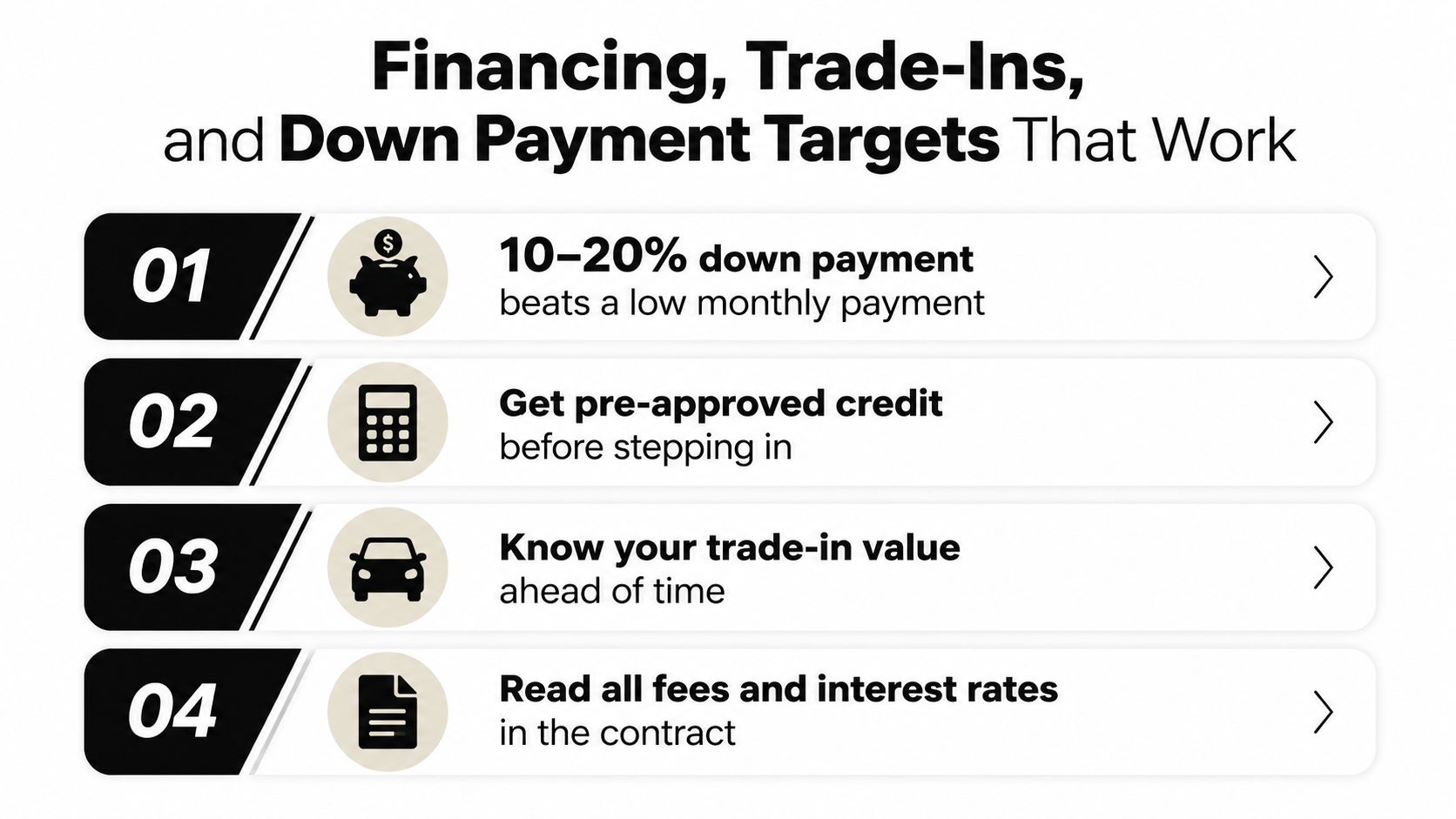
Start financing before you fall in love with a floorplan. A lender pre-approval gives you a realistic ceiling and lets you compare the RV price separately from the payment.
For RV transactions, lender-survey data cited by the RV industry placed the average retail indirect down payment at 17.6%, while an earlier survey placed it just under 22%, according to the RVDA and NRVIA financing packet. I'd prepare for a 20% down-payment target when possible, then compare the payment against depreciation and your expected ownership period.
Bring:
- Income documentation: Recent proof of income and employment information.
- Debt picture: A clear view of existing monthly obligations.
- Insurance information: Quotes for the motorhome or the tow vehicle and trailer combination.
- Trade records: Title, payoff information, service records, and details about existing damage.
- Personal identification: The documents your lender requires for the credit application.
A long loan term can make an expensive RV appear affordable on paper. It also gives depreciation more time to create an equity gap. RVs generally lose value quickly in the first year and continue declining until about five years old, according to Progressive's explanation of RV depreciation.
Contract habit: Negotiate the out-the-door price, trade allowance, interest rate, and optional products as separate decisions.
Dealer-arranged financing can be convenient and may provide access to RV-specific lenders. An outside bank or credit union may offer a useful comparison. Get both options, then read the complete contract for rate, term, fees, warranty products, and GAP coverage. Don't let an extended service contract disappear inside a payment you never calculated independently.
Use this RV financing options guide to organize the conversation before you visit a dealership. Pre-approval doesn't commit you to a purchase. It keeps the payment conversation from controlling the entire negotiation.
Service, Parts, and Repair Turnaround After You Sign
A dealership's service department is part of the product. That's especially true in Utah, where mountain towing, dust, cold storage, and seasonal use put stress on brakes, seals, suspension, plumbing, and electrical systems.
Industry service coverage reported that average repair cycle times improved from about 34 days in 2024 to 31 days in 2025 and 27 days in July 2026. Repairs waiting on an out-of-stock part still averaged about 45 days, while warranty-related repairs averaged about 36 days, according to reported RV repair cycle data.
| Service Type | Peak Season, May to September | Off-Peak, October to April |
|---|---|---|
| General repair | Demand can extend scheduling and completion | Often easier to schedule |
| Parts-dependent repair | About 45 days when a part is out of stock | Still controlled by factory availability |
| Warranty-related repair | About 36 days on reported averages | Often more manageable outside the camping rush |
| Winterization | Limited demand | Best time to reserve a seasonal appointment |
| Brake, tire, and suspension checks | Schedule before major trips | Good time for preventive work |
Ask whether the shop has technicians trained for the brands it sells, whether factory parts are ordered directly, and what alternatives are used when a component is unavailable. Find out whether the dealership offers a shuttle, loaner arrangement, status updates, and a clear process for safety-related repairs.
You should also ask to see the service area before purchase. Read reviews for repeated patterns, not one angry comment. Owners who mention missed calls, unclear estimates, or unresolved warranty claims are telling you something important about the ownership experience.
A capable department won't promise an impossible completion date. It will explain what has been diagnosed, what parts are pending, what work is safety-critical, and when you'll receive the next update.
Your Next Steps and How Motor Sportsland Fits In
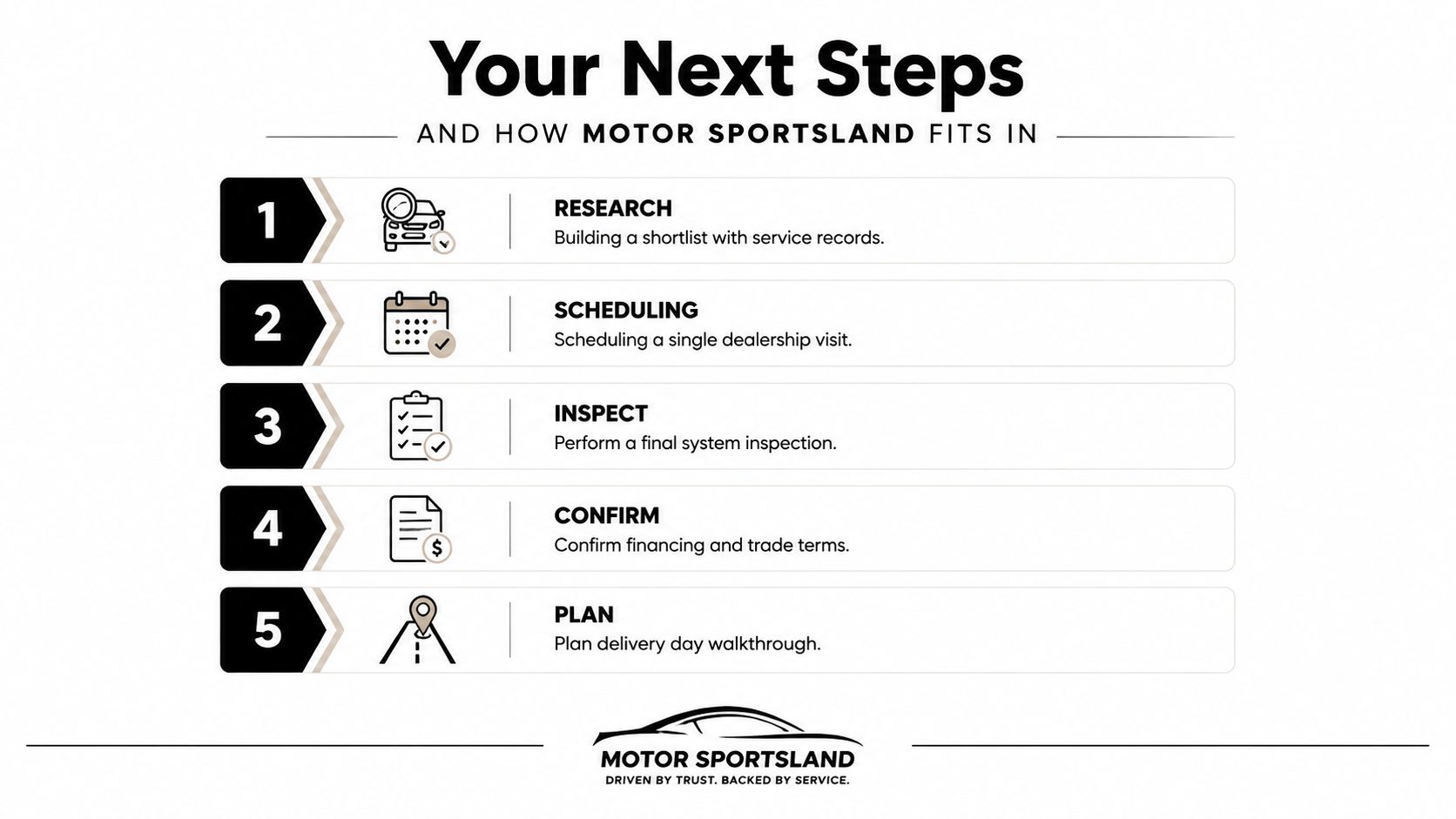
Treat the search as a short qualification process rather than an endless inventory scroll.
Build a shortlist
Choose a few units that fit your tow vehicle, passenger count, storage situation, and Utah travel plans. Compare unloaded weight, loaded capacity, hitch requirements, length, sleeping layout, and access to the systems you'll maintain.
A family heading to Bear Lake may prioritize a bunkhouse and usable storage. A couple traveling through the Wasatch Mountains may care more about braking, cargo capacity, climate control, and a floorplan that remains comfortable during longer stays. A toy hauler buyer should account for cargo weight before deciding that a rear garage solves every storage problem.
Schedule one serious dealership visit
Call ahead and ask the salesperson to have the specific units accessible. Bring your tow vehicle information, a measuring tape, a flashlight, and a written inspection list. A productive visit should include a walk-through, a hitch and weight discussion, a test drive when appropriate, and a clear explanation of service and warranty procedures.
Motor Sportsland offers new and used RV inventory across categories including travel trailers, fifth wheels, toy haulers, folding campers, destination trailers, and Class A, B, and C motorhomes. Its Utah locations provide sales, service, and parts support, and buyers can filter inventory by weight, length, price, floorplan, and features.
Complete the numbers before delivery
Secure pre-approval, obtain insurance information, confirm your trade payoff, and request the complete out-the-door figure. Review every fee and optional product before you arrive for signing. If you're storing the unit through winter, ask the service department about battery care, plumbing protection, roof checks, and pickup scheduling.
RV batteries should be fully charged before storage, disconnected or removed when possible, and recharged every three months, according to Camping World's RV battery maintenance guidance. Another winter-storage guide recommends checking voltage every 30 days and recharging below 75% state of charge, with a smart maintainer preferred for long-term storage, as described by HHS Energy's battery storage guidance. For lithium batteries, Go RVing advises that proper storage should result in a charge drop of only about 2% to 3% per month, with recharge recommended below 50% according to its winter storage guide.
Frequently asked questions
How far should I drive for the right RV dealer?
Drive far enough to find a dealer with the inventory, warranty authority, parts support, and service access your RV requires. A longer drive can make sense if the dealership is still reachable for scheduled repairs and seasonal maintenance.
Is off-season shopping better in Utah?
It often gives you more time for a careful inspection and a less crowded service conversation. Winter is also a useful time to ask how the dealership handles storage, battery maintenance, winterization, and spring pickup appointments.
Can a dealership service department handle mountain-driven wear?
Ask specifically about brake inspections, tire condition, bearings, suspension, hitch components, and cooling systems. A service department that understands Utah canyon and mountain travel should explain what it checks after demanding trips instead of treating every unit like a flat-road commuter vehicle.
What paperwork should I bring to a Salt Lake City financing appointment?
Bring identification, proof of income, current debt information, insurance details, trade title or payoff information, and service records for the trade. Having those documents ready makes it easier to compare terms without guessing.
Should I buy from a smaller independent dealer or a larger affiliated dealer?
Choose the independent route when you're comfortable managing inspection, warranty coordination, and parts questions yourself. Choose an affiliated dealer when factory-authorized support, winter storage planning, and predictable seasonal service access matter more than the lowest initial price.
How should I prepare an RV battery for winter storage?
Fully charge it first, disconnect or remove it when practical, and follow the battery manufacturer's storage instructions. Check it regularly during storage rather than assuming a parked RV is maintaining itself.
Motor Sportsland offers new and used RVs, financing, trade-ins, parts, and service from its Utah locations in Millcreek and Spanish Fork. Stop comparing RV dealerships near me by distance alone, and visit Motor Sportsland to review current inventory, talk through your Utah travel plans, and schedule a service or sales appointment with a team that can support the ownership after delivery.
