
How to Sell an RV in Utah: A Complete 2026 Guide

Selling an RV in Utah usually starts the same way. The kids are older, your camping style changed, or that trailer that was perfect for Bear Lake and Jordanelle a few years ago now feels too small, too big, or just underused. You look at it in the driveway and think, “I should probably sell this thing.” Then the question hits. Sell it yourself, trade it in, or hand it off on consignment?
That decision matters more than most sellers think. Price matters, of course. Photos matter too. But the path you choose changes everything from how much time you'll spend answering messages to how much risk you're taking with paperwork, payment, and no-show buyers. A lot of generic advice online skips that part.
Utah sellers are in a strong category. One 2025 industry summary reports that 8.1 million U.S. households currently own an RV, while 16.9 million say they plan to buy one within the next five years, which points to a large active buyer pool for sellers trying to move a used rig (industry summary on RV ownership and purchase intent). That's the good news. The harder truth is that a big market doesn't guarantee an easy sale. You still need the right prep, the right price, and the right selling method.
Our team in Salt Lake City has watched plenty of owners leave money on the table by overpricing clean units, hiding obvious issues, or choosing a private sale when a trade-in would've been the smarter move. If you want the definitive playbook for how to sell an RV in Utah, start here.
Your First Step to a Successful RV Sale
Stop thinking about the sale as “posting an ad.” Start thinking about it as presenting a used vehicle for inspection by skeptical buyers. That mindset fixes most seller mistakes immediately.
The first job is simple. Get your RV into sale condition before you talk about price. Empty every cabinet, remove personal gear, clean out storage bays, wipe down every surface, and wash the exterior properly. Buyers don't separate condition from cleanliness. If the rig looks neglected, they assume the roof, tires, appliances, and maintenance history were neglected too.
What we tell Utah sellers to do first
A smart pre-sale routine looks like this:
- Deep clean everything: Wash the roofline, awning area, exterior caps, windows, shower, galley, mattresses, and cargo compartments.
- Fix the cheap obvious stuff: Replace burned-out bulbs, cracked vent covers, missing trim, torn screen material, and sticky latches.
- Test every system: Run the slides, furnace, A/C, water pump, water heater, refrigerator, jacks, generator if equipped, and all major lights.
- Gather your paperwork: Pull together the title, lien information if any, owner's manuals, service receipts, warranty info if transferable, and upgrade records.
- Check for Utah-specific wear: Sun-faded decals, cracked sealant from dry summers, and signs of winter storage damage all deserve attention.
Practical rule: If a buyer can spot a problem in the first five minutes, fix it before the listing goes live.
Price after prep, not before
Too many owners pick a number based on what they owe or what they wish it was worth. That's not how used RV pricing works. Market value comes first. Your payoff balance is your problem, not the buyer's.
That's especially important because a 2025 selling guide says new RVs lose 15% to 30% of their value in the first year, and most lose 36% to 38% over the first five years. The same guide says more than 85% of buyers begin their search online, which is why realistic pricing and strong digital presentation are essential (RV pricing and online search behavior).
If you're serious about learning how to sell an RV without wasting a season, accept depreciation early. Sellers who fight it usually end up chasing the market down.
Prepare and Price Your RV for the Utah Market
Utah buyers notice condition fast. They've seen units stored in snow, towed through mountain passes, and parked in dry summer sun. A vague “everything works great” description won't carry much weight here. You need a clean rig, a believable story, and paperwork that backs up your asking price.
Prep like a dealership, not like a weekend seller
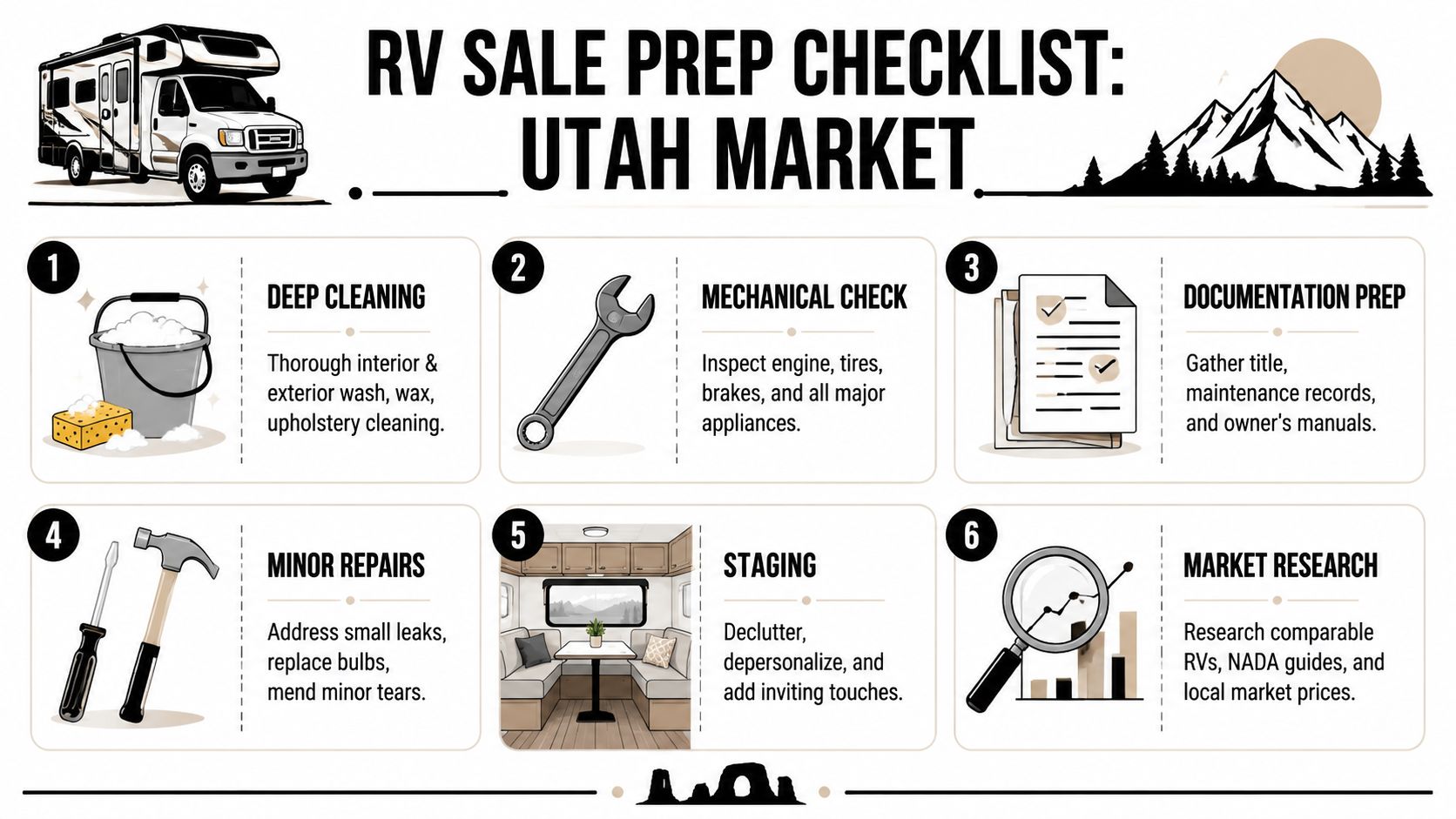
Here's the checklist we'd use before putting a unit in front of buyers:
- Start with the exterior: Oxidized fiberglass, black streaks, dirty wheels, and mildew around seals make buyers think “deferred maintenance.”
- Move to the roof and sealants: Any cracked lap sealant, soft spots, or suspicious staining needs attention before listing.
- Open every compartment: Buyers will. Clean them now and photograph them later.
- Make the interior feel neutral: Remove family photos, pet gear, pantry clutter, and random cords. You're selling space as much as equipment.
- Organize the paper trail: A neat folder with service history carries real weight. It answers questions before they turn into objections.
If the rig needs cosmetic help, even sellers outside the auto world can learn a lot from this guide on professional detailing for better resale. The principle is the same with RVs. Clean, corrected surfaces and a fresh interior change buyer perception before anyone talks numbers.
Price from market guides, then adjust for reality
Use the J.D. Power RV Value Guide as your starting point and focus on the Clean Private Party value, not the fantasy number in your head. Then adjust fairly for your rig's condition, equipment, mileage if applicable, floorplan appeal, and local buyer demand in Utah.
A bunkhouse travel trailer near Salt Lake City may draw stronger family interest than a stripped-down couples coach. A toy hauler may attract buyers heading for the dunes or desert. But don't use “popular floorplan” as an excuse to overshoot the market by a mile.
Here's the blunt version. If your RV sits for weeks with little response, the price is wrong, the photos are weak, or both.
Three pricing traps that stall Utah listings
| Mistake | What sellers do | What happens |
|---|---|---|
| Emotional pricing | Price based on memories, upgrades, or payoff | Buyers scroll past |
| Soft-disclosure pricing | Ask retail money while hiding condition issues | Serious buyers lose trust |
| Hope-based pricing | Start high “to leave room” | Listing goes stale |
A better approach is simple:
- Check the guide value.
- Compare against similar units for sale in your region.
- Be tougher on your RV's flaws than you want to be.
- Leave a little room for negotiation, but not enough to make the listing look detached from reality.
For owners selling a towable specifically, our guide on how to sell a travel trailer covers some model-specific details that matter when buyers compare layouts, weights, and family features.
Clean RVs with complete records get the first calls. Overpriced RVs get saved, watched, and ignored.
Choose Your Selling Path Private Sale vs Trade-In
Most articles on how to sell an RV pretend there's one right answer. There isn't. There are three common paths, and each one fits a different seller.
The mistake is choosing based only on top-dollar potential. You should choose based on speed, effort, risk, and buyer financing reality.
RV selling options compared
| Method | Sale Price | Speed | Effort Level |
|---|---|---|---|
| Private sale | Usually highest potential | Usually slower | Highest |
| Trade-in | Usually lower than private sale | Usually fastest | Lowest |
| Consignment | Middle ground | Moderate | Moderate |
Private sale works when your time is worth less than the upside
Private sale is the path most sellers imagine first. You keep control, set the asking price, field inquiries, and negotiate directly. If the unit is clean, well-documented, and priced right, this can produce the strongest return.
It also comes with the most friction. You'll write the ad, stage the photos, answer repetitive questions, schedule showings, deal with flakes, screen for scams, and sort out whether the buyer can pay. In Utah, where rigs range from family bunkhouses to larger fifth wheels and motorhomes, financing can separate “interested” from “ready.”
That issue is bigger than many sellers realize. A market overview notes that buyer-side affordability is a major bottleneck, with 2024 wholesale shipments at 333,733 compared with a 2021 peak of 600,240, which signals a more cautious environment for sellers and helps explain why dealer-assisted options can solve financing friction more easily (RV market affordability and shipment comparison).
Trade-in is the easy button for sellers who value speed and certainty
A trade-in cuts out the hardest part of the deal. You don't need to find one retail buyer willing and able to buy your exact RV at your exact price on your exact timeline. You hand the unit over, apply the value to your next purchase if you're upgrading, and move on.
That's why trade-ins make sense for sellers with loans, busy schedules, storage pressure, or little appetite for meeting strangers in parking lots. They also make sense when the unit is harder to finance privately because the buyer pool is narrower.
If you want to see what that path looks like, get a trade value estimate. It's one way to compare the convenience trade-off against a private sale before you commit either way.
Consignment fits sellers who want help but still want retail exposure
Consignment sits in the middle. You keep some upside compared with a trade-in, but you hand off a lot of the listing, showing, and sales process. That can work well for owners who don't want the hassle but aren't in a rush.
The downside is simple. You still won't control timing completely, and your RV has to compete with other inventory.
If you need every possible dollar and can handle the work, sell privately. If you need the sale wrapped up cleanly, trade-in usually wins.
Create an RV Listing That Attracts Serious Buyers
A weak listing doesn't just lower your price. It attracts the wrong people. You get messages from shoppers who didn't read the details, buyers who can't afford the rig, and curious browsers who want a campsite tour instead of a transaction.
The fix is a listing that answers real questions before they're asked.
What a strong listing includes
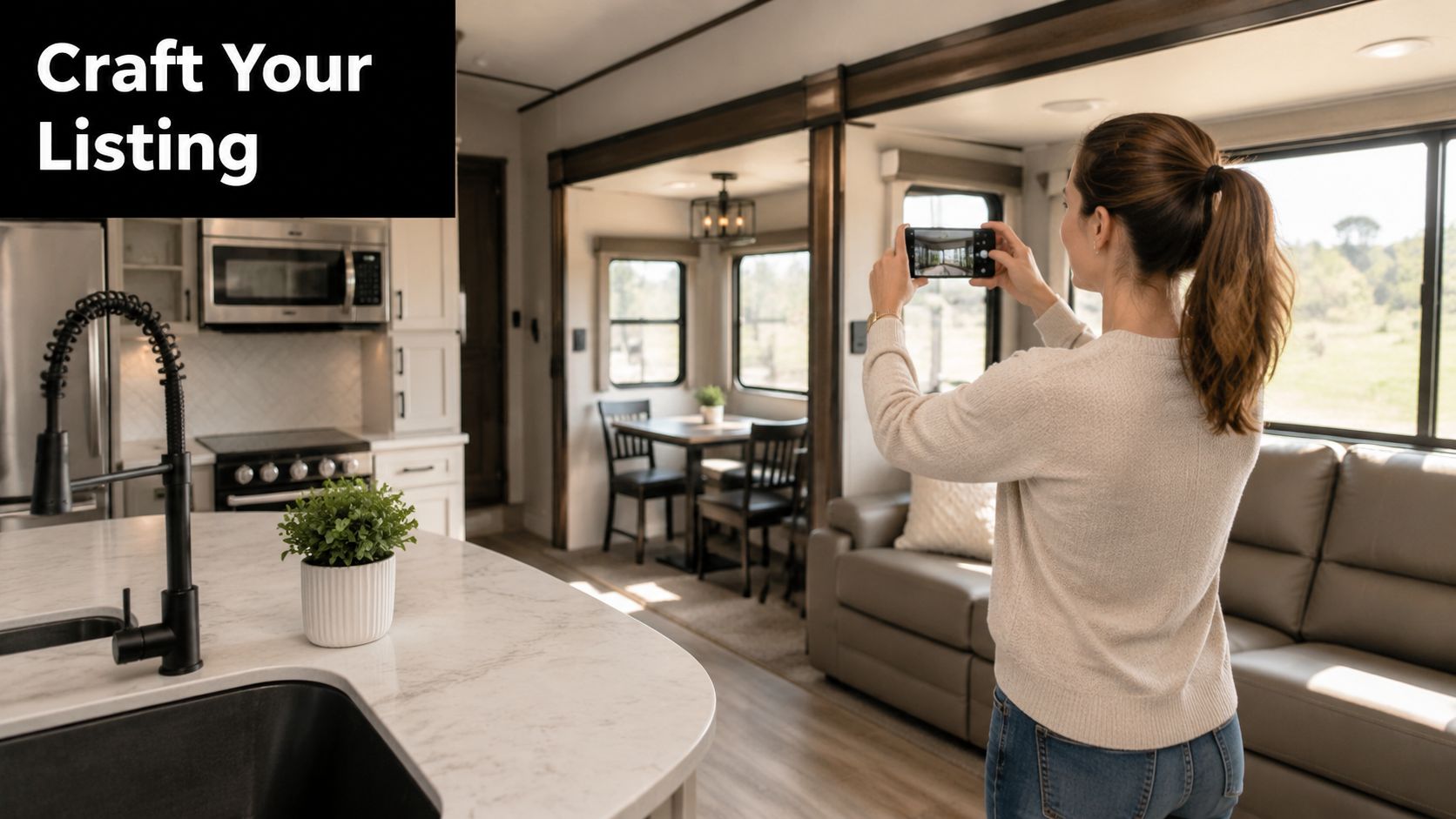
The best private-sale ads on KSL Classifieds, RV Trader, and local Utah groups all do a few things well:
- Lead with the essentials: Year, make, model, length or class, floorplan type, and sleeping setup.
- Show the full coach: Exterior on all sides, hitch or front cap, tires, roof edges if practical, living area, kitchen, bath, bunks, bedroom, storage, and control panels.
- Describe actual ownership history: Say how you used it, where it was stored, and what maintenance was done.
- Disclose known issues plainly: Water intrusion history, soft flooring, seal repairs, appliance quirks, cosmetic damage, or wear from mountain travel.
- Include paperwork mentions: Title status, lien status, manuals, service records, and upgrade receipts.
The listing story buyers believe
A good ad reads like this: clean title, stored covered or properly winterized, systems tested, service records available, known flaws disclosed, ready for inspection.
A bad ad reads like this: “Must sell. Great camper. Everything works. Serious inquiries only.”
Those two listings don't attract the same buyer.
The timing matters too. The optimal private-sale window is late January through March, and failing to disclose latent structural defects is a common pitfall that reduces sale success rates by approximately 40%. That's why honesty in the ad isn't just ethical. It's practical.
Buyers forgive wear. They don't forgive surprises.
A Utah showing story worth learning from
We've seen this play out the same way many times. Seller A lists a bunkhouse trailer with bright exterior photos, clean dinette and bunks, clear maintenance notes, and one line that says the rear corner had a prior seal repair with no current leak. Buyer shows up informed, asks better questions, and stays focused.
Seller B posts six dark photos, hides a stained slide corner, and says “no issues.” Buyer arrives, spots the problem in three minutes, and the whole showing turns into suspicion.
That's the difference between marketing and self-sabotage.
If you want to show buyers how your systems work before they drive across the valley, add a simple walkaround video. A quick format like this helps:
Navigate Showings and Negotiations Like a Pro
Private showings are where a lot of sellers lose control. They let strangers dictate the schedule, tolerate vague “still interested” messages, and start negotiating before the buyer has even seen the rig. Don't do that.
Screen buyers before they get your address
Use a few direct questions before you set a showing:
- Are you paying cash or arranging financing?
- Have you towed or owned this type of RV before?
- When are you looking to buy?
- What specific floorplan or features matter to you most?
- Do you understand the tow vehicle requirements if it's a trailer or fifth wheel?
You're not being rude. You're filtering for readiness.
Meet in a public, well-lit place when possible. If the RV is stored at home, don't invite someone over until they've answered basic questions and confirmed a real appointment. For motorized RVs, verify the driver's license before any test drive. For towables, don't let someone hook up and “just see how it pulls.”
Run the showing like an inspection, not a casual tour
Walk the buyer through the exterior first. Then show storage, utility hookups, roofline condition if visible, and only then move inside. Turn on the lights. Run the slides. Demonstrate the fridge, A/C, furnace, water system, and awning if conditions allow.
Keep the conversation factual. If there's an old repair, say so. If a cushion has wear, point it out. Confidence comes from being open, not from acting like a salesman.
Negotiate with boundaries
Set your bottom line before the showing. Not during it.
When the buyer makes a lower offer, don't fill the silence with discounts. Ask what they're basing it on. If the concern is valid, respond to that issue. If it's a lazy lowball, stay polite and hold your ground.
A simple approach works:
- Thank them for the offer.
- Restate the unit's condition and included records.
- Counter once if you want to keep the deal moving.
- Stop negotiating against yourself.
If the buyer wants a decision “right now” but won't put down a deposit or commit to secure payment, they're not serious enough yet.
Secure Payment and Finalize the Utah Title Transfer
Sellers get burned. Not in the listing. Not in the showing. At the finish line.
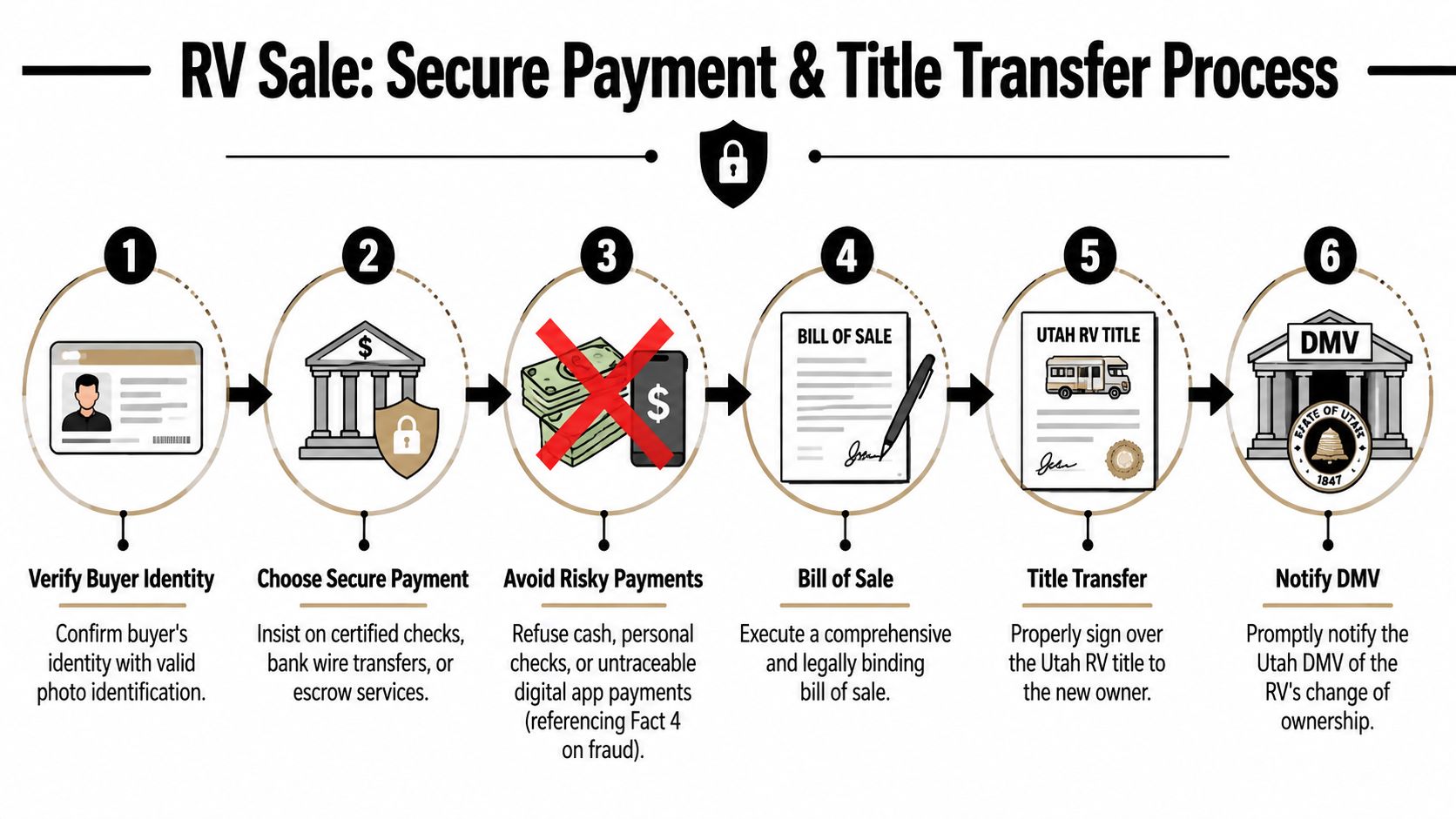
Fraud via fake wire transfers or personal checks accounts for nearly 30% of failed private-deal attempts, and skipping a formal bill of sale leads to a 60% higher likelihood of post-sale legal disputes. The safe standard is a verified wire transfer or cashier's check. Anything looser than that creates unnecessary risk.
Accept only payment methods you can verify
Here's the policy I'd follow every time:
- Use a bank-verified wire transfer: Confirm receipt before releasing keys, title, or possession.
- Or meet at the buyer's bank for a cashier's check: Watch it get issued if possible.
- Reject personal checks: They create too much exposure.
- Be careful with “proof” screenshots: A screenshot is not cleared funds.
- Don't release the RV on promises: No exceptions.
If the buyer needs help understanding financing steps or purchase paperwork, a practical explainer like this RV purchase agreement guide can help them understand what should be documented before money changes hands.
Don't hand over the RV because payment “should clear soon.” Wait until it has cleared.
Utah paperwork you should handle carefully
For a Utah sale, you need to complete the title assignment correctly and create a detailed bill of sale. Include the VIN, make, model, odometer reading if applicable, sale date, sale amount, and signatures. You should also document any lien payoff arrangements clearly if a lender is involved.
Many Utah sellers also use the Utah DMV bill of sale form, often referred to as Form TC-843. If you're unsure whether your title is clean, signed properly, or even available, this overview of NCT advice on missing titles is a useful outside reference for sorting out title problems before you list the RV.
If there's a loan, solve that before delivery day
A lender payoff doesn't kill the deal, but it does complicate it. You need the exact payoff process from the lienholder, the title release steps, and a clear plan for where money goes first. Don't improvise this in a grocery store parking lot with a buyer waiting.
If the buyer is financing, direct them to a legitimate lender or dealership financing channel early so the sale doesn't stall at the last minute. Share a real application path, not vague advice. Sellers often lose momentum because they assume “interested” means “approved.”
Final Utah handoff checklist
Use this sequence:
- Verify buyer identity.
- Confirm cleared payment.
- Sign title exactly as required.
- Complete a bill of sale with all identifying details.
- Remove your plates if required by your situation and keep copies of everything.
- Notify the state appropriately so you're no longer tied to the unit after the sale.
Private sales can work well. They just require discipline. If you want the least complicated route, compare your private-sale plan against dealer options before you invest weeks into messages, showings, and paperwork.
Frequently Asked Questions About Selling an RV
Can I sell my RV in Utah if I still have a loan on it
Yes, but you need the lender payoff process in writing before you accept a deal. Get clear instructions on title release, exact payoff handling, and timing.
Is private sale always better than a trade-in
No. Private sale may bring more money, but it also brings more work, more buyer screening, and more payment risk. Trade-in is often the better choice if speed and simplicity matter more.
What scams should I watch for
Watch for fake wire confirmations, personal checks, overpayment stories, buyers who won't speak by phone, and anyone pushing to take possession before funds clear.
When should I list my RV
Late January through March is the strongest private-sale window for many sellers because buyers are planning summer trips and listings face less competition.
What paperwork matters most
The title and a thorough bill of sale matter most. Make sure the VIN, make, model, and all sale details are accurate and signed properly.
If you want help weighing private sale, trade-in, or consignment, contact Motor Sportsland. We serve Utah RV owners from our Salt Lake area location and can help you compare your options, browse replacement inventory, or take the simpler route if you'd rather skip the listing and negotiation process.
