
How To Buy Used RV Near Me: Expert Tips for Your Next Rig

You’re probably doing what most first-time buyers do. You’ve got a dozen tabs open, a few saved listings, maybe a spouse texting floorplans back and forth, and one big question in your head: how do I buy the right used RV near me without getting burned?
That’s the right question.
Utah is one of the best places in the country to own an RV. You can leave Salt Lake City after work and be heading toward Bear Lake, Jordanelle, Zion, Moab, or the Wasatch backcountry with your own bed, your own gear, and no hotel check-in. But buying used takes discipline. A clean-looking trailer can hide water intrusion. A low monthly payment can distract you from a bad loan. A “great deal” from a private seller can become a repair project before your first weekend trip.
We’ve helped Utah buyers sort through those decisions for more than 55 years. The buyers who end up happy usually do the same few things well. They search locally with purpose, inspect hard, verify paperwork, negotiate with facts, and line up service before they need it. That’s the approach we recommend if you want a used RV that’s ready for real Utah camping, not just a nice photo online.
Your Utah RV Dream Starts with a Smart Local Search
Utah buyers usually start with the fun part. You picture a bunkhouse trailer at Bear Lake, a toy hauler staged for southern Utah, or a fifth wheel parked for a longer stay near the red rocks. That dream matters, but your search gets easier the second you stop typing random terms and start searching like a buyer.
The used market is huge. Used RVs make up about 60% of total RV transactions annually, and RV ownership has risen 20% since 2020, which means you’ll find plenty of listings but also plenty of junk to sort through, according to RV Trader market data.
Search by use first, not by impulse
If you search “buy used rv near me” and click the first shiny unit you see, you’ll waste time. Filter by how you camp.
Ask yourself:
- Towable or motorized: If you already own a capable truck or SUV, a travel trailer or fifth wheel may make more sense than a motorhome.
- Weekend trips or long stays: A compact trailer works for quick Wasatch getaways. Longer trips call for more storage, tank capacity, and living space.
- Family setup or couple’s coach: Bunkhouse floorplans solve a different problem than rear-living couples trailers.
- Mountain towing reality: Utah grades expose underpowered setups fast. Match the RV to your actual tow vehicle, not your optimistic guess.
Use major listing sites to narrow by type, length, and floorplan. On local classifieds, read descriptions even more carefully because listing quality can vary wildly. If you need parts references while researching older imports or hard-to-find caravan components, a specialty catalog like caravan spares online from Barrons can help you figure out whether replacement items are easy to source before you commit.
What a good online listing looks like
Strong listings usually tell on themselves. So do weak ones.
Look for these signs of a serious seller:
- Clear photos: You want roofline shots, corners, tires, under-storage, appliances, bathroom, sleeping areas, and hitch area. One exterior photo isn’t enough.
- Actual details: Brand, model, year, length, sleeping capacity, and known issues should all be in the description.
- Maintenance records mentioned: If the seller has service receipts, winterization history, or roof maintenance notes, that’s useful.
- Specific ownership language: “We replaced the battery,” “the awning fabric was repaired,” or “the fridge works on shore power and propane” beats vague sales talk.
Red flags are easy to miss when the price looks attractive:
- Stock photos instead of real photos
- Very vague descriptions
- No VIN offered when requested
- Suspiciously low price
- Freshly cleaned but barely described interior
- Seller won’t answer basic questions about leaks, title, or storage
Practical rule: If the listing doesn’t give you enough confidence to make a phone call, it definitely doesn’t deserve a road trip.
A smart local search also means timing matters. If you want a better sense of seasonal buying patterns before you jump, our guide on the best time to buy an RV can help you decide whether to move now or wait for a better window.
Evaluating Listings From Utah Dealers vs Private Sellers
Once you’ve got a shortlist, the key decision starts. Not which RV. Who you’re willing to buy it from.
Private sales can look cheaper upfront. Sometimes they are. But first-time buyers usually focus too hard on asking price and not hard enough on total ownership risk.
What you get from a dealer
A dealership purchase is usually smoother because the transaction is structured. You can inspect the RV, review available records, handle paperwork in one place, and ask real follow-up questions without chasing a stranger after work.
That matters because used RV ownership always includes upkeep. Average annual maintenance for used RVs can exceed $2,500, 40% of buyers underestimate repairs, and water damage affects an estimated 25% of used units in Utah-style conditions, according to market research summarized here.
Those costs are why we tell buyers to think in two prices:
- Purchase price
- Purchase price plus immediate fixes
The second number is the one that matters.
What private sellers can hide without meaning to
Not every private seller is shady. Plenty are honest people who loved their trailer and want to move on. The problem is that many owners don’t know what to look for.
They may not notice:
- Minor roof seal failure
- Soft floor near a wall
- Old tires that look fine in photos
- Battery issues
- Water heater or furnace problems
- Signs of poor winterization
And some issues get minimized because the seller has emotional attachment. They remember family trips. You’re the one who’ll inherit the repair bill.
Buy the condition. Don’t buy the story.
A simple side-by-side comparison
| Buying Source | Main Advantage | Main Risk | Best For |
|---|---|---|---|
| Dealer | More structured process, easier paperwork, support options | Higher sticker price on some units | First-time buyers who want less risk |
| Private seller | Potentially lower asking price | Hidden problems, title issues, no post-sale help | Experienced buyers comfortable with inspection and paperwork |
Where first-time Utah buyers usually misjudge the deal
Utah weather is hard on RVs. Snow load, freeze-thaw cycles, spring moisture, and mountain storage conditions can all expose weak seals and neglected maintenance. A trailer that sat outside can look acceptable and still have trouble spots in the roof, corners, or slide seals.
That’s why dealer-inspected inventory often makes sense for newer buyers. Not because every dealer unit is perfect. Nothing used is perfect. But because the buying process usually gives you a clearer picture of what you’re purchasing, and you’re less likely to get stranded trying to solve title, registration, or immediate repair problems alone.
If you do buy private, act like a skeptic. Ask for title details early. Ask where it was stored. Ask what doesn’t work. Ask what they’ve repaired. Then verify all of it.
The Ultimate Utah-Focused RV Inspection Checklist
This is the step buyers skip when they get emotionally attached. Don’t.
A used RV can look clean and still be a bad purchase. Water damage affects up to 80% of used RVs over 5 years old and repairs can exceed $5,000. A moisture meter reading under 15% is a strong target because higher readings correlate with hidden mold and structural problems, based on used RV inspection guidance here.
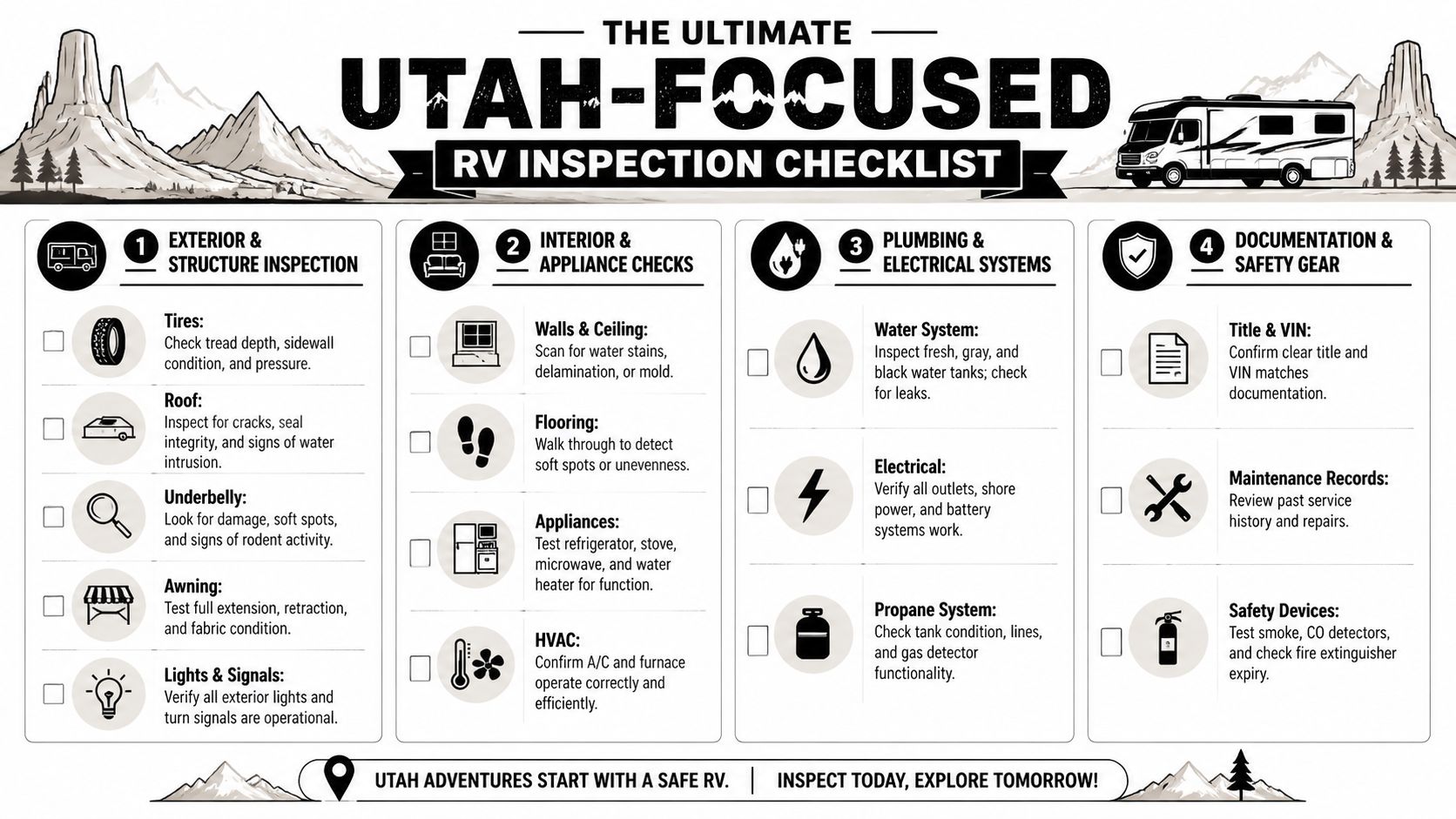
Start outside and stay methodical
Walk around the RV slowly. Don’t talk yourself into it yet.
Check these areas first:
- Roof edges and sealant: Look for cracked sealant, patchwork, gaps around vents, skylights, ladder mounts, and front or rear caps.
- Sidewalls: Watch for bubbling, waves, or delamination. Press gently where allowed. Softness is bad news.
- Windows and corner trim: Staining or failed sealant around frames often points to past leaks.
- Awnings: Extend them fully and inspect fabric, arms, and operation.
- Tires: Read date codes, inspect sidewalls, and look for cracking, uneven wear, or mismatched replacements.
- Undercarriage: In Utah, salted roads and winter exposure can leave corrosion or grime that hides bigger issues.
If you’ve bought a used car before, the mindset is similar. A checklist like this pre purchase car inspection guide from VekTracer is a useful reminder that condition beats cosmetics every time. RVs just add more systems and more places for moisture to hide.
Then move inside and look for evidence, not promises
The interior tells the truth if you pay attention. Open cabinets. Kneel down. Touch walls. Stand in the shower. Walk every inch of the floor.
Look for:
- Soft spots near entry doors, kitchens, bathrooms, and slide edges
- Stains on ceiling panels or upper cabinets
- Musty smell that doesn’t match the “air freshener” smell
- Wall ripples or trim separation
- Signs of past patching around vents or skylights
- Loose flooring near exterior walls
A clean interior doesn’t mean a dry interior.
If an RV smells heavily scented, ask yourself what smell someone is trying to cover.
Test every major system
Don’t accept “it probably works.” Turn it on.
Run the refrigerator, stove, microwave, furnace, air conditioner, water heater, water pump, lights, outlets, slide-outs, jacks, fans, and power awning if equipped. Fill and pressurize the plumbing if possible. Test battery condition and shore power connection.
For Utah buyers, I’d pay special attention to signs of poor winter prep:
- Cracked fittings
- Leaky plumbing connections
- Stiff or damaged dump valves
- Water pump cycling oddly
- Evidence that lines weren’t properly winterized
If roof issues are suspected, learn what repairs can involve before you commit. This breakdown of RV roof leak repair cost gives a practical look at what that kind of damage can turn into.
Use a checklist, not your memory
Here’s the same framework our team would want any first-time buyer to use before making a decision.
| Area | What to Check | Red Flag |
|---|---|---|
| Roof and upper seals | Sealant around vents, skylights, antennas, seams | Cracking, gaps, fresh patching with no explanation |
| Sidewalls and exterior skin | Delamination, bubbles, ripples, corner trim | Softness, waviness, signs of water entry |
| Tires and running gear | Age, sidewall condition, tread, suspension look | Dry rot, uneven wear, obvious neglect |
| Awnings and slide-outs | Full operation, fabric condition, seal contact | Tears, jerky movement, poor sealing |
| Floor and subfloor | Walk every area, especially corners and bath | Spongy feel, uneven sections |
| Ceiling and cabinets | Stains, discoloration, swollen wood | Water marks, mold smell, trim separation |
| Plumbing | Pump, faucets, drains, water heater, fittings | Leaks, drips, cracked fittings |
| Electrical | Shore power, battery, lights, outlets, converter | Dead outlets, weak battery response |
| Appliances | Fridge, furnace, A/C, microwave, stove | Won’t start, weak output, odd noises |
| Documentation and VIN | Match title, VIN plate, service records | Missing paperwork, inconsistent info |
Don’t inspect like a shopper. Inspect like an owner.
The biggest mistake first-time buyers make is trying to confirm the RV is “nice.” That’s not the job. Your job is to prove it has no expensive surprise hiding in it.
Bring a flashlight. Bring a ladder if appropriate and allowed. Bring a moisture meter if you know how to use one. Bring someone who isn’t emotionally invested if you can. Open every compartment. Test every switch.
One dealership option in Utah is Motor Sportsland, which offers used inventory, service support, financing, trade-ins, and local access in Millcreek and Spanish Fork. If you’re comparing sellers, that kind of one-stop setup can simplify inspection follow-up and repairs because you’re not trying to coordinate separate people for sales, parts, and service.
Navigating Paperwork and Verifying Vehicle History
A clean title matters just as much as a clean roof. Maybe more.
First-time buyers often spend hours comparing floorplans and almost no time thinking about ownership documents. That’s backward. If the paperwork is wrong, the deal is wrong.
What to verify before money changes hands
Start with the title. The name on the title should match the seller. The VIN on the RV should match the VIN on the title and any sale documents. If anything feels off, stop and sort it out before you go farther.
You also want to review:
- VIN history report if available
- Service records
- Manuals and appliance documents
- Lien status
- Bill of sale details
- Any warranty or service contract paperwork that may transfer
For valuation, use NADA Guides as a reality check. Don’t treat it as gospel, but do use it to sanity-check the asking price against condition, age, and equipment. A seller can ask whatever they want. That doesn’t make it market-correct.
Where paperwork problems usually show up
Private deals get messy in predictable ways. The title isn’t in the seller’s name. There’s still a loan payoff that hasn’t been coordinated. The VIN plate is hard to access and no one wants to answer direct questions. A “small accident” turns out to be larger than described. Flood or salvage history isn’t disclosed early.
That’s not rare. It’s why document review needs to happen before negotiation gets serious.
Paperwork should lower your anxiety. If it raises your anxiety, something’s wrong.
What a structured purchase changes
When a dealership handles title transfer and registration workflow, buyers usually avoid the most frustrating part of the transaction. You’re less likely to chase signatures, missing documents, or vague payoff timelines. You also get a more consistent record of what was sold and under what terms.
That doesn’t mean you stop reading. It means you can spend your energy understanding the deal instead of trying to rescue it.
Negotiating Price, Securing Financing, and Valuing Your Trade
Here, buyers either save money or give it away.
Most used RV negotiation isn’t about being aggressive. It’s about being prepared. A data-driven negotiation can save you 10% to 25%. Informed buyers negotiate 18% off asking price versus 5% for uninformed buyers, and a $2,000 roof reseal quote can justify a meaningful discount, according to Money’s used RV buying guidance.
Negotiate from evidence
Your offer should come from three things:
- Comparable listings in your region
- NADA value range
- Inspection findings
That’s it.
If the RV needs tires, roof resealing, appliance work, or slide adjustment, put those issues on paper and price them into your offer. Stay calm. Stay specific. Buyers lose their advantage when they get vague or emotional.
Use language like this:
- “The unit fits what we want, but the roof and tire condition change the value for us.”
- “We’re basing our offer on comparable listings plus the repairs we’d need to handle.”
- “If those items are corrected first, we can revisit the number.”
That approach works better than trying to “win” the conversation.
Financing matters more than buyers think
A lower sale price doesn’t automatically mean a better deal if the financing is poor. Older RVs can come with less favorable terms, and that changes the overall cost of ownership over time.
A dealership finance office can be useful here because it gives you a way to compare offers instead of guessing. If you want to understand the options before you sign anything, our guide to RV financing options is a good place to start.
What I’d recommend:
- Get pre-qualified early: Know your comfort zone before you shop seriously.
- Focus on total cost, not just payment: A “manageable” monthly number can still be expensive.
- Ask about term length and age limits: Older units can trigger different lending rules.
- Keep repair reserves in mind: Don’t spend every available dollar on the purchase itself.
Trade-ins can simplify the whole transaction
If you already own an RV, a trade-in can remove a lot of friction. You skip private-sale showings, no-shows, title juggling, and the awkward overlap of buying one RV while still trying to sell another.
The key is simple. Be honest about condition. Clean it well. Gather service records. Present all keys, remotes, and manuals. A realistic trade conversation usually goes better than a private listing full of wishful pricing.
Here’s a helpful walk-through on the financing side before you move forward:
A good RV deal feels clear on paper. If you need three verbal explanations to understand it, slow down.
After the Sale Local Utah Service and Support at Motor Sportsland
Buying right is only half the job. Owning well is what makes RV life enjoyable.
Utah conditions are demanding. We see buyers head into high elevation, desert heat, spring storms, and freezing winter storage within the same ownership cycle. That means your service plan matters from day one, especially if your first season includes mountain towing, cold-weather camping, or storing the RV outside.
What local support should include
The service needs are predictable even if the exact timing isn’t. Most owners eventually need some mix of these:
- Seasonal winterization and de-winterization
- Roof and seal inspection
- Appliance diagnostics
- Electrical and plumbing repairs
- Tire, brake, and running gear checks
- Collision or exterior repair
- Parts replacement and upgrades
If you’re buying your first RV, don’t wait until something fails to ask where service will happen. Figure that out before purchase.
Why local service changes ownership
A local service relationship saves time, but more importantly, it changes your confidence level. When you know where to go for roof work, appliance issues, hitch questions, or winter prep, you’re more likely to use the RV instead of worrying about it.
That’s especially true in Utah, where storage practices and weather exposure can create small issues that become larger ones by the next season. A quick inspection before and after winter is often the difference between routine maintenance and a frustrating spring surprise.
For owners who like to handle simple repairs themselves, having access to a parts department also makes a difference. Some fixes are manageable. Others aren’t. Knowing where that line is helps you keep the RV reliable.
Start Your Utah Adventure with Confidence
You find a used RV on Friday, picture it parked at Jordanelle by Saturday, and feel ready to say yes. Slow down. A smart Utah buyer wins before the first trip by sticking to a clear process and refusing to rush.
Start with local options that fit the way you camp in Utah. If your weekends mean climbing through Parley's, towing into the Uintas, or storing the RV through freeze and snow, those details matter more than a glossy photo gallery. The right used RV for Utah needs to match your truck, your family, your budget, and the mountain conditions it will live in.
Keep your standards high. Read listings carefully, ask direct questions, inspect with discipline, confirm the title and VIN, and settle your financing before you get attached to one unit. If you need coverage lined up before delivery, compare affordable motorhome insurance early so pickup day stays simple.
That approach saves money. It also saves your first season.
At Motor Sportsland, we have spent more than 55 years helping Utah buyers sort solid RVs from expensive mistakes. If you are shopping in Millcreek or Spanish Fork, come in with questions. We will give you straight answers, show you what to watch for, and help you buy an RV you can take into the next Utah camping season with confidence.
Frequently Asked Questions About Buying a Used RV in Utah
You’re standing in a driveway in Sandy or on a dealer lot in Spanish Fork, looking at a used RV that seems right. The floorplan fits. The price feels close. Then the real questions hit. Is this a smart buy for Utah roads, Utah winters, and Utah mountain travel, or are you about to inherit somebody else’s problems?
These are the questions Utah buyers ask us all the time, especially first-time shoppers looking at older travel trailers, fifth wheels, motorhomes, and toy haulers.
Quick answers that matter
| Question | Answer |
|---|---|
| Is now a good time to buy a used RV in Utah? | Buy when you find the right unit in the right condition. Chasing the perfect month matters less than finding an RV with a dry roof, clean title, and service history you can verify. |
| Should I worry about interest rates on older used RVs? | Yes. Older RVs often bring shorter terms and higher rates, so get your financing lined up early and compare the full cost, not just the payment. |
| Is a private seller always cheaper? | No. A lower asking price can disappear fast if the tires are aged out, the appliances have issues, or you discover title problems after the handshake. |
| What’s the first thing I should inspect on a used RV? | Start up high. Check the roof, sealant, front and rear caps, wall corners, and every spot where water can get in. In Utah’s freeze and thaw cycles, old water damage gets expensive fast. |
| Do I need insurance before taking delivery? | Usually, yes. Set it up before pickup so you are covered on day one. If you are comparing options, this guide to affordable motorhome insurance gives a useful overview of common coverage types. |
| What type of used RV works best for a Utah family? | For a lot of first-time Utah buyers, a bunkhouse travel trailer is the practical place to start. It gives you space, manageable towing, and fewer ownership costs than jumping straight into a motorhome. |
| Does Utah altitude matter when buying a used RV? | Absolutely. If you plan to tow through Parley's, climb toward the Uintas, or camp in higher elevations, match the RV to your tow vehicle honestly. Heavy trailers feel a lot heavier on mountain grades. |
| What should I ask about winter use? | Ask how it was stored, whether it was winterized every season, and if any water lines, tanks, or fittings were repaired after freezing. Utah winters expose weak maintenance fast. |
A few blunt answers from experience
If a seller cannot explain storage history, maintenance, and title status clearly, walk away.
If the RV smells musty, shows fresh interior patches, or has soft spots near the walls or slide openings, assume water got in and inspect it much harder.
If you are buying for Utah camping, do not shop by floorplan alone. Weight, ground clearance, furnace performance, tire age, and tank condition matter a lot more here than they do in flat, mild-weather markets.
At Motor Sportsland, we also advise first-time buyers to prepare a realistic budget for the first year. Even a good used RV may need batteries, tires, sealant work, or a full systems check before it is ready for weekends at Jordanelle, Bear Lake, or down south in Moab.
Good questions save money. In the used RV market, they also save your season.
