
Expert RV Refrigerator Repair Tips for Utah 2026
A lot of RV refrigerator problems start the same way. You load groceries the night before a trip, head up toward the Wasatch, park on a sloped site, and wake up to warm milk, soft butter, and a fridge that suddenly looks expensive. That doesn't always mean the refrigerator has failed. In our service conversations with Utah owners, the first win is usually figuring out whether the unit is broken, whether it's the wrong power source, or whether the fridge type changes the whole repair path.
That distinction matters because RV refrigerator repair isn't one repair. A Norcold or Dometic absorption fridge behaves nothing like a 12V compressor model, and a fix that helps one can waste time on the other. Utah adds its own wrinkle too. Mountain campsites, high-altitude propane performance, winter storage, and long summer heat all put extra stress on fridge systems.
This guide walks through the practical checks that solve the easy problems first, then gets into the repairs owners can reasonably handle on their own. It also shows where DIY stops making sense. If you're trying to protect your food, your trip, and your wallet, this is the order that works.
Is It Actually Broken Initial Fridge Diagnostics
Before you pull panels or order parts, start with the checks that eliminate false alarms. A surprising number of refrigerator complaints come down to setup, airflow, or power mode.
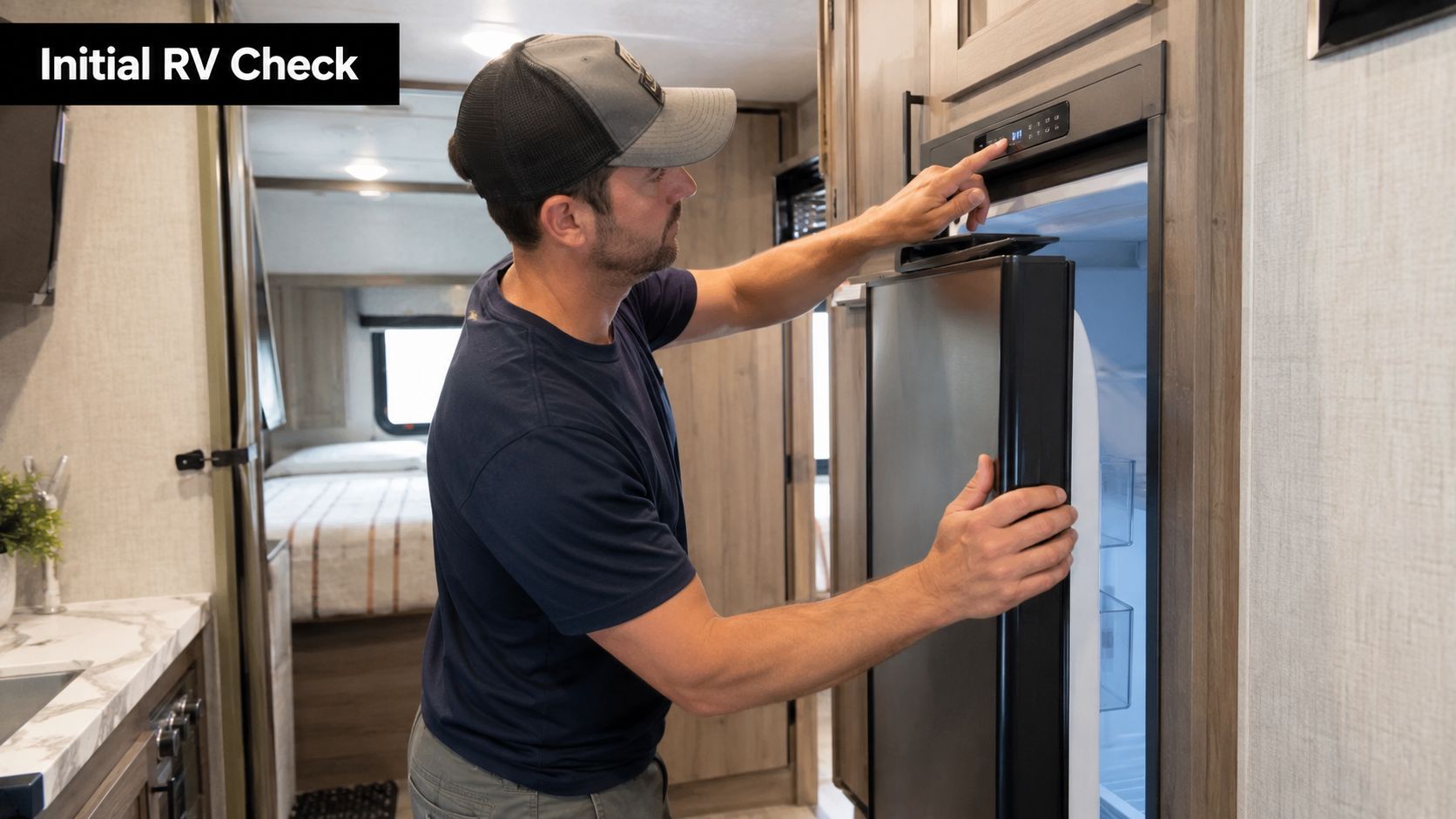
Start with the power source
Many RV fridges use more than one energy source, and each mode has its own failure point. Check the control panel first and confirm what mode the fridge is trying to run on.
Use this quick checklist:
- 12V supply: If the coach battery is low or a fuse has failed, the control system may not operate correctly even if the fridge is set to propane or shore power.
- 120V AC input: If you're plugged in, verify the outlet feeding the refrigerator has power. A tripped breaker or a loose campground connection can mimic a fridge failure.
- Propane availability: Make sure the tank valve is open and another LP appliance, such as the stove, lights normally. If the fridge won't cool on gas, no propane flow is the first thing to rule out.
Check vent airflow before assuming a major fault
Absorption refrigerators depend on heat transfer and ventilation. If leaves, mud dauber nests, road debris, or insulation scraps block the exterior access area, cooling drops fast.
Inspect both exterior vent openings. Look for obvious blockage around the lower burner area and the upper vent path. Don't poke around with the propane on. Shut the system down first.
Practical rule: If the back of the fridge can't breathe, the fridge can't cool.
A lot of owners also skip routine care until something stops working. Our team points people to this RV refrigerator maintenance guide because regular vent and burner cleaning prevents many of the “it just quit” scenarios.
Level matters more than most owners think
This is the check that catches people camping on mountain sites. All ammonia absorption refrigerators must be completely level, both front-to-back and side-to-side, when stationary and powered on, because the cooling process relies on gravity. If the unit is tilted more than approximately 3 degrees, it can fail to cool or stop working entirely, as explained in this absorption refrigerator leveling FAQ.
That's why one owner can have a fridge that works perfectly in a driveway in Millcreek and then “fails” at a sloped campsite near Jordanelle. The fridge didn't necessarily break. The cooling cycle couldn't circulate properly.
The first-pass decision
If the unit is level, has clear ventilation, and is definitely getting the right power source, then move on to diagnosis. If one of those basics is wrong, fix that first and give the fridge time to respond before taking anything apart.
Absorption vs Compressor Identifying Your RV Fridge Type
A lot of bad RV refrigerator repair starts with a wrong assumption about the appliance itself. Owners see “RV fridge” and treat every model the same. That's where wasted time begins.
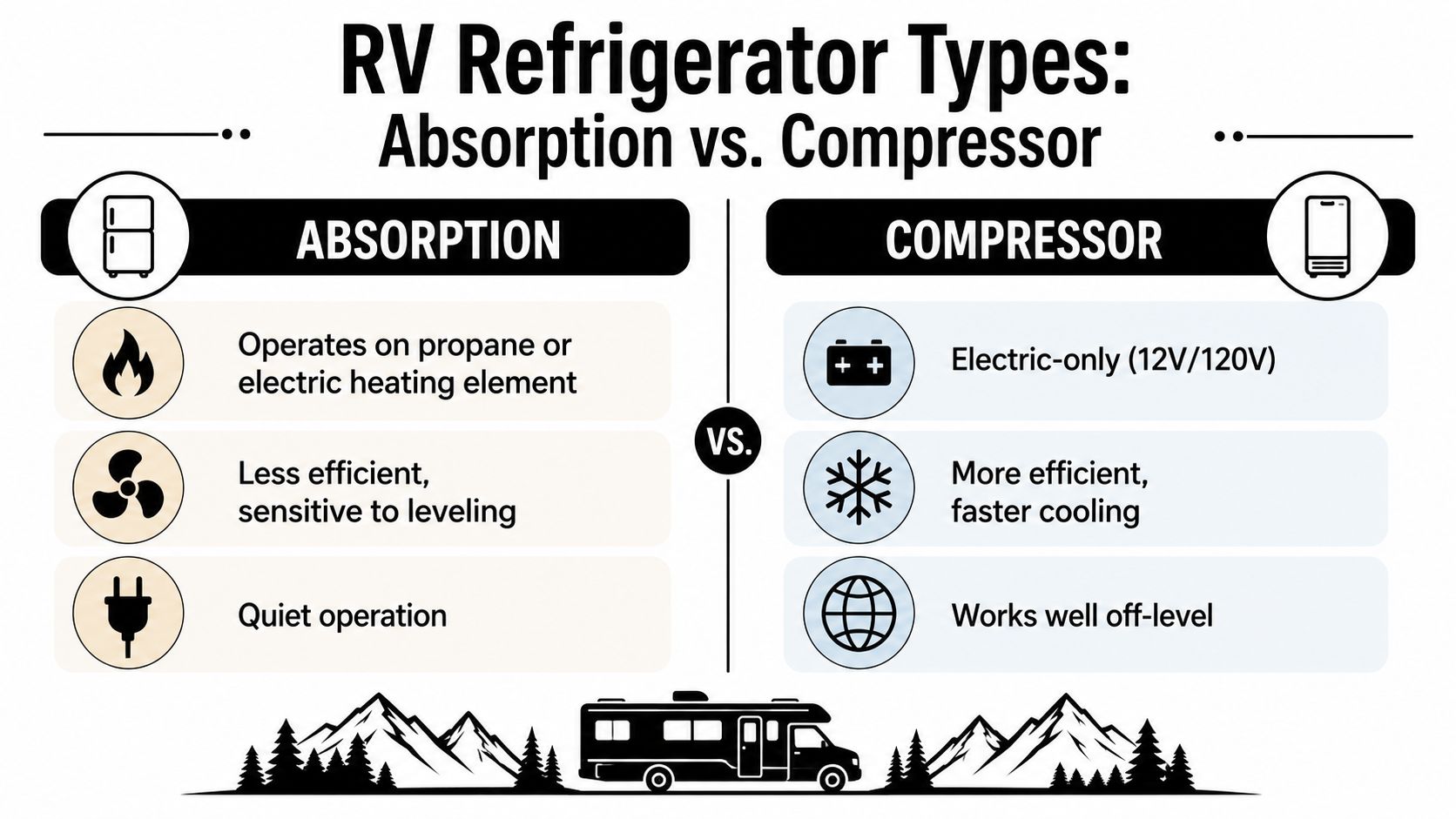
How to identify the type in your coach
Look for these clues before doing any repair:
- Absorption fridge: Usually found in traditional RV setups. Often runs on propane and electric. Common brands include Dometic and Norcold.
- 3-way fridge: A variation often found in smaller RVs or older units. It may run on propane, 12V DC, and 120V AC.
- Compressor fridge: Electric-only. Usually a modern 12V design, sometimes residential-style in larger rigs.
If you open the exterior service panel and see a burner assembly and flue tube, you're dealing with an absorption-style refrigerator. If there's no propane burner and the system behaves more like a home refrigerator, it's likely a compressor unit.
RV Refrigerator Type Comparison
| Fridge Type | How It Cools | Common Failure Point | Utah Camping Note |
|---|---|---|---|
| Absorption | Uses heat and an ammonia absorption cycle | Burner blockage, poor ventilation, off-level operation | Sensitive on uneven mountain campsites |
| 3-Way | Similar absorption system with multiple power inputs | Burner issues, power selection problems, control faults | Useful flexibility, but more inputs mean more things to verify |
| Compressor | Uses a compressor and electric power | Low voltage, wiring issues, control faults | Better choice for off-level campsites, but battery condition matters |
What works better in Utah conditions
Utah is a good place to understand the trade-off.
An absorption fridge works well for owners who spend time off-grid and want propane operation, but it's less forgiving. If you camp on uneven terrain around the Wasatch Mountains or pull into a quick overnight stop without leveling properly, performance can drop fast.
A compressor fridge cools more like a home unit. It doesn't care nearly as much about being perfectly level, which is useful on sloped sites or quick lunch stops. The trade-off is electrical demand. If your battery system is weak, the fridge may be fine while the power system is not.
Why the fridge type changes the repair plan
A propane flame issue matters on an absorption fridge. It means nothing on a compressor fridge. A battery-voltage problem can cripple a compressor fridge while an absorption unit on propane may keep running.
That's why broad appliance advice often falls short. The first question in successful RV appliance repair guidance should always be, “What kind of refrigerator is this?”
If the repair advice doesn't match the refrigerator design, ignore the advice before you waste a Saturday on the wrong fix.
Common DIY RV Refrigerator Repair Steps
A common shop scenario goes like this. The fridge was cold at home, the RV drove up into Utah heat, and by evening the milk is warm. Owners often assume the cooling unit has failed. In service, the first wins are usually simpler than that.
The safest DIY work is cleaning, inspection, and a few basic checks with a meter. The right steps depend on the refrigerator design. An absorption fridge can lose cooling because of burner contamination or poor airflow. A compressor or 12V fridge is more likely to quit because of voltage drop, wiring resistance, or a control fault.
Cleaning an absorption burner assembly the right way
On a Dometic 3-way or similar gas-electric absorption fridge, a dirty burner area is a frequent cause of weak cooling on propane. Utah adds a wrinkle here. At higher elevation, thinner air can make a marginal flame pattern show up faster, so a burner that seemed acceptable at lower elevation may struggle in the mountains.
Use this sequence:
- Shut off LPG and all power sources. The burner compartment needs to be dead before you touch it.
- Remove the exterior access panel. Use good light so you can see soot, rust flakes, and wire routing.
- Document the layout before taking parts apart. A few phone photos save a lot of frustration during reassembly.
- Clean the burner and orifice carefully. Use compressed air and a brass brush. Do not poke the orifice with anything that can enlarge it.
- Pull and clean the flue baffle. Soot in the flue interferes with heat transfer, which is the whole job of an absorption system.
- Inspect the thermocouple or flame-sense area. Dirt and corrosion can make the gas valve drop out or create unreliable ignition.
After cleaning, check the flame. LPG pressure should be 11 inches of water column, and the burner flame should be mostly bright blue, sometimes with a slight orange tip. A lazy yellow flame, popping, or frequent outage points to an air-fuel problem, contamination, or regulator trouble.
In the service bay, this cleaning solves many propane cooling complaints before major parts ever enter the conversation. If the burner is clean and the flame is still wrong, stop there and have a technician check pressure, regulator performance, and combustion setup.
Thermostat or control board
This is one of the easiest places to waste money.
Owners often replace the thermostat because it seems cheaper and simpler. Then the fridge still will not ignite, will not switch modes, or goes dead again because the actual fault is on the control side.
A simple rule helps:
- Thermostat suspicion: The refrigerator runs, but box temperature is inconsistent or does not respond normally to setting changes.
- Control board suspicion: The refrigerator will not start correctly, fails to switch between power modes, loses ignition sequence, or has power available at the unit but no proper command response.
Start with symptoms and inputs before ordering parts.
- Confirm the refrigerator is receiving the correct power for the mode you are testing.
- Inspect board plugs and ground connections for corrosion, looseness, or heat damage.
- Check fuses at the refrigerator, not just the main coach panel.
- If the complaint is gas ignition, inspect the igniter path, burner ground, and related wiring before blaming the board.
- If the complaint is weak cooling on electric, verify the heating element circuit on absorption models or supply voltage on compressor and 12V models.
Power quality matters more on compressor and 12V fridges than many owners expect. If voltage is low at the refrigerator, the fridge may look failed when the actual problem is upstream. A quick review of RV power converter repair and 12V power symptoms can save time if the refrigerator issue is part of a larger coach electrical problem.
A thermostat affects temperature control. A failed board usually interrupts commands, ignition, or mode changes.
What not to do
A few DIY habits turn a small repair into a bigger one.
- Do not replace parts one at a time without testing. That is the fastest way to spend money and still have a warm fridge.
- Do not use steel wire on burner components. Brass is safer for delicate parts.
- Do not adjust gas pressure by feel. Pressure needs to be measured, not guessed.
- Do not keep running an absorption fridge badly out of level. Short stops are one thing. Prolonged off-level operation can damage the cooling unit.
- Do not chase propane fixes on a compressor fridge. That sounds obvious, but it happens more than you would think when owners follow generic online advice.
If you can clean, inspect, document wiring, and verify voltage, DIY repair makes sense. If the job has moved into sealed cooling unit problems, live gas-pressure adjustment, or board-level diagnosis without clear test results, that is the point to hand it off.
Preventative Maintenance A Checklist From Our Service Bay
A refrigerator that cools fine in the driveway can still struggle on the road in July. In our service bay, the repeat failures usually trace back to basic upkeep that was skipped for a season or two, especially on units that sit through a Utah winter and then get pushed hard in summer heat.
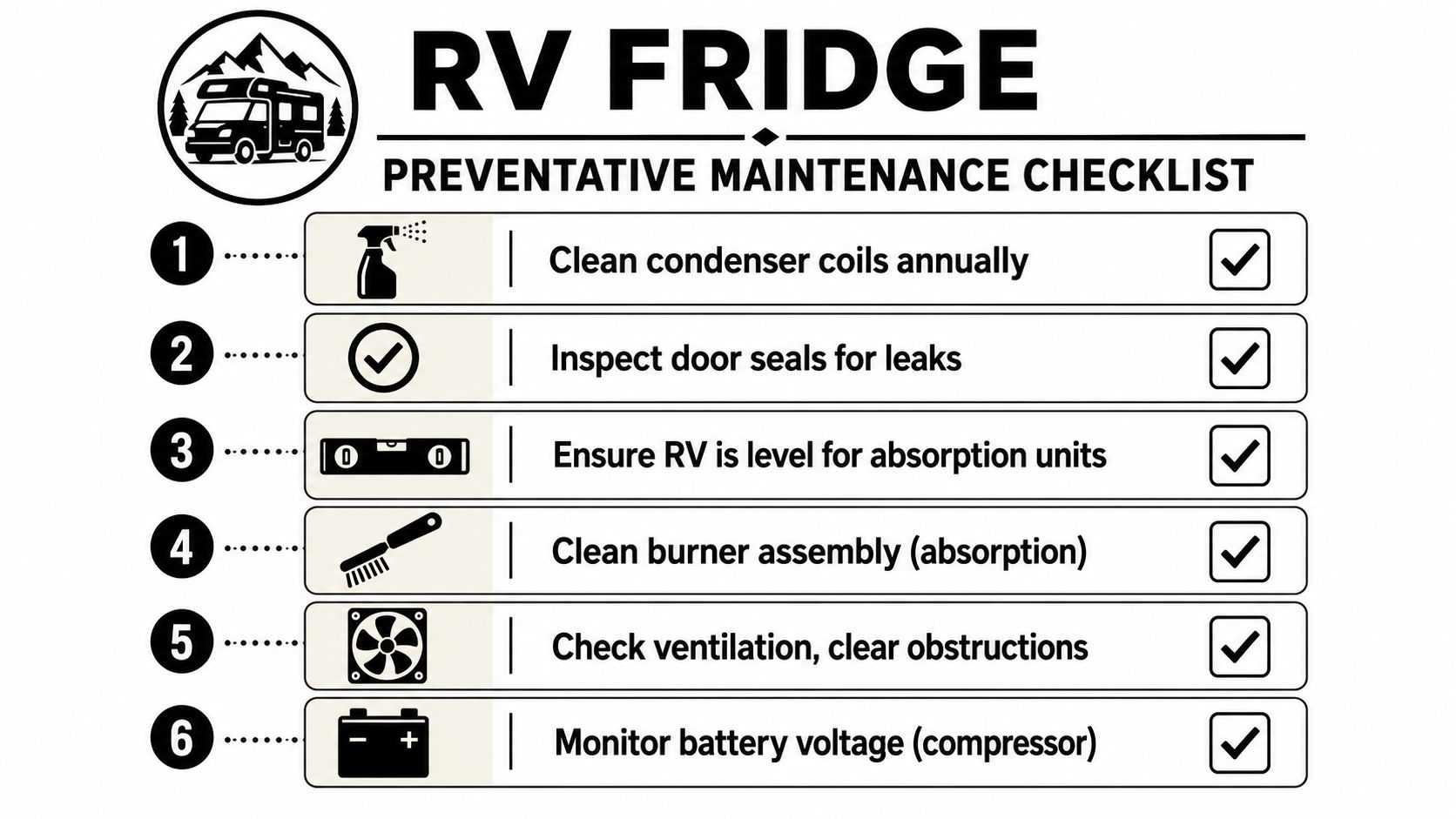
Good maintenance is different for each fridge type. That is the part generic checklists often miss. An absorption fridge depends on clean airflow, proper burner performance, and being reasonably level. A compressor or 12V fridge cares more about clean coils, fan operation, and steady electrical supply. If you maintain the wrong system, you can still end up with a warm box and spoiled food.
The maintenance that pays off
Run through this checklist at least once before the season starts, then again if cooling drops off during hot-weather travel:
- Clean condenser and cooling areas: Dust, pet hair, lint, and road grime trap heat. Less heat shed at the back means poorer cooling inside.
- Check door seals: Use the dollar bill test around several spots on the door, not just one. Uneven grip often shows a warped gasket or hinge alignment issue.
- Inspect exterior vents: Remove leaves, insect nests, and debris that block airflow. Absorption fridges are especially sensitive to restricted venting.
- Clean the burner assembly on absorption units: Light soot and corrosion can weaken flame quality long before the fridge quits completely.
- Confirm the fridge is operating level if it is an absorption model: That matters most during extended parking, not just quick lunch stops.
- Inspect 12V connections on compressor and 12V fridges: Loose or heat-darkened terminals create voltage drop, and low voltage can look like a refrigerator failure.
- Listen for fans: A failed condenser fan can cause poor cooling in high ambient temperatures, even when the sealed system itself is still healthy.
One caution from the shop. Do not wash the back of the refrigerator with high-pressure water or start bending cooling fins straight with pliers. Both mistakes create repair bills.
A seasonal rhythm that works in Utah
Utah adds its own stress. Higher elevation can make absorption fridge burner performance less forgiving, and desert travel puts extra demand on venting and heat rejection. A fridge that seems acceptable in spring can show its weak points fast in Moab, Bear Lake, or southern Utah in mid-summer.
| Season | What to Check | Why It Matters |
|---|---|---|
| Spring | Vents, seals, burner area on absorption units, coil area on compressor units, startup cooling performance | Finds storage damage, nests, and weak cooling before the first trip |
| Mid-summer | Airflow, fan operation, door seal hold, cooling consistency during hottest part of the day | High ambient heat exposes restricted venting and marginal electrical supply quickly |
| Fall | Full cleaning, gasket inspection, interior wipe-down, drain and moisture check | Prevents odors, corrosion, and mold from developing during storage |
| Winter storage | Leave the fridge clean, dry, and propped open if the manufacturer allows it | Reduces mildew, stale odors, and gasket sticking |
At Motor Sportsland, we also tell Utah owners to pay attention to altitude complaints that only show up in the mountains. On absorption fridges, a burner that is slightly dirty or weak at lower elevation can become much more obvious at altitude because combustion is already working with thinner air.
Small checks prevent big repairs. They also help you tell the difference between normal hot-weather struggle and a fridge that is starting to fail.
When to Stop and Call Our Service Center
A lot of fridge problems are still worth checking yourself. A few are the point where a careful owner should stop, shut the unit down, and get it diagnosed before a small repair turns into a safety issue or an expensive wrong guess.
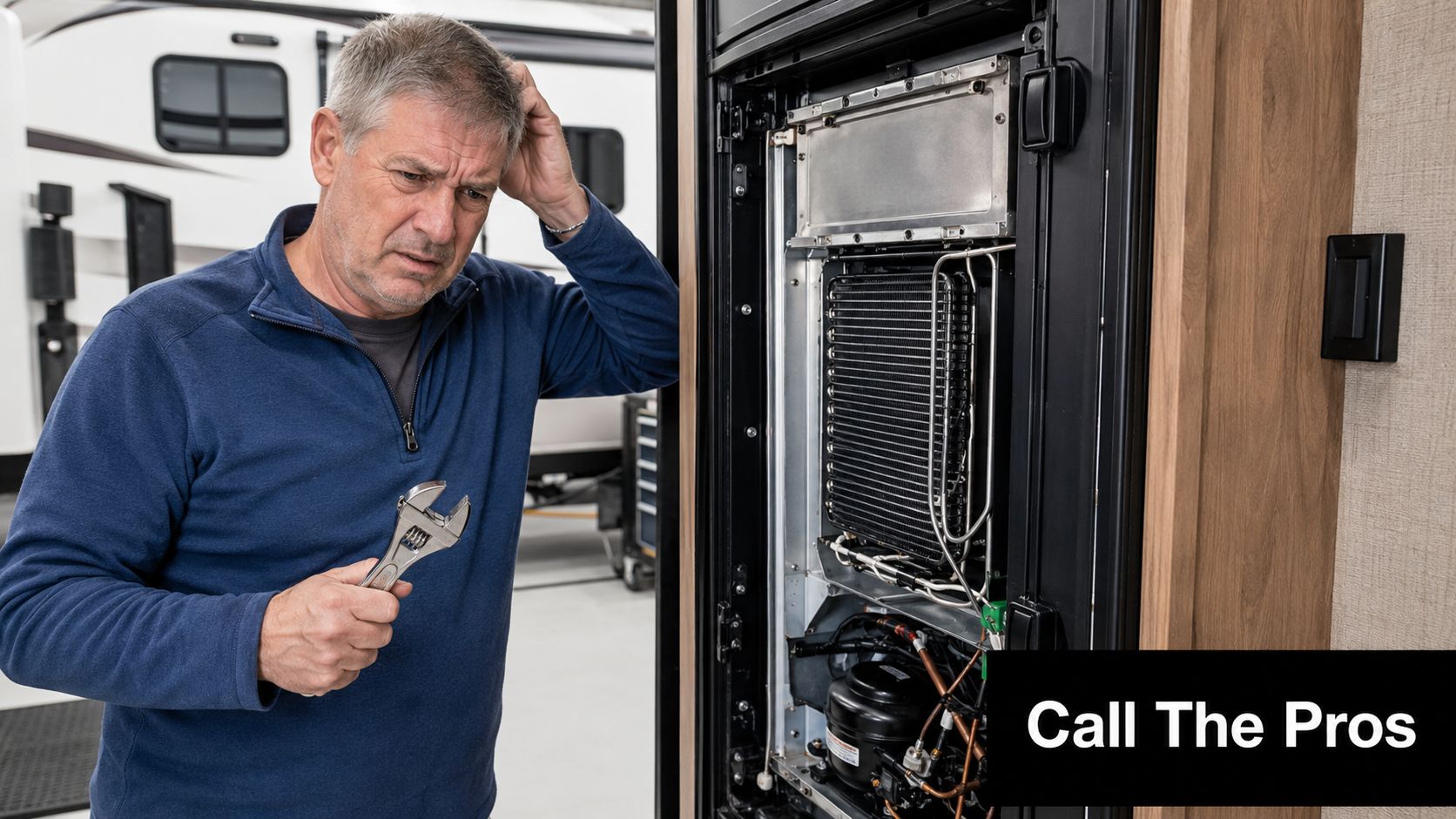
Stop immediately for leak or combustion warnings
If you smell ammonia or see yellow residue behind an absorption refrigerator, shut it off. Those are classic signs of a cooling unit leak, and cleaning or resetting the fridge will not fix that failure.
Stop for combustion warnings too, especially on propane-capable absorption models:
- Persistent yellow flame
- Soot buildup
- Repeated ignition failure after basic cleaning
- Heat damage around wiring or control components
Those symptoms usually mean the problem has moved past routine maintenance. In Utah, altitude can make a weak burner show its flaws faster, but altitude does not explain soot, overheating, or obvious leak signs.
Call once the repair requires diagnosis, not guessing
The biggest DIY mistake we see is treating every RV fridge like it fails the same way. They do not.
If an absorption fridge still will not cool after the basic checks, the fault may be in the cooling unit, control board, heating element, gas valve, or airflow setup. If a compressor or 12V fridge is not cooling, the work usually shifts toward voltage drop, wiring, fans, thermostat input, or compressor protection faults. At that point, random parts swapping gets expensive fast and can create a second problem that was not there when you started.
A professional diagnosis often costs less than replacing the wrong part, or replacing the whole refrigerator before anyone confirms what failed.
A helpful walk-through on common refrigerator issues is below if you want to compare what you're seeing before booking service.
Cases where service usually makes more sense
Bring it in when any of these apply:
- The cooling unit may have failed. Removal, sealing, alignment, and post-repair testing need to be done correctly.
- The control board diagnosis is unclear. A bad board, bad sensor, or bad power feed can look similar at first.
- Propane pressure or burner adjustments are involved. Flame quality needs measurement and proper setup, not guesswork.
- The refrigerator is installed in a tight slide-out or cabinet. Access alone can turn a simple repair into damaged trim, pinched wiring, or a venting problem.
- You have a Utah mountain-only complaint. If the fridge acts up mainly at elevation, that pattern matters and should be tested with the refrigerator type in mind.
Motor Sportsland handles refrigerator diagnosis, appliance repair, and related coach service for Utah owners who need the fault confirmed before authorizing parts or replacement.
Your Utah RV Fridge Questions Answered
A reliable fridge usually comes down to three habits. Check the simple stuff first. Know what kind of refrigerator you own. Stay ahead of maintenance before a weekend trip turns into a parts hunt.
Utah owners feel these issues harder because campsite angles, mountain travel, and storage swings expose weak systems quickly. The good news is that the first layer of RV refrigerator repair is usually logical. You don't need to start with disassembly. You need to start with setup.
Quick answers we hear all the time
Why does my RV fridge work at home but not at camp?
If it's an absorption fridge, site angle is a common reason. A driveway at home may be level enough, while a mountain campsite may not be. Power source differences can also explain it. At home you may be on stable shore power, while at camp the fridge may be trying to run on propane or battery support.
How long should I wait after making a fix?
Give the refrigerator time to respond after correcting the issue. RV fridges don't always recover instantly, especially absorption models. If you change modes, level the coach, or clean the burner area, monitor performance before deciding the repair failed.
Is a residential-style fridge easier to live with?
For many owners, yes. Compressor-based residential or 12V models are less sensitive to leveling and usually feel more familiar in daily use. The trade-off is dependence on a healthy electrical system.
Should I replace parts myself if the fridge still turns on?
Only if the diagnosis is reasonably clear. Power at the panel doesn't prove the thermostat is bad, and it doesn't prove the board is good. If you can't narrow the fault with confidence, parts swapping usually wastes money.
Does Utah altitude affect fridge performance?
It can, especially for propane operation. Higher elevation changes how burners behave, and weak flame quality becomes more obvious. That doesn't automatically mean the refrigerator is defective. It may mean the burner area is dirty, airflow is poor, or the system needs proper service.
Is a warranty worth considering for refrigerator ownership?
It can be. Refrigerator replacement and installation costs add up quickly, and many owners prefer predictable coverage over reacting to a major failure later.
Helpful next steps for owners shopping or servicing in Utah
If your current rig keeps giving you appliance trouble, it may be worth comparing newer floorplans and fridge setups before your next travel season. Some owners want the simplicity of a modern 12V refrigerator. Others still prefer propane capability for longer off-grid camping.
A few useful places to continue your search:
- Browse new RV inventory at Motor Sportsland
- Compare used RV inventory for value-focused buyers
- Explore RV financing options
- Check RV service and repair support
- Look through travel trailers for Utah family camping
- Review fifth wheels and larger extended-stay models
FAQ
Q: What's the first thing to check in RV refrigerator repair?
A: Confirm the refrigerator is getting the correct power source, verify airflow through exterior vents, and make sure an absorption fridge is level before assuming a component has failed.
Q: Do all RV refrigerators need to be level?
A: No. Absorption refrigerators do. Compressor refrigerators are much less sensitive to leveling during normal operation.
Q: What's the most common DIY fix for an absorption fridge that won't cool on gas?
A: Cleaning the burner assembly, flue baffle, orifice, and related flame-sensing components is one of the most productive first repairs.
Q: How do I know if it's the thermostat or the control board?
A: Start with symptom pattern and power verification. Temperature regulation issues can point toward the thermostat, while ignition, mode-switching, or command failures often point toward the control board.
Q: When should I stop DIY RV refrigerator repair?
A: Stop if you smell ammonia, see yellow residue, notice unsafe flame behavior, suspect a cooling unit leak, or can't confidently diagnose the electrical fault.
Q: Is maintenance really that important for RV fridges?
A: Yes. Routine cleaning, vent inspection, seal checks, and proper operation habits prevent a large share of refrigerator failures.
If your refrigerator still isn't cooling, or you'd rather have a technician sort out the diagnosis before you spend money on parts, contact Motor Sportsland. You can schedule service, browse new and used RV inventory, or stop by our Salt Lake City area locations in Millcreek and Spanish Fork to talk through which fridge setup makes the most sense for the way you camp in Utah.
