
Class C Motorhomes for Sale in Utah: 2026 Buyer's Guide
You're standing on a Salt Lake City lot, comparing two Class C motorhomes that look equally comfortable inside. One has a compact floorplan that will fit more Utah campgrounds, while the other offers extra living space, heavier construction, and more towing ability. The difference won't show in the upholstery. It will show on a Wasatch Mountain climb, in a tight campground turn, or when your loaded coach is weighed before a long trip.
The right Class C motorhome for sale in Utah needs to match more than your sleeping needs. You'll want to understand chassis ratings, payload, floorplan design, depreciation, winter storage, and access to technicians who know how Utah weather affects RV systems. This guide brings those decisions together from the practical perspective of a Utah RV dealer. It also explains how to compare new and used coaches, when a Super C makes sense, and what to inspect before you commit.
Why Class C Motorhomes for Sale Lead First-Time RV Buyers in Utah
A young family from the Salt Lake Valley planning weekends at Jordanelle needs more than sleeping capacity. The coach must handle the access road, fit the campground site, and remain manageable on a Wasatch climb. A retired couple heading beyond the Great Salt Lake may value the same basic platform for different reasons, including easier driving and faster setup than towing a separate trailer.
That shared usefulness explains why Class C motorhomes for sale in Utah attract first-time buyers. The cab-over bunk adds sleeping space without requiring a larger floorplan, while the familiar cab, kitchen, bathroom, and integrated living area keep the learning curve reasonable. Shorter models can suit tight campground spurs, although every passenger, water tank, bicycle, and tool reduces the payload available for the trip.
Buyer data supports the category's broad reach. Thirty-nine percent of first-time RV owners choose a Class C, according to Go RVing's Class C owner demographic profile. The profile also reports purchases among 22% of young families and 30% of millennial and Gen-Z buyers, helping explain why the segment serves both new RV households and experienced travelers seeking a motorized coach.
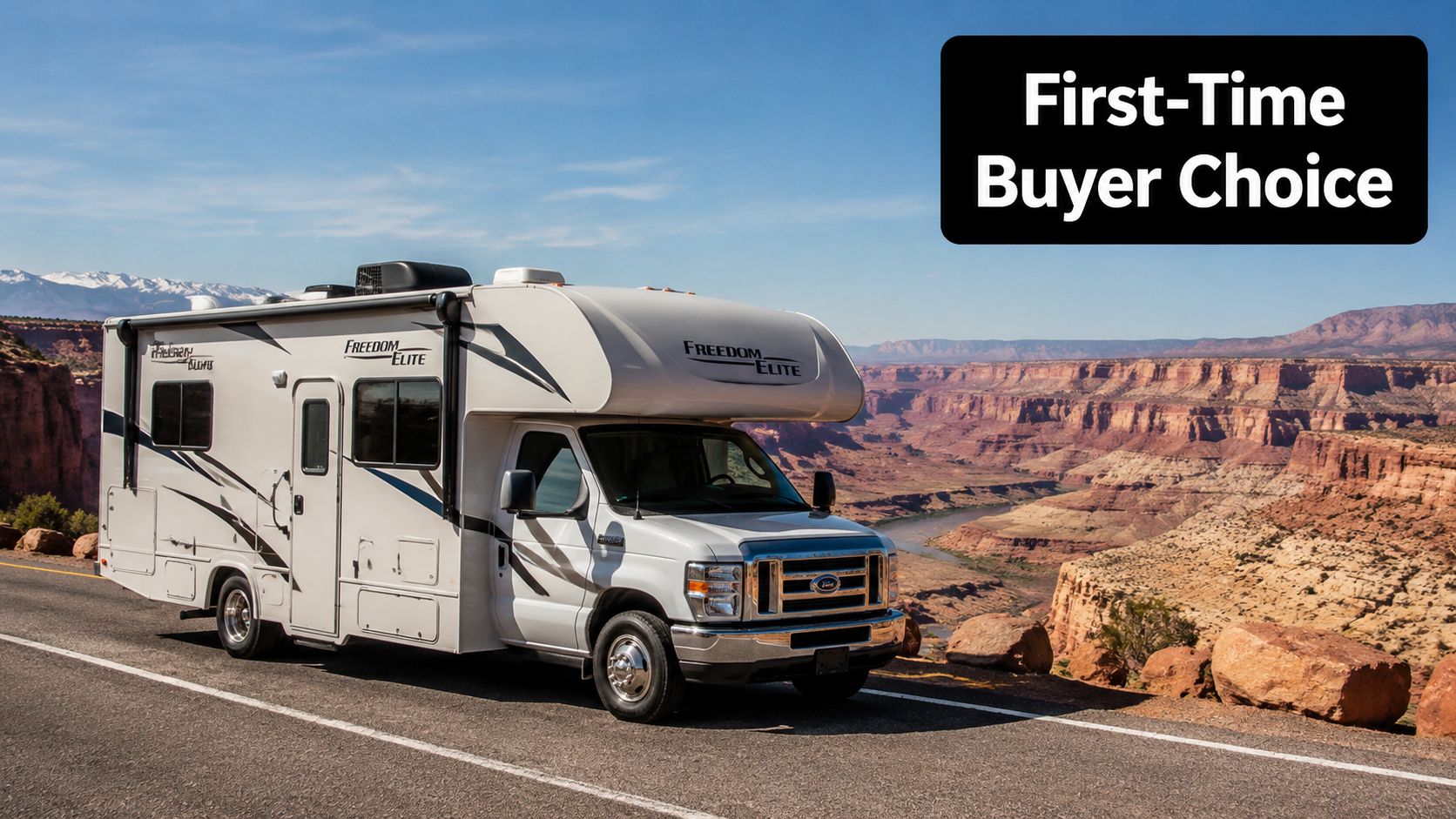
Why the same layout works for different households
A family can use the cab-over bunk for children, then convert that space to bedding or gear storage later. A couple may instead want a walk-around bed, an accessible bathroom, and exterior compartments that do not require unloading the coach. Those preferences matter more after Utah driving, campground access, and winter storage enter the decision.
The same profile reports that 7% of RVers own a Class C, while 64% of Class C owners are age 55 or older and 42% are retired. It also reports that 44% pay cash up front. The figures show a wide ownership mix. Class Cs serve as starter RVs, retirement coaches, and practical replacements for a towable trailer.
At Motor Sportsland, our team has helped thousands of Mountain West customers compare that fit. Start with actual routes, passenger count, cargo, storage plans, and access to winter service. Upholstery sets the first impression. Payload, mountain performance, and local technician access determine whether the coach remains useful after the first season.
Practical rule: Choose the coach for your real Utah trips, not the maximum people listed in the brochure.
Understanding Chassis, Length, and Payload Limits Before You Shop
A Class C purchase should begin underneath the living area. Most conventional models use a light- or medium-duty cutaway van or truck chassis, while a Super C uses a heavier truck platform. A compact diesel Class C may use a Mercedes-Benz Sprinter or Ford Transit chassis, whereas a Super C can be built on Ford F-550, Ford F-600, or Freightliner platforms.
That distinction changes how the coach feels on mountain roads and how much equipment you can carry. A compact diesel Class C typically falls within a 9,000 to 12,500 pound GVWR range, while Super C models generally occupy a much heavier 19,500 to 31,000 pound GVWR range, with towing capacity commonly described around 10,000 to 20,000 pounds in the cited market summary from Dynamax. These are category ranges, not promises for every floorplan.
Read the ratings in the right order
GVWR, or gross vehicle weight rating, is the maximum loaded weight of the motorhome itself. It includes passengers, fuel, water, food, clothing, dealer-installed accessories, bicycles, tools, and anything stored in the coach. GCWR, or gross combined weight rating, covers the motorhome plus a towed vehicle or trailer.
The 2026 Winnebago EKKO Sprinter illustrates why buyers need more than a sleeping-capacity number. Its published specifications list a GVWR of 11,030 pounds, a GCWR of 15,250 pounds, a front GAWR of 4,410 pounds, and a rear GAWR of 7,720 pounds in the manufacturer's specifications. GAWR refers to the maximum permitted load on an individual axle. You can be under the total GVWR and still overload an axle if cargo is concentrated in the wrong area.
Before you compare Class C motorhomes for sale, ask for:
- The actual vehicle weight: A coach's brochure dry weight won't include your passengers, water, fuel, options, or personal cargo. Motor Sportsland's RV dry-weight resources can help you understand why those figures differ.
- The available payload: Subtract the coach's actual loaded weight from its GVWR. Treat every installed rack, battery, solar component, and cargo box as part of the calculation.
- The axle ratings: Check whether storage bins, generators, water tanks, and rear cargo place too much weight on one axle.
- The combined rating: If you'll tow a vehicle, trailer, ATV, or boat, compare the loaded motorhome and trailer combination with the GCWR.
Length affects Utah access
A practical Class C range is 24 to 30 feet, identified by a 2026 industry article as a “sweet spot” that balances interior comfort with access to campgrounds that impose length restrictions, as described in this Winnebago inventory article. Shorter coaches are easier to place on compact sites and narrow spur roads around Utah parks. Longer coaches can provide better separation, larger kitchens, and more storage, but they demand more attention at fuel stations, switchbacks, and older campground loops.
Walk through the coach with the slides closed. Test the turning radius in the lot. Then ask whether your intended campsite accepts the full exterior length, including rear accessories and any hitch-mounted equipment. The coach that feels spacious in a showroom can feel oversized once you're negotiating a tight road near Bear Lake.
| Chassis Type | Typical GVWR Range | Best For | Towing Potential |
|---|---|---|---|
| Compact gas or diesel Class C | 9,000 to 12,500 lb | Weekend travel, couples, small families, easier campground access | Depends on the individual chassis and loaded weight |
| Standard Class C | Varies by model and chassis | Family trips, longer stays, more interior space | Check the coach's GCWR and hitch rating |
| Super C truck chassis | Roughly 19,500 to 31,000 lb | Heavy gear, larger trailers, demanding mountain travel | Roughly 10,000 to 20,000 lb in the cited market summary |
New vs Used Class C Motorhomes for Sale and Financing Realities
The new-versus-used decision isn't just about the monthly payment. A new coach gives you current finishes, updated systems, and the opportunity to select a specific floorplan. A used Class C may reduce the initial cost, but its condition, maintenance history, roof care, tires, appliances, and evidence of water intrusion deserve close inspection.
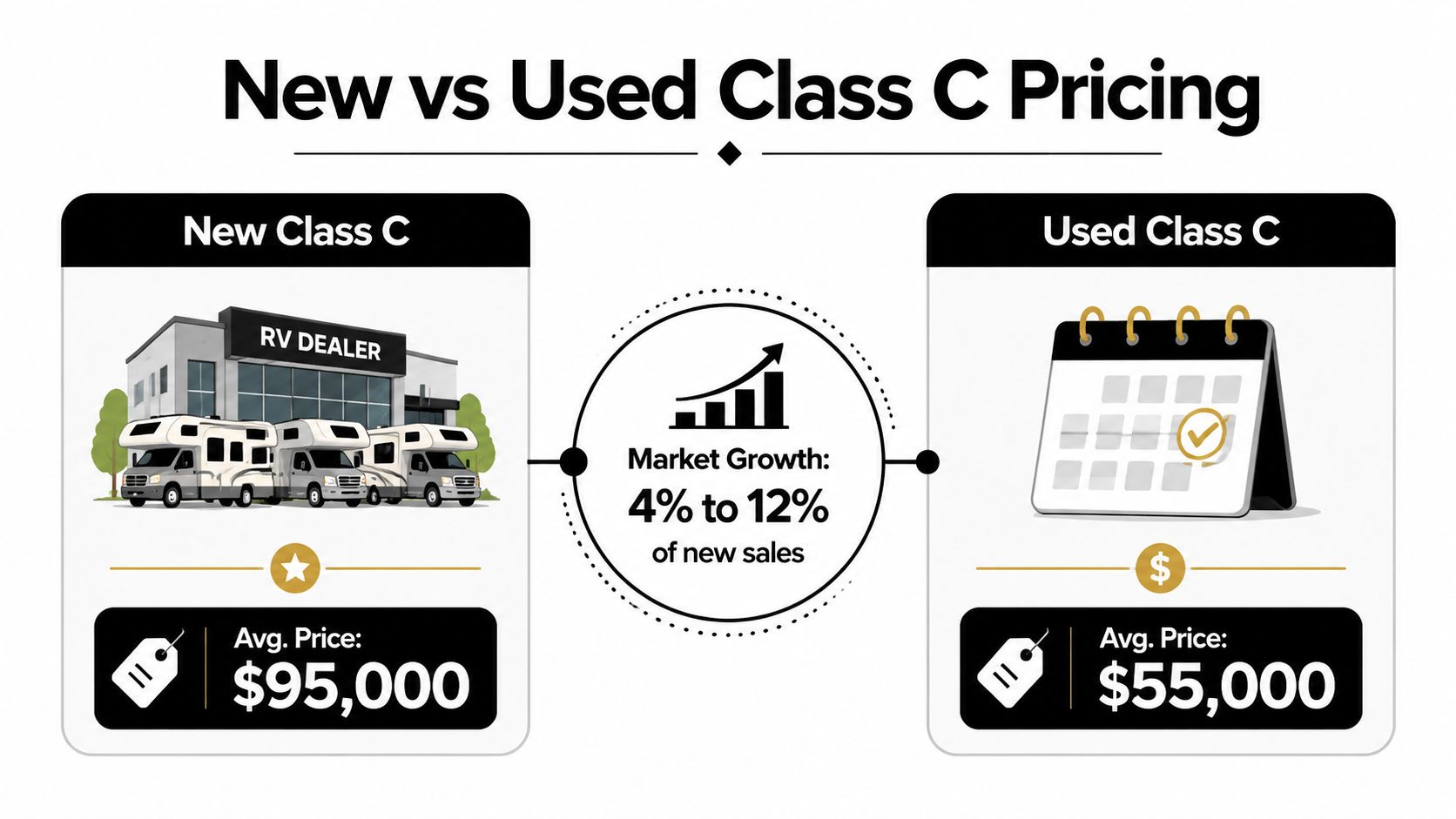
Class C demand has strengthened within the motorized RV category. RV.com reports that Class Cs represented about 4% of all new RV shipments in 2011 and 6% in 2025. When towables are excluded, Class Cs grew from 42% of motorhome sales in 2015 to 60% in 2025, according to the same source. That doesn't mean every new coach is a bargain, but it does show why buyers continue to compare this category closely.
Build a total-cost comparison
Black Book's 2025 RV market updates place average motorhome selling prices around the mid-$63,000 range, while also documenting month-to-month declines late in 2025, as summarized in market coverage referencing the RV updates. The practical implication is straightforward. Buyers should consider how a softer market could affect trade-in value, loan balance, and depreciation after purchase.
A useful comparison looks like this:
| Buying New | Buying Used |
|---|---|
| Current equipment and finishes | Potentially lower acquisition cost |
| Factory warranty may cover eligible repairs | Service records become especially important |
| More choice of exact floorplan | Previous owner may have already absorbed early depreciation |
| Higher initial balance can increase depreciation exposure | Inspection can reveal deferred maintenance |
| Dealer-installed options need to be included in weight calculations | Modifications may complicate weight and warranty questions |
Nearly half of Class C buyers, 44%, pay cash up front, according to Go RVing's owner profile. Cash can simplify the transaction, but it shouldn't erase the need for a reserve for tires, batteries, winterization, repairs, registration, insurance, and storage. Financing can preserve liquidity, yet an extended loan term may leave you owing more than the coach's market value after depreciation.
Use a pre-qualification process before falling in love with a floorplan. Compare the total amount financed, rate, term, down payment, trade value, and estimated ownership expenses. Our RV financing options page is a useful starting point for organizing those questions.
For used inventory, inspect the roof, seams, cab-over area, flooring near slide-outs, window corners, plumbing compartments, and electrical panels. Ask how the unit was stored and whether the owner maintained the chassis separately from the house systems. A clean older coach with documented care can make more sense than a newer unit carrying expensive options you won't use.
Floorplans, Slide-Outs, and Toy Hauler Compatibility Explained
A floorplan should answer a daily question: what happens when everyone is inside? A compact Class C under 24 feet may be easier for a short weekend at Jordanelle State Park, especially when the trip includes narrow access roads and limited parking. A larger coach can make a rainy day or extended stay more comfortable, but the added room may come with more weight, more systems, and a larger turning envelope.
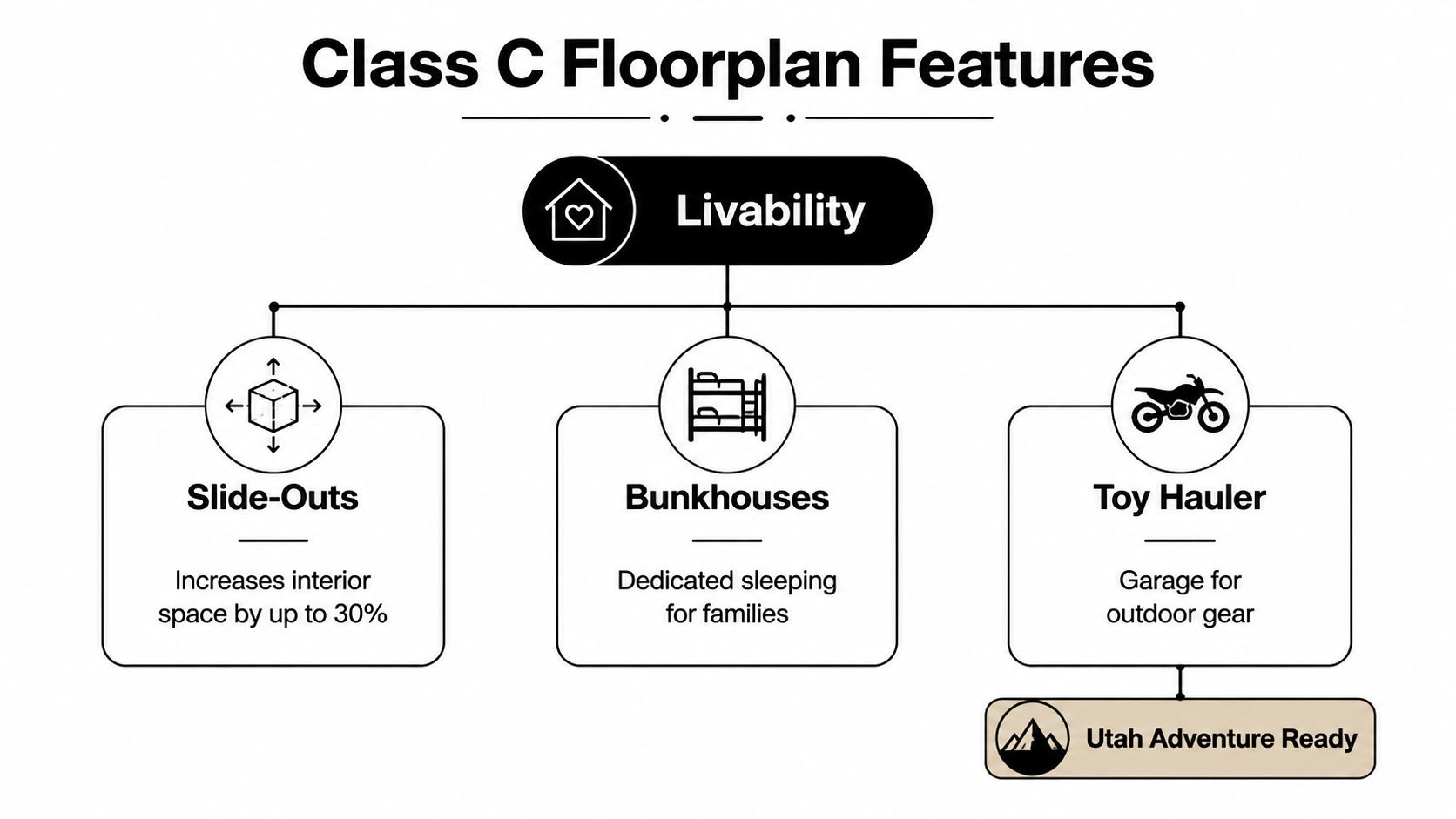
Slide-outs deserve a practical inspection rather than automatic praise. Market coverage says 74% of Class C models introduced from 2023 to 2025 feature slide-outs and 68% include solar panels, according to this Class C market report. Slide-outs can make a coach feel significantly larger at camp, but they also add mechanisms, seals, wiring, and operating procedures that owners must maintain.
Match the layout to the trip
For short trips, a single-slide model can provide enough seating and kitchen room without making setup complicated. For seasonal travel, multiple slides may make the interior more livable, but confirm that you can access the refrigerator, bathroom, and beds with the slides retracted. That matters during fuel stops, overnight parking, and bad weather.
Families should check:
- Seatbelts: Count legal travel positions, not just sleeping spaces.
- Bunk access: Make sure children can reach bunks safely and that the ladder doesn't block the living area.
- Bathroom usability: Test the shower, toilet, and sink with the door closed.
- Storage reach: Open exterior compartments and verify that your chairs, hoses, tools, and winter gear fit.
- Bed conversion: Try the dinette and sofa conversions in person. A bed that's difficult to make every night becomes a daily annoyance.
A king-bed layout can suit couples who spend long stretches on the road, but it may reduce hallway clearance or exterior storage. Compare those trade-offs in Class C motorhomes with a king-size bed before treating mattress size as the deciding feature.
When a toy hauler or Super C makes sense
A toy hauler Class C can be valuable for Utah owners who regularly carry motorcycles, ATVs, kayaks, or fishing equipment. The garage gives you a dedicated loading zone, but it also consumes living space and adds rear weight. Weigh the loaded coach rather than assuming the garage capacity fits your equipment.
A Super C is a different ownership proposition. Its heavier-duty chassis, larger storage areas, and stronger towing potential can suit a trailer or serious powersports load, but it may feel excessive for quick campground weekends. In practical terms, choose the compact Class C when access and simplicity dominate, a standard Class C when family living space is the priority, and a Super C when the load and terrain justify the heavier platform.
How Motor Sportsland Helps Utah Buyers Find and Service Their Class C
A local dealer matters most after the sale. Utah owners face freezing temperatures, dry air, mountain grades, dusty campground roads, and long distances between remote campsites. A nearby service relationship can make it easier to address a small plumbing leak or battery problem before it becomes a trip-ending repair.
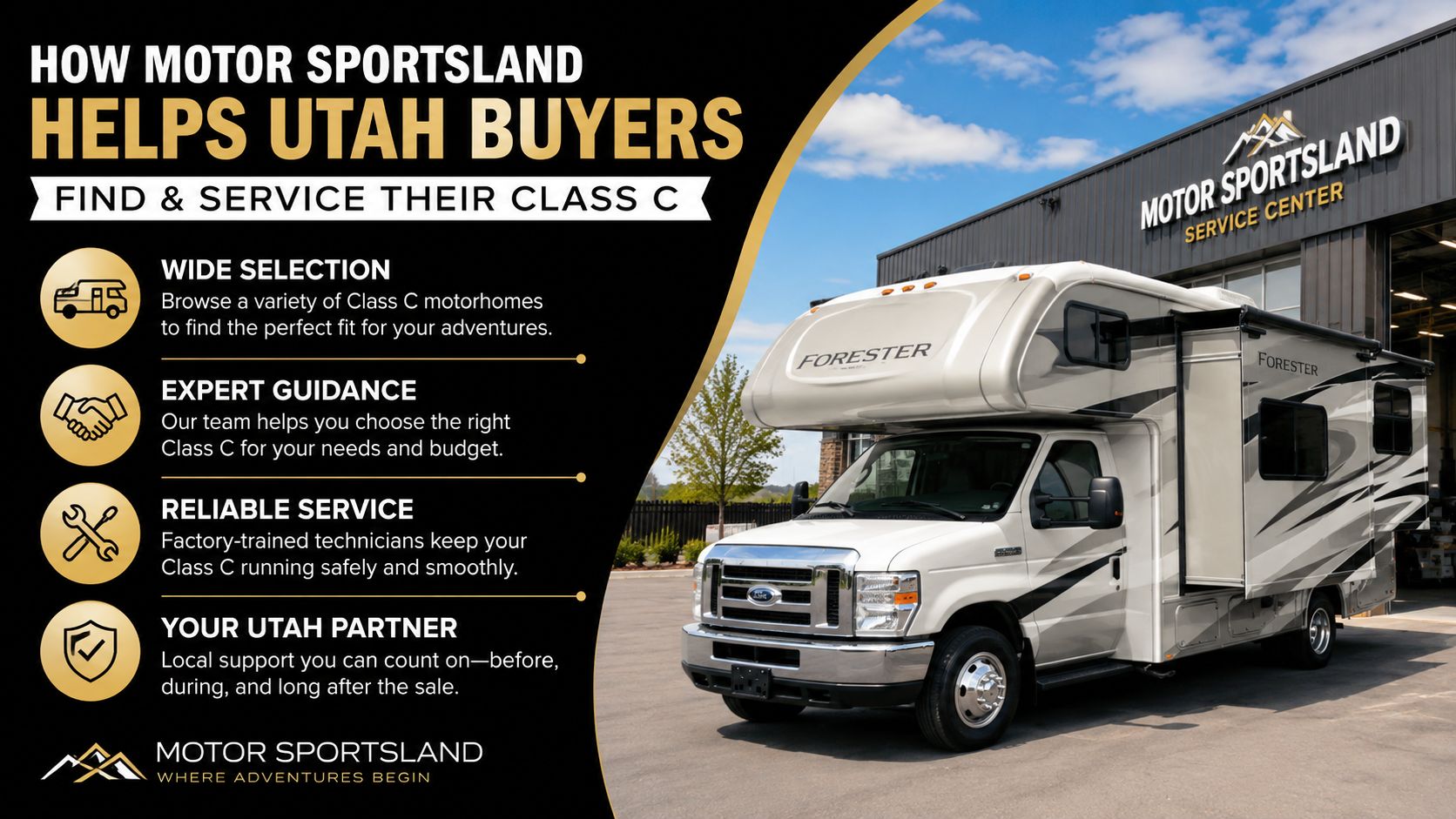
Motor Sportsland has served Utah customers for over 55 years, with locations in Millcreek and Spanish Fork. The dealership's inventory process lets shoppers compare RVs by weight, length, price range, floorplan, and features. That approach keeps the search focused on how the coach will be used instead of leaving buyers to sort through trim names alone.
What a useful dealer conversation covers
Bring a written list of your passengers, cargo, trailer plans, preferred campgrounds, and storage arrangement. A knowledgeable salesperson should help you identify which compromises are acceptable. If you're comparing brands, Motor Sportsland works with manufacturers including Forest River, Keystone, Jayco, KZ, EAST TO WEST, Redwood, and Heartland, although the right choice still depends on the individual coach and your requirements.
The service side handles maintenance checks, repairs, plumbing and electrical work, installations, upgrades, parts, and collision repair. Ask technicians to inspect roof seals, slide-out operation, chassis fluids, batteries, propane components, tires, and water systems before a major Utah travel season.
Service perspective: A pre-trip inspection is cheaper and less stressful when you schedule it before the first warm weekend, not the day before departure.
The dealership also provides trade-in evaluations, financing tools, inventory browsing, Owner's Picks, and rotating Deals of the Week. Those options can help buyers compare the full transaction, but you should still request the out-the-door figures and confirm every installed accessory.
This video walkthrough can give shoppers another way to understand the dealership experience before visiting.
Insurance deserves attention too. Coverage requirements and policy details vary by state and use, so a resource such as the Florida motorhome insurance tag can help you identify questions to raise with an insurance professional, even if your coach is registered and stored in Utah.
Utah-Specific Ownership Tips for Storage, Winterizing, and Service
A Class C that works well in Florida still needs a different ownership routine in Salt Lake City. Freezing temperatures can damage water lines, pumps, filters, and valves, while dry mountain air and intense sun can age exterior seals. Utah owners should plan maintenance around the seasons instead of waiting for a warning light or visible leak.
Prepare before the first hard freeze
Start winterization while daytime temperatures remain manageable. Drain the fresh-water tank, water heater, gray tank, and black tank according to the manufacturer's procedure. Bypass the water heater if the system uses a bypass valve, then use RV-approved antifreeze where appropriate. Don't use automotive antifreeze in the potable-water system.
A practical winter checklist includes:
- Plumbing: Drain low-point lines and protect the pump, faucets, toilet valve, and exterior shower.
- Batteries: Clean terminals, charge batteries fully, and follow the battery maker's storage guidance. Check charge periodically if the coach remains connected or stored away from shore power.
- Propane: Close the service valve when appropriate, inspect hoses and regulators, and have a qualified technician check suspected leaks.
- Exterior seals: Clean and inspect roof, window, slide-out, and compartment seals before snow and ice arrive.
- Interior moisture: Ventilate carefully, use moisture control, and inspect cabinets and corners for condensation or early mold.
Treat mountain driving as part of ownership
Wasatch passes place sustained demands on the engine, transmission, cooling system, brakes, and tires. Downshift before a descent rather than riding the brakes, leave extra following distance, and avoid loading the coach beyond its ratings. High altitude can change engine response, especially when a gas engine is working hard, so allow more time for acceleration and plan fuel stops around the route.
Before a trip to Bear Lake, a high-elevation campground, or a remote desert road, ask a technician to check belts, hoses, fluids, tire condition, battery output, generator operation, and brake performance. If the coach has a diesel engine, follow its maintenance schedule and confirm the emissions system is ready for the trip.
Keep a seasonal service calendar
Schedule a spring inspection after storage, a pre-summer check before your longest trips, and a fall appointment before winterization. Around Salt Lake City, look for covered or secure storage that limits snow accumulation and unauthorized access, then confirm whether you can maintain shore-power connection safely.
Local service access also helps with upgrades that improve Utah usability, such as battery replacements, solar work, suspension checks, hitch equipment, plumbing repairs, and collision repairs. The best Class C motorhome for sale is still a poor ownership choice if you can't maintain it where you live.
Motor Sportsland offers new and used RV inventory, financing support, trade-in assistance, parts, and service for Utah owners comparing Class C motorhomes for sale. Visit Motor Sportsland to browse available coaches, then contact the Millcreek or Spanish Fork team for a weight, floorplan, winter-storage, and service discussion based on your actual travel plans.
Class C Motorhome Buying Mistakes Utah Shoppers Should Avoid
The most expensive mistakes usually happen before the contract is signed. Buyers focus on the cab-over bed, theater seating, or exterior graphics, then discover that the coach cannot carry the equipment their family brings to camp. A motorhome that handles well unloaded may feel very different with passengers, full tanks, bikes, food, and a hitch-mounted rack.
Mistakes that create trouble later
- Shopping by sleeping capacity: A coach may sleep a family comfortably but lack enough travel seats, payload, or storage for that same group.
- Using dry weight as the final number: Dry weight excludes much of what you'll carry. Confirm actual vehicle weight and available payload.
- Ignoring axle ratings: Rear storage and hitch cargo can create an axle problem before the total GVWR appears exceeded.
- Skipping a closed-slide inspection: Make sure the kitchen, bathroom, refrigerator, and sleeping areas remain usable during travel.
- Assuming every hitch can tow your vehicle: Compare loaded weight, GCWR, hitch rating, braking requirements, and local regulations.
- Treating solar and slide-outs as free upgrades: Newer features can improve comfort, but they add weight and maintenance responsibilities.
- Failing to test the driving position: Drive, park, reverse, and make tight turns before deciding that a particular length feels manageable.
- Buying without a winter plan: A coach needs a storage location, winterization routine, battery strategy, and spring inspection before purchase.
Before signing: Put your intended cargo on paper and ask the dealer to explain where that weight will travel in the coach.
A careful buyer also checks the roof and cab-over area for stains, bubbling, soft flooring, or fresh sealant that may conceal earlier water intrusion. On a used Class C, request maintenance records and inspect the generator, appliances, plumbing, HVAC, slide mechanisms, tires, and chassis. If the seller won't allow a meaningful inspection, walk away.
Questions to Ask Before Choosing Class C Motorhomes for Sale
A good appointment should feel like a working session, not a race through a showroom. Bring the people who will travel, sit in every seat, test the beds, and open the storage compartments. Your answers should narrow the search before you compare colors and options.
Which Class C size fits my Utah trips?
Consider your most frequent destination, not only the longest trip you might take. A compact coach may be easier for short campground spur roads and city errands, while a larger coach may be more comfortable for seasonal travel. Verify campground length rules and measure the full coach with accessories.
Should I choose gas, diesel, or Super C?
Gas models can suit buyers who prioritize a simpler entry into motorhome ownership and moderate travel. Diesel and Super C options deserve closer consideration when mountain performance, extended travel, or heavy towing are central to the plan. Compare the chassis ratings and service requirements rather than choosing by engine label alone.
How much payload do I need?
Make a list of passengers, water, fuel, clothing, food, tools, batteries, bikes, propane, and outdoor equipment. Add the weight of dealer-installed accessories, then compare the total with GVWR and the individual axle ratings. If your list leaves little margin, choose a different floorplan or chassis.
Are slide-outs worth the maintenance?
They can improve interior living space, especially for longer stays. Test every slide, inspect seals and flooring, and confirm that essential areas remain accessible when the slides are closed. A simpler layout may work better for frequent short trips.
What should I inspect on a used coach?
Start with water intrusion, roof seals, cab-over construction, flooring, tires, battery condition, generator operation, appliances, plumbing, and chassis records. Ask how the motorhome was stored and whether it was winterized consistently.
Where will I service and store it?
Identify a Utah service provider before purchase, especially if you're new to motorhomes. Confirm winter storage arrangements, seasonal access, battery care, and the timing of spring and fall inspections. A realistic ownership plan protects both your budget and your travel calendar.
Class C motorhomes for sale can be an excellent fit for Utah families, couples, retirees, and outdoor travelers, but the right coach is the one whose chassis, payload, length, floorplan, and service plan match your actual life. Start with the numbers, drive the candidates through real maneuvers, and inspect the systems you'll depend on during Wasatch winters. Browse available inventory through Motor Sportsland, or schedule a visit to compare Class C options with a Utah team that understands mountain roads, campground access, and year-round ownership.
