
Class B Motorhomes for Sale: 2026 Utah Guide
You're halfway up Parleys Canyon when the question gets serious. The van is climbing steadily, the trailhead parking lot is coming into view, and you're wondering whether a 30-foot Class A would have made the trip more comfortable, or perhaps made parking, fuel stops, and mountain driving harder. That's the decision behind shopping for Class B motorhomes for sale in Utah. You're not just choosing a floor plan. You're choosing how easily you'll move through Salt Lake City, reach Jordanelle or Bear Lake, store the vehicle through winter, and live with its limits once the purchase is complete.
Our team at Motor Sportsland helps buyers sort through that decision without relying on glossy manufacturer language. The right answer depends on four things: size, intended use, budget, and ownership reality. This guide explains what Class B vans offer, how new and used choices differ, what to inspect, how Utah's mountains change the ownership equation, and when buying now makes more sense than waiting for perfect market conditions.
Why a Class B Might Be the Smartest RV You Buy This Year
A couple recently came to us after comparing a large motorhome with a camper van for weekend trips from Salt Lake City. They liked the living space of the larger coach, but they also pictured themselves navigating crowded trailheads, narrow campground roads, and city errands between trips. After a long mountain drive, the question changed from “Which RV has more features?” to “Which RV will we use?”
That's where a Class B earns its place. One industry profile reports that Class B motorhomes are owned by 4% of RVers, operate an average of 21 days per year, and account for 56% of their owners' vacation time. Those figures describe a vehicle used heavily for short-duration travel, rather than a full-time residence. The same profile reports that 73% of use occurs in summer, with 42% young families, 45% millennial and Gen-Z owners, and 34% first-time buyers represented among owners. See the camper van market profile for the underlying segment information.
Why Utah favors the smaller footprint
Utah gives Class B owners a lot to do. You can leave Salt Lake City for the Wasatch Mountains, spend a weekend near Moab, or make a longer run toward Yellowstone without handling a large coach at every fuel station. A shorter van also gives you more flexibility at campgrounds, especially where the site layout matters as much as the posted length.
The market is commercially significant, too. One projection places the global Class B motorhome market at USD 15.3 billion in 2025, USD 16.33 billion in 2026, and USD 27.43 billion by 2034, with a projected 6.7% compound annual growth rate. North America represented 47.6% of global market share in 2025 in that same projection. Those are forecasts, not guarantees for any individual model, but they confirm that compact motorhomes remain an established category. You can review the global camper van market forecast for the broader context.
For Utah buyers, the practical questions are straightforward:
- Will you use the van for weekends, road trips, or extended travel?
- Do you need a bathroom and indoor cooking, or mostly a sleeping platform?
- Can you live with compact storage and smaller tanks?
- Will you drive it often enough to justify the purchase?
Our advice is direct. If you want to explore more often, park easily, and avoid treating every trip like a logistical operation, start with Class B motorhomes. If you need separate bedrooms, large tanks, or room for a full family indoors during a storm, move up to Class C or Class A.
What Class B Motorhomes Actually Are
A Class B motorhome is a camper van built on a van chassis. The conversion typically adds sleeping space, a compact kitchen, plumbing, electrical equipment, and sometimes a wet bath or shower inside the original van body. Common platforms include the Mercedes-Benz Sprinter, Ford Transit, and Ram ProMaster.
Think of RV classes as parking requirements. A Class B is closest to a large vehicle that can use ordinary parking spaces and, depending on its height, may fit some residential storage arrangements. A Class C usually needs a long driveway. A Class A often needs a dedicated storage lot because its length and height make ordinary parking impractical.
The compact footprint is not a minor convenience. Class B motorhomes commonly fall around 17 to 23 feet, with many near 20 feet, according to RV size guidance. Another RV-access source says vehicles up to 19 feet can fit in 98% of parks, although individual campground restrictions still vary. That shorter length can help when you're looking at tight Utah sites, overflow areas, and older campgrounds. Review the RV dimensions and park-access guide before assuming any specific campground will accept your van.
The three motorhome classes at a glance
| Class Type | Length | Weight | MPG | Sleeps | Best For |
|---|---|---|---|---|---|
| Class A | Usually much longer than a Class B | Heaviest motorhome category | Lowest among the three | Most spacious | Full amenities, extended stays, large groups |
| Class B | Commonly 17–23 feet | Van-based GVWR varies by chassis | Generally better than larger motorhomes | Couples, solo travelers, some small families | Frequent driving, trailheads, city parking |
| Class C | Between compact vans and large coaches | Heavier than most Class B vans | Usually below Class B efficiency | Families needing extra beds | More interior room without a bus-style coach |
The label covers several different products. A true camper van concentrates on efficient use of a small interior. A touring coach may emphasize finished cabinetry, comfortable seating, and road-trip convenience. An adventure van may add four-wheel drive, higher clearance, and equipment designed for rougher access roads.
The trade-off is space. A Class B won't give you the storage volume or separate living zones of a larger motorhome. It gives you a usable basecamp that's easier to drive, easier to place, and less intimidating for a first-time RV owner.
Real-World Class B Specs and Market Context
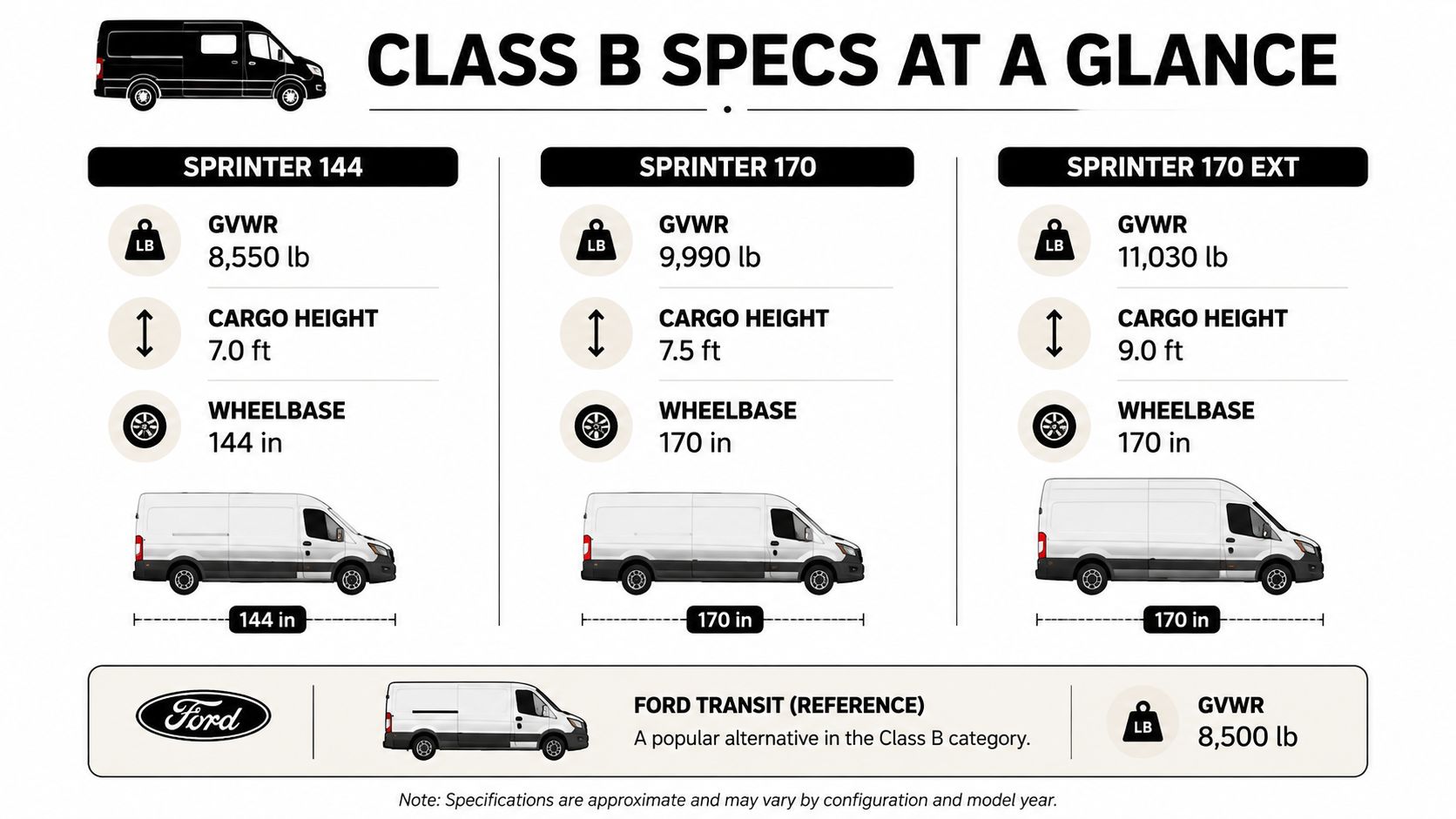
Buyers shopping Class B motorhomes for sale often focus on the floor plan first. We recommend starting with weight, wheelbase, height, and payload, because those specifications determine how the van behaves after you add people, water, food, bikes, recovery gear, and dealer-installed equipment.
Class B motorhomes are commonly built on van chassis and often measure about 18 to 21 feet, with gross vehicle weight ratings around 9,350 pounds in real-world market examples. GVWR includes passengers, cargo, fluids, and accessories, so exterior length alone won't tell you whether the finished van is comfortably within its limits. The RV dry-weight explanation is useful when comparing listed weights with the load you'll actually carry.
Wheelbase changes the driving experience. A shorter van is easier to place in a downtown parking area and generally feels less cumbersome on tight roads. An extended van can provide more sleeping, storage, or bathroom space, but it needs more room to turn and more attention at the rear when reversing.
Fuel economy and usable range
Fuel economy is one of the strongest reasons buyers choose a Class B. Independent RV coverage places efficient diesel and lighter gas builds roughly in the 18 to 22 mpg highway range, with some compact platforms reaching the low twenties under favorable conditions. Those results reflect lower mass and less aerodynamic drag than larger motorhomes, and a typical 24 to 25 gallon tank can provide useful travel range. See the fuel-efficient Class B RV overview for the source context.
You should still compare the actual chassis, roof height, drivetrain, conversion weight, and driving conditions. A loaded van climbing US-6 over Soldier Summit won't behave like an unloaded van cruising on level interstate pavement.
What equipment matters most
Ignore the longest feature list and look for equipment that matches your trips:
- Battery capacity: A larger house battery bank helps when you camp without hookups, but it also adds weight and cost.
- Inverter output: More inverter capacity can support more appliances, but only if the battery system and wiring can supply it safely.
- Heating: Diesel or propane heating matters during Utah shoulder seasons, particularly when overnight temperatures fall quickly.
- Solar: Solar can extend off-grid convenience, but it won't replace careful power management in shade or during short winter days.
- Freshwater capacity: Compact tanks save weight and space, but they require more frequent campground service.
Don't buy a van because it has the most electrical capacity on the spec sheet. Buy the system that supports how you camp.
New Versus Used Class B Motorhomes
The new-versus-used decision comes down to cash flow, warranty preference, and must-have equipment. Neither choice is automatically smarter. A new van gives you current equipment and manufacturer coverage. A used van can give you a better entry point and access to configurations that are no longer common.
The first ownership period usually carries the steepest depreciation. Industry buying guidance commonly describes a 20% to 30% loss during the first three years, but that range is a general market guideline, not a promise for every model or transaction. Condition, mileage, chassis reputation, conversion quality, drivetrain, and maintenance records all matter.
| Factor | New Class B | Used Class B |
|---|---|---|
| Purchase position | Highest upfront cost | Lower entry point is possible |
| Warranty | Manufacturer coverage may apply | Coverage varies, often narrower |
| Selection | Current floor plans and equipment | Older layouts and uncommon builds |
| Risk | Fewer prior-use variables | Requires deeper inspection |
| Depreciation | More exposure early in ownership | Some depreciation may already be absorbed |
| Best fit | Buyers prioritizing coverage and current features | Buyers prioritizing value and configuration |
Match the budget to the priorities
A buyer working below $70,000 will usually spend more time in the used market. A budget around $90,000 to $140,000 can open current-year options, depending on the build and equipment. At $150,000 or more, premium conversions and higher-end adventure configurations become more accessible. Treat these as shopping bands, not guaranteed prices.
Used vans deserve extra attention if they spent years in coastal salt states. Inspect the undercarriage, fasteners, brake components, wiring, and body seams. A clean interior doesn't prove that the chassis avoided corrosion.
We recommend asking for service records, checking the title carefully, and paying for an independent inspection when the vehicle's history is incomplete. Our team can also explain how a pre-owned inspection differs from a new-unit delivery review, so you know which concerns are mechanical, which are cosmetic, and which should stop the purchase.
Dealer perspective: A missing maintenance record is not automatically a deal breaker. A seller who can't explain major repairs, title history, or water intrusion deserves much more scrutiny.
Inspection and Test-Drive Checklist for Class B Buyers
A Class B inspection should begin before you open the side door. The van combines a road vehicle with a compact house, so you need to evaluate both systems separately and together.
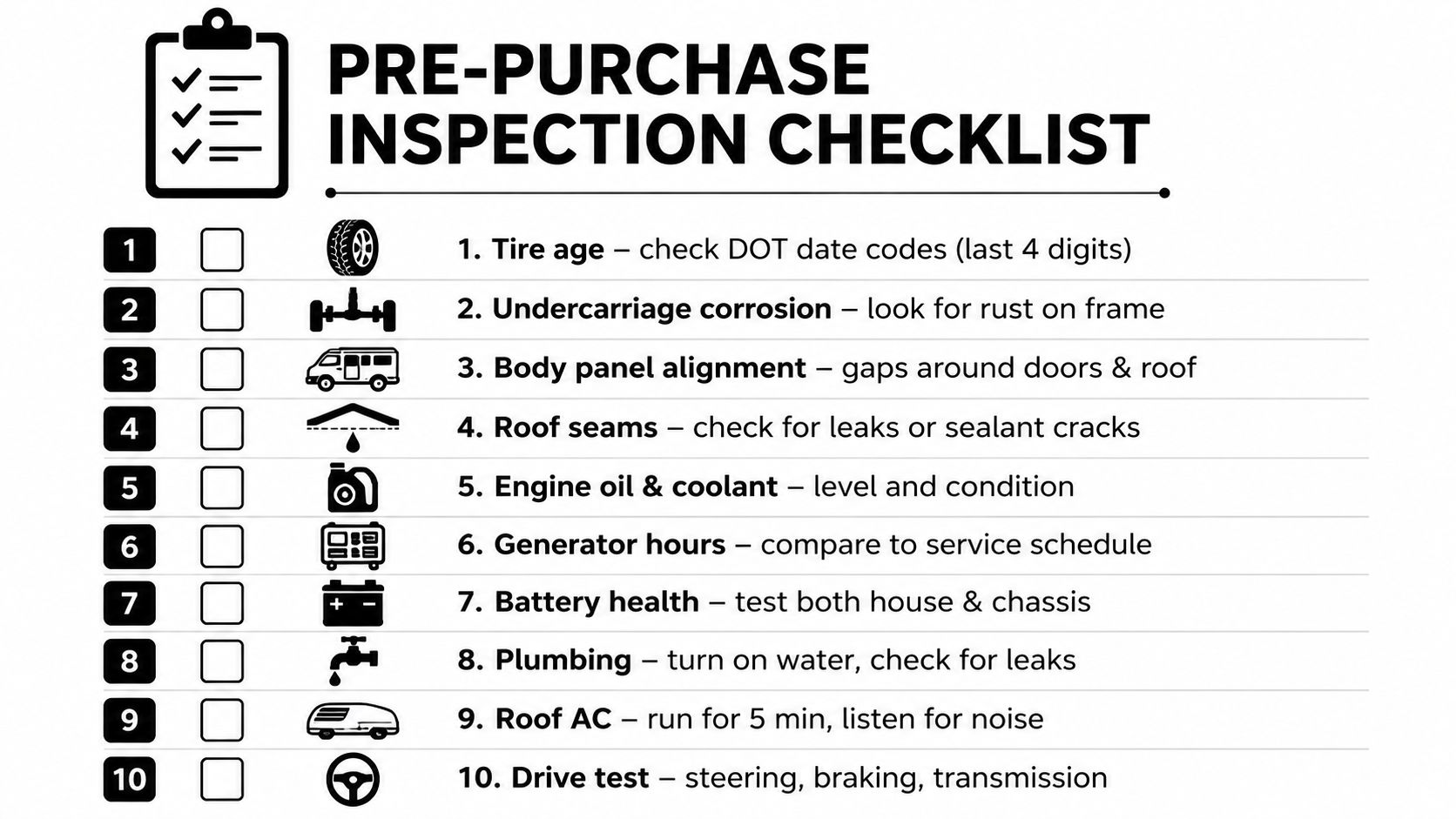
Start outside. Read the DOT date codes on the tires, look for uneven wear, inspect the undercarriage for corrosion, and compare body panel gaps around doors and roof edges. Check roof seams and sealant for cracking or separation. A small roof issue can become a large interior repair after repeated Utah freeze-thaw cycles.
Test every system under real conditions
A quick walk-through isn't enough. Plug into shore power, then test the systems in their normal operating modes. If the van uses propane, verify that the appliances ignite and run correctly.
- Water system: Fill or connect the water supply, operate each faucet, and inspect beneath sinks and cabinets.
- Refrigerator: Test available cooling modes and confirm that controls respond properly.
- Furnace and water heater: Let each run long enough to confirm heat production and stable operation.
- Air conditioner: Listen for unusual vibration, cycling, or compressor noise.
- Inverter and batteries: Check charging behavior and confirm that outlets work when shore power is disconnected.
- Generator: Run it under load for at least 20 minutes, rather than letting it idle without appliances connected.
Safety comes first. A motorhome owner's manual warns that carbon monoxide is deadly, says never to operate a generator indoors or in a confined space, and instructs owners to shut off propane at the tanks during an emergency. It also advises turning off air conditioners and other 120-volt appliances before starting the generator. Read the motorhome generator and propane safety manual before operating unfamiliar equipment.
The road test should include uneven pavement and a controlled stop. Watch for transmission hesitation, steering wander, brake vibration, ABS warning lights, and unusual driveline noise. Finish by verifying the VIN, title branding, service history, and any documented conversion work.
A worn tire, cracked sealant, weak battery, or overdue service may be a reconditioning item. Unexplained water damage, serious corrosion, warning lights, or a title problem should make you walk away or renegotiate from a well-documented position.
Financing, Trade-Ins, and Insurance for Class B Purchases
Most Utah buyers follow one of three paths: finance the van, trade another vehicle, or combine both. Prepare before you fall in love with a floor plan. Pre-qualification helps you understand the payment range you can manage and keeps the inventory search focused.
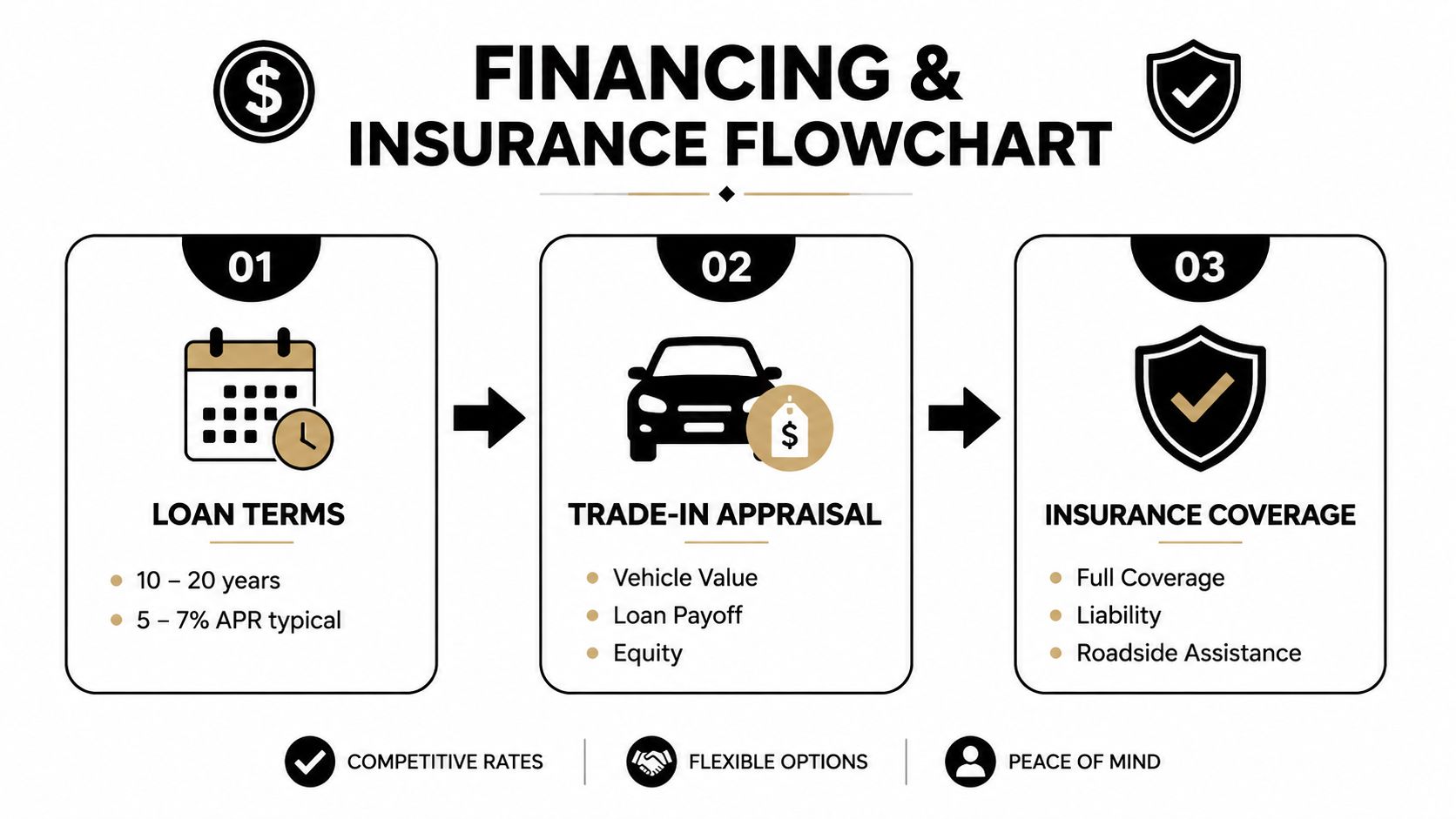
Class B loans commonly use terms from 10 to 20 years, depending on the lender, vehicle age, loan amount, and borrower profile. Lenders may request income verification, identification, residence information, insurance details, and the trade-in loan payoff. Start with a credit application before scheduling a long dealership visit.
Handle the trade and coverage separately
A trade appraisal isn't the same as comparing your loan payoff with an online retail listing. Dealers evaluate condition, market demand, service history, and likely wholesale value. Bring both keys, service documents, payoff information, and honest details about repairs.
Insurance also deserves an early conversation. Class B coverage can differ from ordinary van insurance because the vehicle contains permanently installed living equipment. Ask about collision protection, roadside assistance, storage conditions, and whether a new vehicle needs replacement-cost coverage. Older vans may have different coverage needs, but liability-only insurance leaves the vehicle itself unprotected.
If credit history needs work before you apply, a resource such as Superior Credit Repair Birmingham Alabama can help explain credit-related preparation, even though Utah lenders and local requirements still control the actual RV application.
Our RV financing options guide covers the questions to ask before submitting an application. Motor Sportsland can coordinate lender applications and trade information, while you'll still need to choose insurance and provide accurate financial documentation. The timeline depends on lender response, title status, appraisal, and vehicle preparation, so ask for a clear delivery plan before signing.
Owning a Class B in Utah Mountains and High Country
A Class B feels manageable on the freeway, but Utah's grades expose the difference between a lightly loaded van and one packed with water, bikes, recovery gear, and camping supplies. On I-15 through Parleys Canyon or US-6 over Soldier Summit, hold a steady line, leave room for braking, and pay attention to transmission temperature and brake smell on long descents.
Tire condition matters more than many first-time buyers expect. A van with good tread but old or improperly inflated tires won't deliver the same grip on a cold mountain road. Four-wheel drive can help with traction, but it doesn't cancel stopping distance or poor road judgment.
Winter storage is part of the purchase
If your van will sit from November through April, plan the storage routine before you buy. Preserve the house and chassis batteries according to the manufacturer's instructions, protect the propane system, inspect for rodent access, and drain or winterize plumbing based on the expected temperatures. Covered or indoor storage can reduce exposure, but the right choice depends on ventilation, security, access, and cost.
High-country camping adds another layer. Propane regulators can struggle in extreme cold, generators can lose performance above 6,000 feet, and freshwater lines can freeze during shoulder-season trips. Test the furnace, understand your heating system, and don't assume the insulation of a van conversion matches a larger four-season coach.
For rougher routes, compare drivetrain, clearance, tire design, and recovery points rather than buying four-wheel drive as a badge. Our guide to four-wheel-drive Class B RVs covers the equipment questions worth asking before heading toward Moab, Goblin Valley, the Uintas, or a Yellowstone loop.
The best Class B ownership rhythm is simple. Carry less, secure everything, monitor your power and water, and plan campground access before leaving town.
Your Next Steps and Where Motor Sportsland Fits In
The right purchase starts with an honest use case. If you want a vehicle for quick departures, city parking, trailhead access, and two-person travel, Class B motorhomes for sale deserve serious attention. If you need multiple private sleeping areas, large holding tanks, or substantial indoor living space, a Class C or Class A may serve you better despite the added size.
New and used shoppers should also approach the current market with discipline. Industry updates describe a segment that has normalized after unusually strong pandemic-era demand. One update reported motorhome shipments of just over 36,000 units in the first quarter of 2026, with Class B shipments edging lower while Class A and Class C shipments rose. Another reported that Class B shipments fell 12.07% in the fourth quarter of 2025, while used Class B units were up 7.83% in December 2025. Review the recreational vehicle market update for those reported figures and the surrounding context.
That combination gives buyers an edge, but it doesn't make every van a bargain. Inventory may offer more negotiating room, especially on older model years, while desirable layouts and well-maintained used units can still attract attention. Waiting may bring different choices, but no forecast can tell you whether the exact wheelbase, drivetrain, bed layout, and price you want will appear later.
Use a three-step buying plan
Browse by requirements, not labels. Filter current inventory by length, drivetrain, sleeping arrangement, bathroom design, and budget. A shorter van with the right bed may serve you better than a larger unit with equipment you won't use.
Schedule a walkthrough. Sit in the driver's seat, measure the bed, open every cabinet, inspect the bathroom, and ask where bikes, skis, tools, and winter gear will go. Compact interiors punish vague assumptions.
Drive Utah roads before committing. A dealership-lot loop won't show how the van feels on a grade, in crosswinds, or on uneven pavement. Ask for a test drive that reflects your actual use.
Motor Sportsland has served Utah RV buyers for 55 years through locations in Millcreek and Spanish Fork. Its inventory includes new and used recreational vehicles, including Class B models, and its service operation handles maintenance, repairs, plumbing, electrical work, upgrades, parts, and collision repair. The dealership also accepts trade-ins and works with multiple lenders, which can simplify the handoff from research to ownership.
Bring your checklist, budget, trade information, and questions. The goal isn't to buy the largest or most heavily equipped van. It's to buy the Class B you'll confidently drive into the Wasatch Mountains, maintain through winter, and use often enough to justify owning it.
Frequently asked questions about Class B motorhomes
What is a Class B motorhome?
A Class B motorhome is a camper van built on a van chassis with integrated sleeping, cooking, electrical, and plumbing features. It usually has a smaller footprint than Class A and Class C motorhomes, making it easier to drive and park.
Are Class B motorhomes good for Utah travel?
Yes, especially for couples and active travelers who prioritize maneuverability. Their compact size works well for Salt Lake City errands, trailhead access, and many campgrounds, but mountain grades, winter temperatures, and high-altitude system performance still require preparation.
Should I buy a new or used Class B?
Choose new if warranty coverage and current equipment matter most. Choose used if you want a lower entry price or a specific older configuration, but insist on a careful inspection, complete VIN review, and service documentation.
What should I inspect first on a used camper van?
Start with tires, corrosion, roof seams, moisture intrusion, warning lights, generator operation, batteries, plumbing, and service records. Water damage, serious chassis corrosion, unresolved warning lights, or title problems should receive immediate attention.
Can a Class B motorhome fit in a standard parking space?
Many Class B vans are compact enough for ordinary parking spaces, but length, height, rear overhang, and local restrictions vary. Measure the specific van and confirm the rules for the places you plan to visit.
How do I prepare for financing?
Get pre-qualified, gather income and identification documents, collect your trade-in payoff and service records, and speak with an insurer before finalizing the purchase. A clear budget should include ownership costs beyond the vehicle payment.
Motor Sportsland offers new and used RV inventory, trade-in evaluations, financing assistance, and service support for Utah Class B buyers. Visit Motor Sportsland to browse current options, schedule a walkthrough, and arrange a test drive before your next trip into the Utah mountains.
