
Best Truck for Towing RV: Utah’s Top Picks 2026

You've probably been there already. You found the right travel trailer or fifth wheel for weekends at Bear Lake, longer runs to Zion, or summer escapes into the Uintas. Then you start shopping trucks and every ad seems to shout one thing. Bigger tow number. Bigger badge. Bigger promise.
That's where a lot of first-time RV buyers get sideways.
The best truck for towing an RV usually isn't the truck with the flashiest max towing claim. It's the truck that still has enough real carrying capacity for your family, your hitch, your gear, and the way you travel through Utah. A setup that feels fine on flat ground can become tiring fast when you're climbing into thinner air, dropping down canyon grades, or dealing with crosswinds near the Great Salt Lake.
Around Salt Lake City, we see this mistake often. A buyer matches the truck to the brochure headline instead of the loaded RV. The result is a combination that may work on paper but never feels relaxed or confidence-inspiring on the road. A better approach is payload-first matching. That's how you choose a truck you'll still be happy with after the novelty wears off and the actual trips begin.
Introduction
A simple way to think about it is this. Towing capacity is what your truck can pull. Payload is what your truck can carry on itself. For RV owners, payload is often the number that runs out first.
Think of towing like pulling a wagon and payload like loading a backpack. You might be strong enough to pull the wagon, but if the backpack is already overloaded with people, cargo, hitch hardware, and trailer weight pressing down on the truck, you're still over your limit. That's why shoppers can buy a truck with a respectable tow rating and still end up with a poor RV match.
For RV buyers, this matters most with heavier travel trailers, fifth wheels, and toy haulers. A trailer can look towable based on the advertised tow number, then eat up the truck's usable capacity once the actual load is added. That's one reason why guidance focused only on big marketing numbers misses the point.
A useful industry reminder comes from Good Sam's towing guidance, which notes that over 68% of tow vehicle violations occur due to payload mismanagement rather than insufficient towing power.
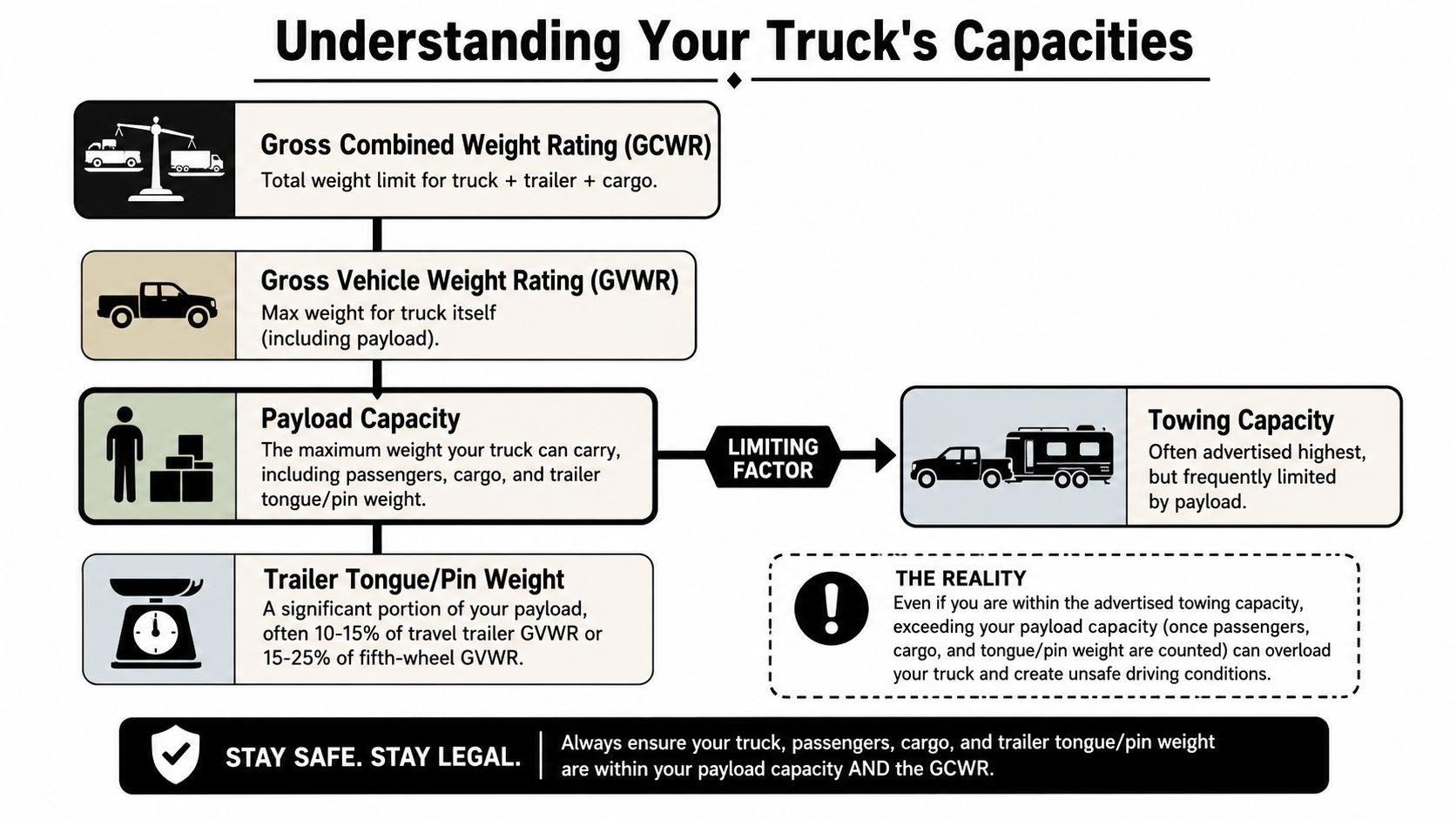
What the weight terms mean in plain English
A few terms matter more than the rest:
- GVWR means the maximum allowed weight of the truck itself when loaded.
- GCWR means the maximum allowed weight of the truck and trailer together.
- Payload means how much weight the truck can carry, including passengers, cargo, hitch equipment, and trailer tongue or pin weight.
- Curb weight means what the truck weighs before you load it up.
If you're comparing trailers, it also helps to understand how RV dry weight differs from ready-to-camp weight. Dry numbers can be useful for comparison, but they're not the whole story when you're choosing a tow vehicle.
Travel trailers, fifth wheels, and toy haulers don't load the truck the same way
A travel trailer usually puts tongue weight on the hitch behind the truck. A fifth wheel puts pin weight in the bed, and that load can use up payload quickly. A toy hauler adds another wrinkle because cargo changes from trip to trip, which means your real weight can swing more than many buyers expect.
Practical rule: Don't shop for the highest advertised tow rating first. Shop for the truck that still works after you add passengers, bed cargo, hitch equipment, and the trailer's real loaded hitch weight.
That's also why half-ton, three-quarter-ton, and one-ton trucks tend to fit different kinds of RVs. The right answer changes based on what you're pulling and how you use it.
Matching Your Truck to Your RV
The truck classes that work best for RV towing are easier to understand when you start with the trailer, not the truck badge. Heavy-duty pickups have become the benchmark because published tow ratings in top configurations can reach nearly 40,000 pounds, but the better takeaway is more practical: there's no single best pickup truck for towing, and the right choice depends on payload and your RV's actual loaded weight.
Here's a quick match-up guide built around how most buyers shop.
| RV Type | Typical Dry Weight (lbs) | Recommended Truck Class | Example Truck Models |
|---|---|---|---|
| Lightweight travel trailer | Varies by model | Half-ton truck | Ford F-150, Ram 1500, Chevrolet Silverado 1500 |
| Large travel trailer | Varies by model | Three-quarter-ton truck | Ford F-250, Ram 2500, Chevrolet Silverado 2500HD |
| Smaller fifth wheel | Varies by model | Three-quarter-ton or one-ton truck, depending on loaded pin weight | Ford F-250, Ford F-350, Ram 2500, Ram 3500 |
| Heavy fifth wheel | Varies by model | One-ton truck | Ford F-350, Ram 3500, Chevrolet Silverado 3500HD |
| Toy hauler | Varies by model and cargo | One-ton truck in many cases | Ford F-350, Ram 3500, Chevrolet Silverado 3500HD |
Half-ton trucks for lighter travel trailers
A half-ton can be a good fit when the trailer is light and the family packs sensibly. This is usually the category where buyers get in trouble by assuming a headline tow rating tells the whole story. It doesn't.
Half-tons are attractive because they're easier to live with day to day. They ride better unloaded, fit more easily in garages and parking lots, and can make sense if the RV will stay modest in size. The catch is that hitch weight, passengers, and cargo can tighten the margin quickly.
Three-quarter-ton trucks for bigger trailers and selective fifth-wheel use
For many Utah buyers, this is the practical middle ground. A three-quarter-ton truck gives you a stouter frame, stronger suspension, better stability, and a more relaxed feel on grades and in wind. It's often the right answer for larger travel trailers and some smaller fifth wheels, but you still need to check the loaded numbers carefully.
If you're comparing hitch-loading basics across trailers, this primer on essential boat towing information is useful because the same discipline applies to RV owners. Proper hitch weight matters for control, braking feel, and sway behavior.
One-ton trucks for heavy fifth wheels and toy haulers
When buyers move into larger fifth wheels or toy haulers, the best truck for towing an RV often falls into this category. One-ton trucks give you more room to work with, and that usually shows up as less stress behind the wheel. In the mountains, that confidence matters.
A one-ton doesn't always mean overkill. Sometimes it means buying enough truck once instead of replacing it after one season because the setup feels maxed out every time you head toward a canyon.
Gas, diesel, 4×2, 4×4, and axle ratio trade-offs
A few choices change how the same truck behaves:
- Gas engine: Lower upfront complexity, often a sensible fit for lighter or occasional towing.
- Diesel engine: Better low-end pulling feel for long grades and heavier loads, especially when towing often.
- 4×2: Simpler and lighter, but less useful for mixed-weather camping and dirt access roads.
- 4×4: A smart Utah choice for many buyers who travel shoulder season, camp off pavement, or tow in changing weather.
- Lower axle ratio for daily use: Better for unloaded driving manners.
- Tow-focused axle ratio: Better for pulling confidence, especially in mountain terrain.
Decoding Engines Drivetrains and Axles
Choosing the right truck class gets you close. The powertrain and running gear determine how that truck feels when it's working.
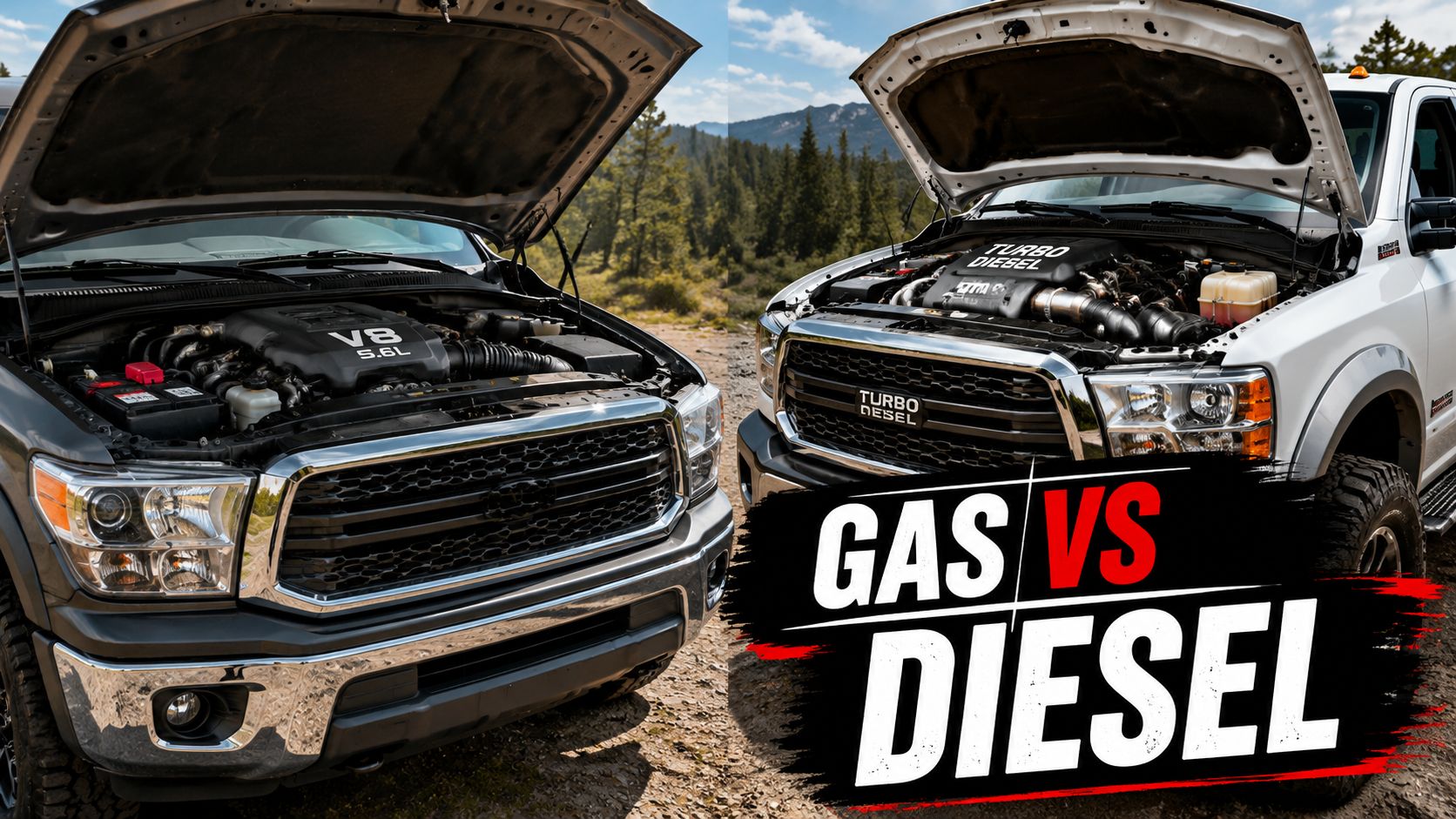
Gas or diesel in Utah towing conditions
A gas truck can be a very reasonable tow vehicle. If you're pulling a lighter trailer a handful of times each season and using the truck as a daily driver the rest of the year, gas is often the simpler ownership experience.
Diesel earns its keep when loads get heavier or the route gets steeper. The low-end power delivery feels calmer on climbs, and that matters when you're headed through mountain passes with a full trailer behind you. For buyers looking at bigger fifth wheels, diesel is often the configuration that makes the whole combination feel less busy.
A truck that tows comfortably on a flat test drive can feel very different on a long Utah grade with a full water load, bikes in the bed, and a family in the cab.
4×4 and axle ratio choices that actually matter
In Utah, 4×4 is more than a lifestyle box to check. If you camp outside peak summer, use gravel roads, or travel when weather can change in a single afternoon, it's a practical upgrade. Even at the campground, traction can matter more than buyers expect.
Axle ratio is one of the most misunderstood towing specs. A tow-oriented ratio helps the truck get moving and stay in the power band more easily under load. The trade-off is that unloaded driving may feel busier. If your truck is going to spend serious time towing through hills, a towing-focused axle setup is usually worth discussing.
Why payload changes with truck configuration
Truck trim, cab size, bed length, drivetrain, and engine all affect payload. That's why two trucks with the same badge can have very different real-world capability. A concrete example from Living Vehicle's towing guide is that single-rear-wheel Ford F-350 trucks commonly have 3,000 to 4,000 pounds of payload, which is a big reason they're such common RV tow vehicles.
That number matters because pin weight can consume a large share of the truck's capacity before you add coolers, tools, passengers, or anything else in the cab and bed.
Transmission heat matters too when towing in elevation and summer temperatures. If you want a quick mechanical overview, this explanation of GFX's automatic cooler advantages is worth a read.
One more item deserves real attention before you sign for a truck. Hitch type and brake control setup change safety more than many first-time owners realize.
Essential Hitches and Braking Systems
A good tow vehicle can still be a poor towing setup if the hitch and brake system aren't right for the trailer.
Choosing the right hitch for the trailer type
A conventional receiver hitch is the normal choice for most bumper-pull travel trailers. This is the setup many families start with, and it can work very well when the truck and trailer are matched correctly.
A fifth-wheel hitch mounts in the bed, over or near the rear axle area, which generally improves stability for heavier trailers. A gooseneck-style connection also uses the bed area, though RV buyers most often talk in terms of fifth-wheel towing. The key point is simple. Bed-mounted trailer connections change how weight is carried and usually provide a more planted feel with larger RVs.
Why integrated brake controllers matter
This is one of the clearest real-world safety upgrades in current truck shopping. Recent NHTSA-linked reporting summarized by Car and Driver notes that integrated braking systems on many 2025+ trucks reduce stopping distances by 18% for heavy trailers compared to aftermarket controllers.
That matters in Utah because mountain descents punish marginal braking setups. A factory-integrated brake controller generally communicates more cleanly with the truck's systems, and the result is more predictable trailer braking. It's not just about convenience. It's about smoother control when traffic compresses, weather changes, or the road falls away under you.
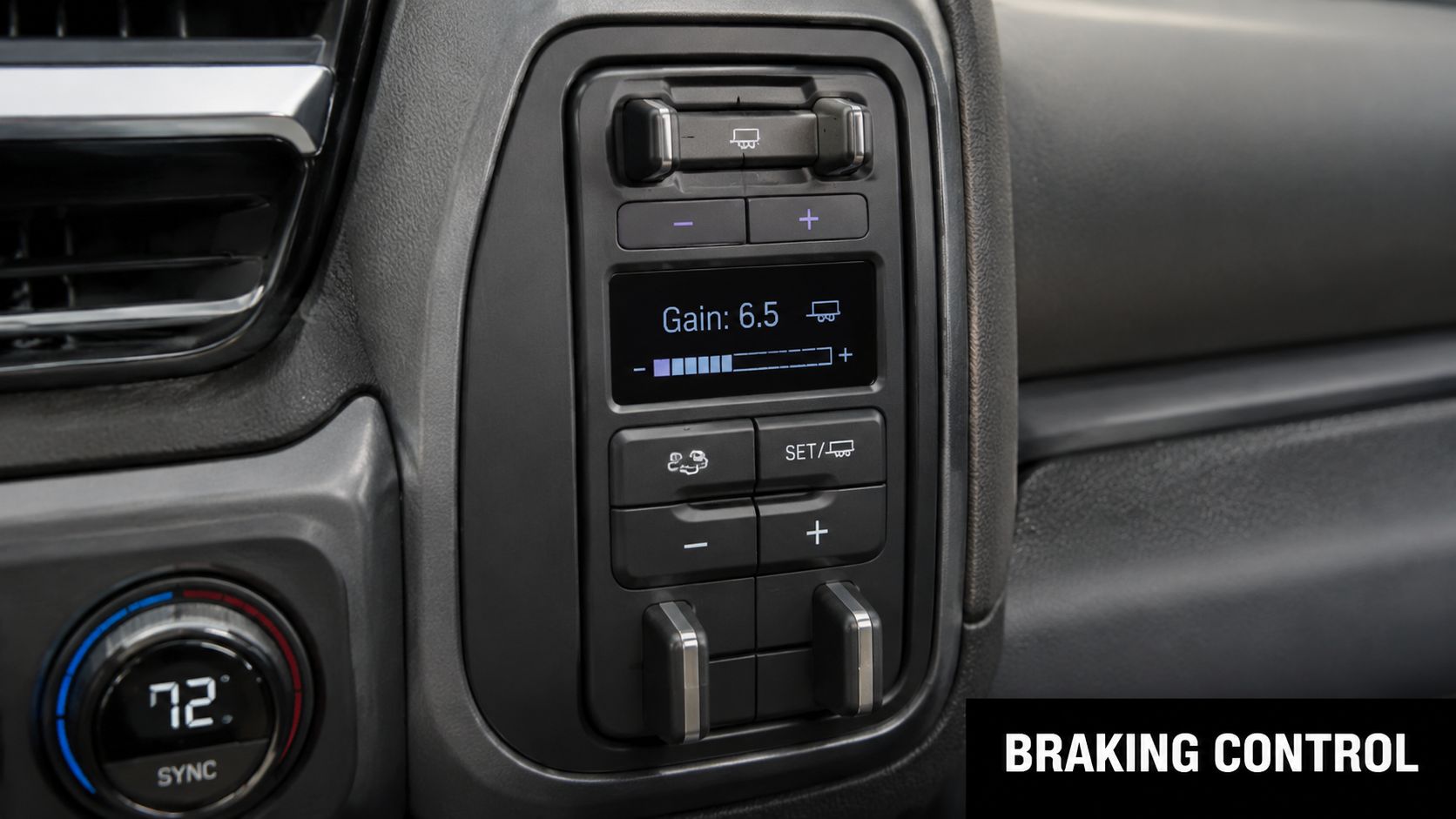
Safety note: If you're shopping used, don't assume the brake controller setup is equal from one truck to the next. Verify what's factory-integrated, what's aftermarket, and how the trailer actually brakes under load.
If you want a practical overview of setup basics, this guide on choosing a camper brake controller covers what to look for and why it matters.
Utah Towing Safety and Legal Tips
Utah adds a few real-world challenges that generic towing advice tends to gloss over. Elevation, grades, wind, and temperature swings all make a setup work harder.
The most useful rule is simple. Industry guidance from Heartland recommends leaving about a 10% safety margin below your truck's rated towing capacity. In plain terms, a truck rated at 12,000 lb should ideally tow 10,800 lb or less for general safety.
A practical pre-trip checklist
Before any longer tow, check the basics in this order:
- Truck tires: Look for proper inflation, uneven wear, and sidewall age.
- Trailer tires: Verify condition before every trip, not just at the start of the season.
- Lights and signals: Confirm brake lights, running lights, and turn signals with a walk-around.
- Brake feel: Make sure trailer braking engages smoothly and doesn't grab or lag.
- Mirrors and visibility: Set towing mirrors so you can see down both sides of the RV.
- Load placement: Keep cargo balanced to reduce sway and improve control.
- Coupler and cables: Inspect the hitch latch, safety chains, and breakaway connection.
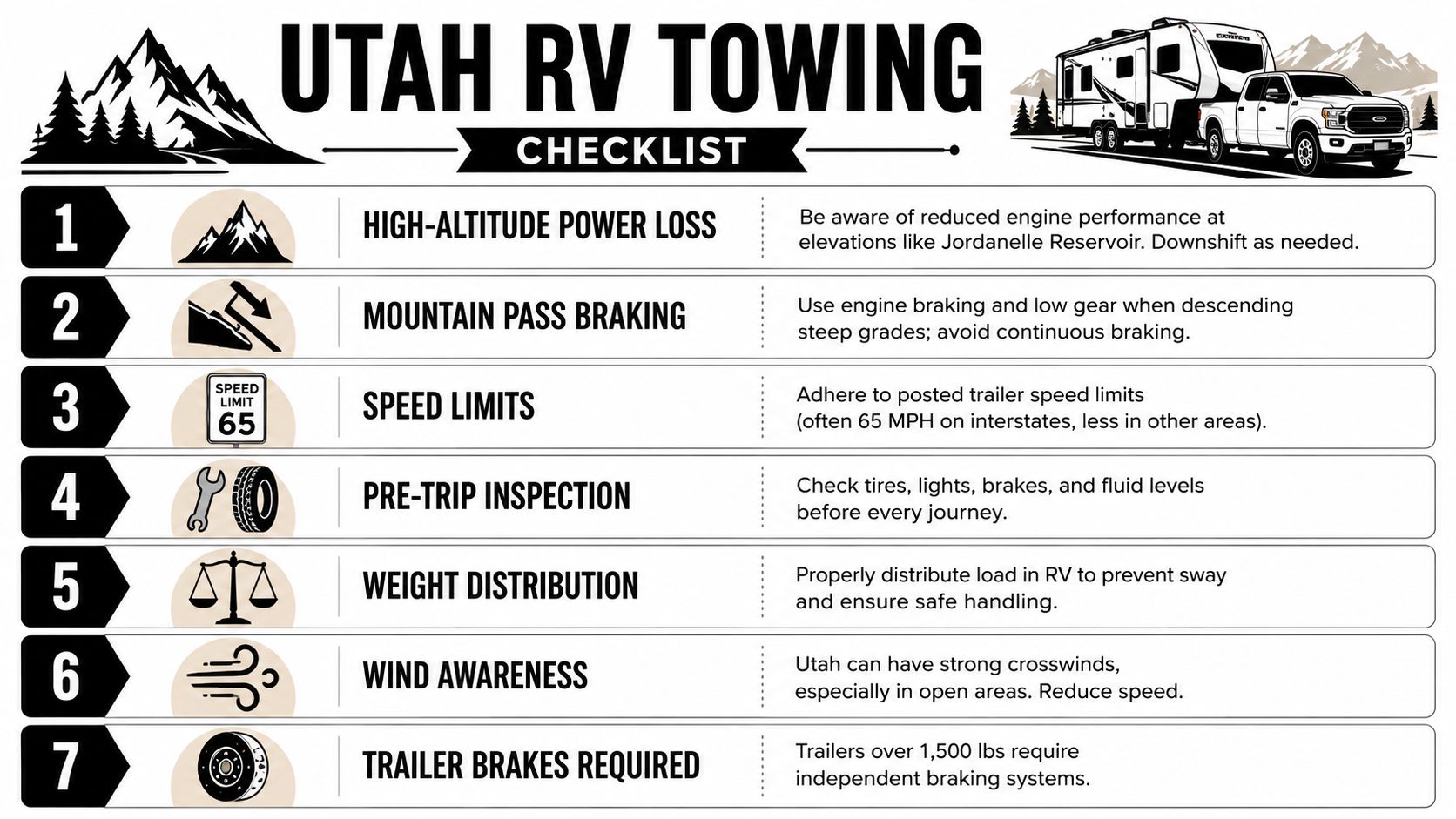
What catches drivers off guard in Utah
High altitude can make a truck feel flatter on climbs. Long descents require restraint, not panic braking. Crosswinds can move a tall trailer around more than new owners expect, especially in open areas west of the valley and around the Great Salt Lake.
If your combination feels twitchy, don't try to solve it with speed. Slow down, rebalance cargo, and address the hitch setup. This guide to RV sway control is a good starting point if you're troubleshooting handling.
Your Next Steps and Final Checks
If you're still narrowing down the best truck for towing an RV, keep the process simple. Start with the loaded RV you want. Then work backward into the truck.
For a used tow vehicle, I'd check these items before anything else:
- Tires and wheels: Look for age, uneven wear, and evidence of hard service.
- Rear stance: A truck that sags unloaded deserves a closer suspension inspection.
- Hitch area: Check the receiver, bed, and frame area for signs of heavy wear or poor installation work.
- Brake controller setup: Confirm whether it's factory integrated or aftermarket.
- Service records: Regular maintenance matters more than a polished exterior.
- Cab and bed payload sticker: Read the actual truck sticker instead of assuming every model is the same.
Buyers also ask whether financing, hitch installation, and service can be handled without juggling several shops. In practice, that's the smoother path. Motor Sportsland is one option for RV buyers who want help with trailer matching, service work, and accessory installation through a local dealership workflow, rather than piecing it together on their own.
Shop for a setup you can tow comfortably on your worst travel day, not just your easiest one.
If you already own the truck, the next smart move is to match it to the right trailer. If you already own the trailer, verify the numbers and equipment before assuming the truck is enough.
Frequently Asked Questions About Towing
Can a half-ton truck tow an RV
Yes, many half-ton trucks can tow RVs, especially lighter travel trailers. The key question isn't just whether it can pull the trailer. It's whether the truck still has enough payload for passengers, cargo, and hitch weight.
Is a diesel always the best truck for towing an RV
Not always. Diesel makes the most sense for heavier trailers, frequent towing, and long mountain grades. Gas can still be the better ownership fit for lighter towing and more everyday driving.
Do I need a one-ton truck for a fifth wheel
Some smaller fifth wheels may fit a three-quarter-ton on paper, but many buyers end up happier in a one-ton because of payload and stability. Fifth-wheel pin weight is often what pushes the decision.
Is towing in Utah harder than towing in flatter states
It can be. Utah adds altitude, steep grades, and crosswinds. A truck that feels fine in easy conditions can feel strained faster in the mountains.
What matters more, tow rating or payload
For many RV buyers, payload is the limiting factor that decides whether the combination is workable. That's why payload-first shopping is the smarter way to choose.
If you want help matching a trailer to the right truck, browse Motor Sportsland inventory online, compare travel trailers and fifth wheels by size and floorplan, or stop by one of our Salt Lake area locations for a practical, no-pressure conversation about what will tow safely in Utah.
