
Best RV Parts Utah: Your 2026 Source Guide
You're parked near Jordanelle, the slide-out won't retract, and the forecast is turning cold. The part may be small, but finding the correct replacement in Utah can involve more than searching a catalog and choosing the lowest price. Compatibility, local inventory, return policies, installation, mountain towing, winter storage, and seasonal demand all affect whether you're back on the road today or waiting for a special order.
That's the practical problem behind RV parts Utah searches. The right purchase starts with identifying the failure, then choosing the right source and deciding whether the repair belongs at the parts counter or in a service bay. Utah's outdoor recreation economy reached $9.5 billion in value-added in 2023, supporting 71,898 jobs, and RVing contributed $412 million to that total, according to the Utah Division of Outdoor Recreation report. RV ownership here is a substantial market, not a niche hobby.
Motor Sportsland serves Utah owners from Millcreek and Spanish Fork, with parts, diagnostics, installation, and repair support through its Service Center. The advice below is designed to help you identify parts accurately, avoid preventable delays, and prepare an RV for Wasatch Mountains travel, Great Salt Lake heat, and cold-weather storage.
The Utah Reality Behind an RV Parts Search
A slide-out that refuses to retract at Jordanelle often looks like a single failed motor or switch. In practice, the fault could involve a fuse, wiring, a ground connection, a control board, or a mechanical obstruction. Replacing the first visible component without testing can leave the original problem in place and create a second one.
Utah adds pressure to that decision. Mountain roads place demanding loads on hitches, brakes, tires, axles, and tow vehicles. Freeze-thaw cycles punish roof sealants and slide-out seals, while high-altitude sun can age exterior materials faster than an owner expects. A part that seems acceptable for a short lowland trip may not be the right choice before a climb through the Wasatch Mountains.
The three decisions behind every parts purchase
Most owners need to answer three questions:
- What failed? Start with the symptom, then test the related fuse, breaker, wiring, ground, fluid, or mechanical connection.
- Where should the part come from? Local dealers, retail chains, parts stores, online sellers, and salvage sources each solve different problems.
- Who should install it? A fuse or bulb may be a reasonable driveway replacement. Brake assemblies, propane components, converters, inverters, and structural hardware deserve more caution.
The national aftermarket survey from the RV Industry Association found that the average RVer made about six aftermarket purchases in the prior two years, while newer and younger owners made more than double that number. The survey also found fragmented buying behavior, with 21% of purchases made where the RV was purchased, 18% at a retail chain, 16% at a local parts store, and 8% at another RV dealer. Owners use multiple channels because no single source consistently has every part, every time.
Practical rule: A cheap part that doesn't fit is more expensive than a correctly identified part that costs slightly more.
Motor Sportsland's Millcreek and Spanish Fork locations give Utah owners a local touchpoint for parts questions, diagnostics, and installation. The useful outcome isn't just knowing where a storefront is. It's knowing what information to collect, which categories require exact matching, and when a service appointment will save more time than another round of online ordering.
Identifying the Exact Part You Need Before You Buy
The most common parts-counter problem is an owner who has the right symptom but the wrong component. “The water heater doesn't work” isn't a part number. Neither is “the awning is broken.” The technician or parts specialist needs the RV's identity and the failed component's identity.
Build a proper identification packet
Before ordering, collect:
- Vehicle identity: Record the VIN, manufacturer, model, model year, and floorplan if available.
- Appliance information: Photograph the data plate on the furnace, refrigerator, water heater, air conditioner, generator, or converter.
- Part markings: Capture every label, stamped number, connector shape, fuse rating, and bracket detail.
- Installation context: Take wide and close photographs showing how the part mounts and where wires, hoses, or fasteners connect.
- Failure behavior: Write down what happened, including whether the component failed suddenly, worked intermittently, tripped a breaker, leaked, or made unusual noise.
An awning example shows why this matters. Two awning assemblies can look alike while using different motor connections, fabric dimensions, mounting brackets, or replacement end caps. A photograph of the entire awning, a close-up of the motor label, and the RV make, model, and year give the parts department a much better chance of matching the correct item on the first order.
Test the simple causes first
A converter, inverter, fuse, or wiring fault can disable appliances, slide-outs, and charging circuits. That doesn't mean the largest component in the system has failed. With the power sources isolated as appropriate, an owner can inspect accessible fuses, breakers, visible wiring, loose terminals, and ground connections. Stop if testing involves live high-voltage circuits, propane, structural lifting, or a component you can't safely isolate.
A useful RV repair and parts identification FAQ notes that commonly replaced items include tires, batteries, water pumps, roof sealants, awning components, slide-out seals, brake components, roof vents, propane regulators, trailer lights, fuses, and appliance control boards. It also emphasizes supplying the VIN, make, model, year, appliance model numbers, or photographs when identifying a replacement.
Use this pre-order checklist:
- Confirm the symptom, not just the suspected part.
- Match the part number and revision, where listed.
- Compare connectors, mounting points, dimensions, and ratings.
- Ask whether the part is repairable, replaceable, or warranty-controlled.
- Confirm the return policy before opening packaging.
- Keep the old part until the replacement has been installed and tested.
Where to Source RV Parts in Utah
The best source depends on the part and the urgency. A local RV service center is usually the safer starting point for model-specific components, warranty work, and repairs involving multiple systems. An online retailer may be perfectly sensible for a standard fuse, bulb, filter, or sealant, provided the specifications match.
The Motor Sportsland RV parts department is one local option for Utah owners who want to discuss fit, availability, and installation rather than relying on a product photo alone. For discontinued plastic trim, cabinet hardware, or an older appliance component, a salvage or liquidation source can sometimes succeed where a new-parts catalog can't.
Comparing RV Parts Sourcing Channels in Utah
| Channel | Fit assurance | Typical turnaround | Return handling | Warranty support |
|---|---|---|---|---|
| Local RV dealership or service center | Strongest for model-specific parts when the RV and component are verified | Depends on stock and supplier availability | Staff can help diagnose mismatches before ordering | Best suited to dealership-installed or warranty-related work |
| Retail chain or auto parts store | Good for standardized automotive or electrical items, limited for RV-specific assemblies | Often quick for stocked commodity items | Usually governed by the chain's standard policy | Varies by brand and whether installation is documented |
| Online retailer | Broad selection, but compatibility depends on the buyer's research | Shipping introduces another delay | Returns may require repackaging and shipping | Buyer typically manages manufacturer and seller communication |
| Salvage or liquidation yard | Useful for discontinued trim, panels, and older components | Unpredictable, based on available inventory | Often limited or final sale | Usually limited compared with new OEM supply |
A fragmented channel pattern is normal. The RV Industry Association survey cited earlier found purchases distributed among the original RV seller, retail chains, local parts stores, and other RV dealers. That behavior makes sense, but it also increases the chance of inconsistent identification and return handling.
For specialized manufacturing context, American Additive Manufacturing automotive offers useful background on how additive manufacturing supports automotive applications. That perspective can help owners understand why a replacement bracket, trim component, or discontinued plastic part may require a different sourcing approach than a standard stocked component.
OEM Versus Aftermarket Parts and When Each Makes Sense
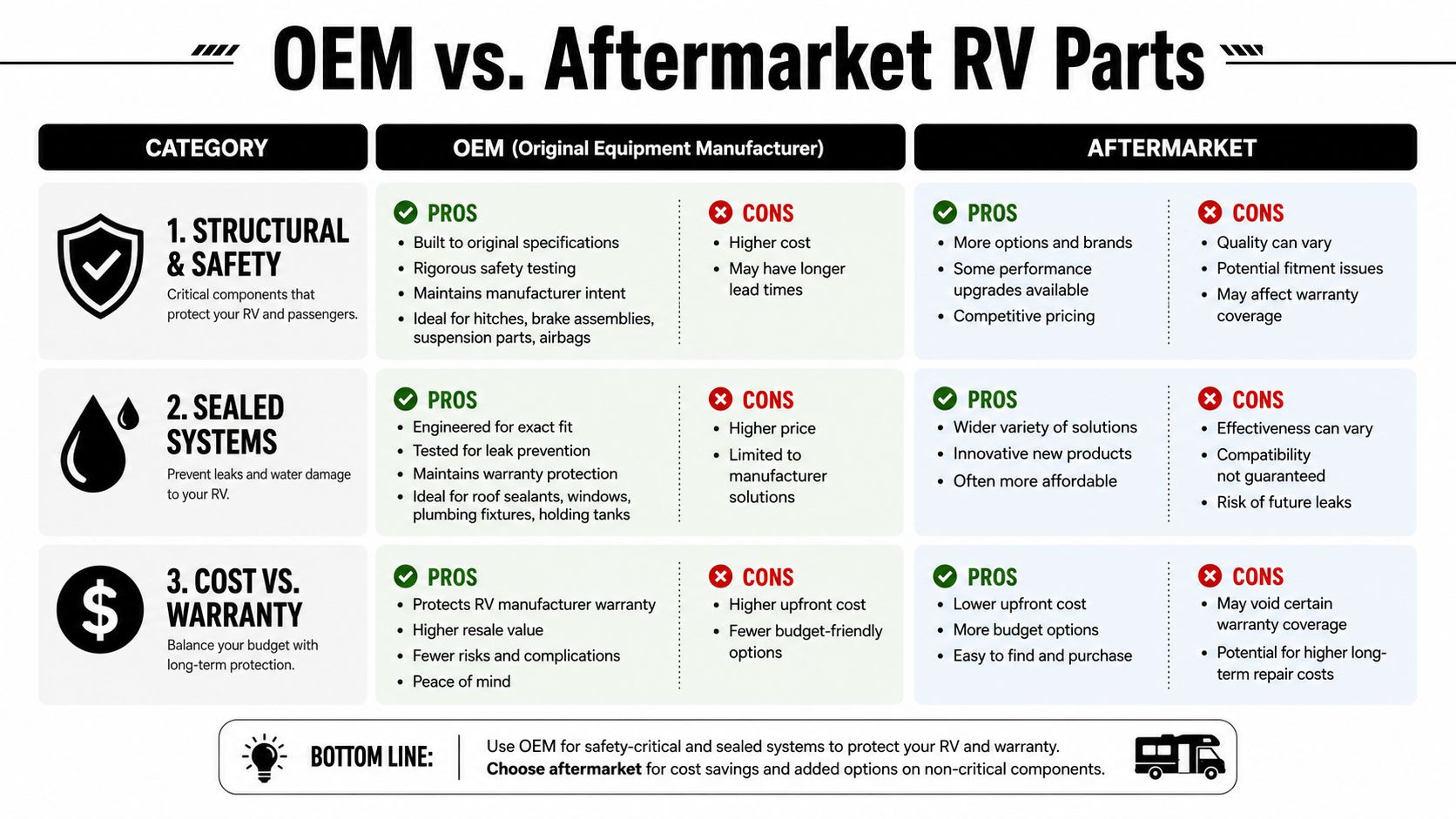
OEM and aftermarket aren't automatic winners or losers. The correct choice depends on safety, fit, exposure, warranty, and the cost of a second repair. A low-priced aftermarket item makes sense when it meets the original specification and is easy to inspect or replace. It becomes a poor bargain when a mismatch can damage another system or create a towing risk.
Structural and safety components
Hitches, brake assemblies, axles, couplers, tongues, A-frames, glazing materials, lighting, and running gear aren't generic accessories. Federal baseline requirements appear in 49 CFR Part 571, while CSA Z240 RV standards address specific RV components including couplings, tongues, A-frames, glazing materials, truck-camper lighting, and running gear.
For mountain towing, use a component with the correct rating and geometry, and verify installation. OEM is often the simpler choice when the part is structural, safety-related, or tied to a manufacturer warranty. A qualified aftermarket equivalent can work, but the installer must confirm specifications rather than relying on appearance.
Sealed systems and electronics
Roof sealants, slide-out seals, awning fabrics, propane regulators, converters, inverters, and appliance control boards behave differently from bulbs or fuses. Freeze-thaw cycles, UV exposure, heat, moisture, and vibration all matter. An aftermarket sealant may be appropriate for a specific roof membrane, but the wrong chemistry can create adhesion or warranty problems.
Electronics require exact voltage, amperage, connector, and programming compatibility. A control board that physically fits may still communicate incorrectly with the appliance. When a replacement affects charging, propane ignition, slide movement, or appliance safety controls, professional verification is usually worth the time.
A simple decision rule
Choose OEM or a documented equivalent when the part is:
- Structural or safety-related
- Part of a sealed system
- Covered by an active warranty
- Difficult to access after installation
- Connected to propane, braking, charging, or control electronics
Aftermarket is often practical for properly matched filters, bulbs, fuses, standard wiring, and other consumables. Savings come from a correct fit and a clean installation, not from choosing the least expensive listing.
How Motor Sportsland's Service Center Handles Parts Diagnostics and Installation
A proper RV parts repair begins with intake, not a box of parts. The advisor needs to know what the owner noticed, when it started, what conditions trigger it, and whether another system failed at the same time. Bring the VIN, make, model, year, appliance data plates, photographs, and any removed component.
The Motor Sportsland RV Service Center describes a broad service mix that includes maintenance, repairs, installations, plumbing, electrical work, upgrades, RV parts, and collision repair. Its approach follows the same principle a careful owner should use at home: check the system, decide whether repair or replacement makes sense, install the component correctly, then test the result.
What the diagnostic process should include
A multi-system inspection can involve:
- Electrical: Batteries, converter or inverter operation, fuses, breakers, grounds, wiring, charging circuits, and appliance power.
- Propane: Connections, regulators, appliances, ignition behavior, and safety concerns.
- Plumbing: Fresh-water supply, pumps, drains, fittings, leaks, and freeze-related damage.
- Climate systems: Air-conditioning and furnace operation, airflow, controls, and related power.
- Exterior and movement systems: Roof condition, slide-out hardware, awnings, hitch components, brakes, and lighting.
One failure can look like another. A converter problem may present as a dead refrigerator or inoperative slide-out. A plumbing leak can reach adjacent electrical components. Replacing only the visible symptom can lead to repeat labor and another trip to the shop.
The parts operation is organized around high-turn failure classes such as electrical, plumbing, appliances, roof and slide-out hardware, and hitch and brake components. That doesn't guarantee every component is on the shelf, but it creates a more practical starting point than source-on-demand ordering for every repair.
Customer-supplied parts can be discussed during intake, but the Service Center may recommend its own supplied component when fit, warranty coordination, quality control, or return responsibility matters. Ask before purchasing. A shop may not be able to warranty labor or diagnose a mismatch in the same way when the component arrives without verified specifications.
After installation, the technician should test the repaired system and related functions. Watch this RV service overview to see the kind of service conversation owners should expect before authorizing work.
Exact completion time depends on diagnosis, parts availability, technician scheduling, and warranty coordination. The practical question isn't only “how fast can the part arrive?” It's whether the part is correct, whether labor is available, and whether testing reveals another fault before the RV leaves.
Planning and Prep Tips That Save Utah Owners Money
A roof seal can fail during a storm, a battery can go flat before a mountain departure, and a brake fault can appear when a long tow is already planned. At that point, there is little time to confirm fit, compare warranty terms, or arrange qualified installation. The saving comes from protecting turnaround time before the failure strands the RV.
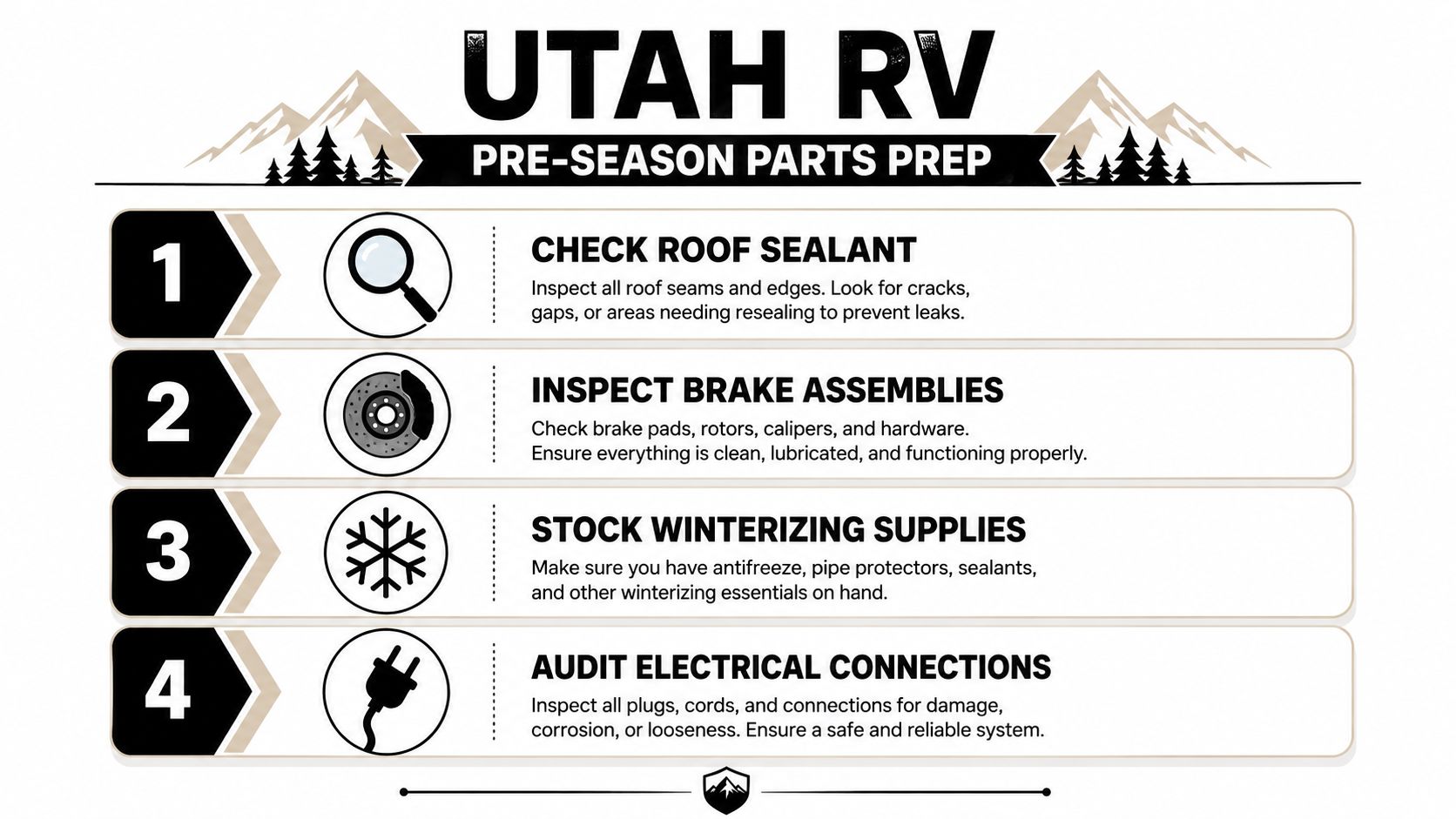
Utah's conditions create several seasonal exposures. Wasatch cold snaps can freeze water lines and damage plumbing. Summer hail can harm roof components and vent covers, while high-altitude UV and temperature swings wear on sealants, awnings, tires, and exterior plastics. A pre-season inspection gives you time to identify the correct part and book labor before a minor defect interrupts a trip.
A practical Utah preparation routine
Inspect the roof, seals, battery compartment, tires, brakes, exterior lights, water system, furnace, and slide-outs. Photograph serial plates while they are easy to reach, then save the images with the RV's records. A planned maintenance task, such as the steps in this RV air filter replacement guide, is easier to handle before a breakdown.
Keep a supply kit matched to the RV:
- Electrical consumables: Correctly rated fuses, bulbs, connectors, and spare wiring.
- Water-system supplies: Compatible hose washers, fittings, clamps, and winterizing materials.
- Exterior protection: Approved roof sealant, compatible caulk, and slide-out seal care products.
- Travel spares: A suitable battery plan, tire equipment, trailer-light supplies, and the correct hitch or brake information.
- Identification records: VIN, appliance model numbers, photographs, warranty documents, and prior repair notes.
Avoid filling the storage compartment with every possible spare. Prioritize items that are easy to identify, safe to store, and capable of stopping a trip when they fail. For complex components, keep the identification details and failure symptoms rather than guessing at a replacement. A wrong part costs more when it also consumes a service appointment.
Storage rules can change your parts decision
Check local requirements before buying parts for winter storage or extended occupancy. A Utah municipal draft ordinance states that RVs may not be located, used, or occupied for residential or storage purposes except in approved RV parks. The same published document describes limits on street parking, including 24 consecutive hours within any 7-day period, with setbacks of 30 feet from the front property line and 15 feet from other property lines.
Some codes also restrict visible storage of damaged or inoperable RVs. West Jordan's code for a senior housing development requires stored RVs to be operable and, where required, currently licensed. It also bans inoperable vehicles, trailers, and boats from storage areas, as stated in the West Jordan municipal code.
Temporary RV housing raises separate plumbing and utility concerns. A Utah county summary says an RV used as temporary housing must be properly insulated so attached water lines do not freeze, and that power, water, and septic connections may require inspection. Confirm your municipality's rules before ordering parts for long-term occupancy or storage.
Putting It Together and Next Steps
Use a simple decision model whenever you need RV parts in Utah:
- Identify the part: Start with the VIN, model, year, data plate, photographs, and failure symptoms.
- Classify the component: Separate safety and structural parts from consumables and cosmetic items.
- Match the source to the risk: Use local service support for model-specific, warranty, diagnostic, and installation work. Use online or retail sources for verified commodity parts.
- Choose OEM or aftermarket deliberately: Default to OEM or a documented equivalent for regulated, safety-related, sealed, or electronically integrated components.
- Plan before the season: Inspect roof seals, brakes, electrical connections, plumbing, appliances, and winterization needs before a trip exposes the weakness.
Parts availability is only one part of turnaround. Recent IDS trend reporting shows work orders with out-of-stock parts averaged 54.3 days in 2026, even after improving by 7 days year over year, while RV News reported out-of-stock parts rising from 22% of bottlenecks in 2022 to 31% in 2024 in its coverage of the trend. The IDS trend report supports a practical conclusion: confirm compatibility and coordinate labor before assuming local pickup alone will solve the delay.
Frequently asked questions
Can Motor Sportsland help identify a part?
Yes. Bring the RV's VIN, make, model, year, appliance data plate, photographs, and the failed component if it's safe to remove. Those details help the parts or service team verify fit before ordering.
Can the Service Center install customer-supplied parts?
Ask during intake. Installation may depend on compatibility, warranty terms, component quality, and whether the shop can stand behind the repair and post-install testing.
Which RV parts should Utah owners avoid buying generically?
Use caution with hitches, brake assemblies, axles, couplers, propane regulators, converters, inverters, appliance control boards, roof sealants, and slide-out seals. These parts require exact specifications or compatible materials.
Is local pickup always faster than ordering online?
Not necessarily. Local pickup helps when the correct part is stocked, but diagnosis, compatibility checks, labor scheduling, and warranty coordination can still determine the final turnaround.
What should I do before towing to Bear Lake or Jordanelle?
Inspect the brakes, hitch, tires, lights, battery and charging system, roof seals, slide-outs, plumbing, furnace, and air-conditioning system. Replace or repair questionable items before departure rather than during the trip.
How long will a typical repair take?
There isn't one dependable timeline. The answer depends on the fault, parts availability, technician schedule, and whether testing reveals related system damage.
Motor Sportsland has served Utah RV owners for over 55 years from Millcreek and Spanish Fork, with a Service Center that handles maintenance, repairs, installations, plumbing, electrical work, upgrades, RV parts, and collision repair, as described on the Motor Sportsland website. That combination is useful when a parts question turns into a diagnostic or installation job.
Bring your RV identification details and photos to Motor Sportsland for help matching parts, diagnosing related system problems, and planning installation for Utah travel and winter storage. Visit Motor Sportsland to browse inventory, contact the Millcreek or Spanish Fork team, or schedule Service Center support before your next trip.
